Scientists Identify Warning Signals of Atlantic Ocean Current Collapse
New research identifies hidden signals within the Gulf Stream that may predict a catastrophic collapse of Atlantic currents and global weather systems.
◆
Key Points
☼ AI-Generated Summary
◆New statistical signals in the Gulf Stream suggest the AMOC current system is nearing a collapse threshold.
◆The 2026 study highlights how critical slowing down makes the ocean less resilient to climate perturbations.
◆Advanced hybrid flood models are essential for predicting the economic and physical risks to coastal infrastructure.
◆A total failure of the Atlantic currents would trigger rapid cooling in the Northern Hemisphere and massive sea-level rise.
Share
Deep Currents and Global Hazards
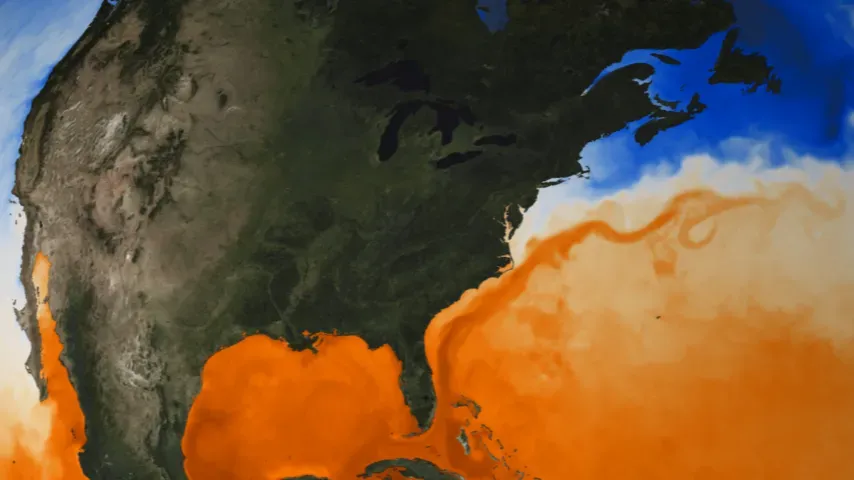
Cape Hatteras is frontline observer for the subtle, rhythmic pulses of the North Atlantic. Beneath the churning surface of the Atlantic Ocean, a massive conveyor belt of water known as the Atlantic Meridional Overturning Circulation, or AMOC, moves heat from the tropics toward the northern latitudes. Recent data published in March 2026 suggest that this critical engine of the global climate may be nearing a point of failure. Researchers at Live Science have identified hidden signals within the Gulf Stream that indicate the system is losing its stability. This thermal instability suggests that the current is no longer as resilient as it once was, raising the possibility of a total collapse that would fundamentally alter the climate of Western Europe and North America.
Oceanic stability is a luxury the next generation may never know.
Scientists previously viewed the AMOC as a slow, predictable giant. Recent observations of the Gulf Stream reveal that the current is fluctuating in ways that mirror the early warning signals of other complex systems on the verge of breakdown. These signals involve increased variance and a phenomenon called critical slowing down, where the system takes longer to recover from small perturbations. If the AMOC ceases to function, the result would be a rapid drop in temperatures across the North Atlantic, rising sea levels along the US Eastern Seaboard, and a complete shift in global precipitation patterns. While some skeptics suggest the current is merely experiencing a natural cycle, the majority of evidence points to human-driven climate change as the primary catalyst for this destabilization.
The Architecture of Modern Flood Modeling
Accurate predictions are the only defense against the looming maritime shift. A study highlighted by Phys.org emphasizes that before rain begins to fall, scientists and engineers rely on advanced digital simulations to guide billion-dollar decisions. These models impact everything from infrastructure design to public safety and insurance rates. Current efforts to map the future of flooding rely on four distinct model types: physical, conceptual, empirical, and stochastic. Physical models use the laws of fluid mechanics to simulate water movement, whereas empirical models look at historical trends to predict future events. Conceptual models simplify the water cycle into manageable components, and stochastic models use probability to account for the inherent randomness of weather.
This complexity requires a hybrid approach to maintain accuracy.
Individual models often fail when faced with the extreme outliers produced by a collapsing ocean current. Physical models require immense computing power but offer high precision, yet they can miss the broader statistical trends captured by stochastic simulations. Integrating these disparate methods allows researchers to create a more thorough picture of risk. For instance, a hybrid model can simulate how a Gulf Stream shift would specifically affect coastal drainage systems in New York or London. Such precision is necessary because the economic stakes are increasingly high, with insurance companies using these forecasts to determine whether certain regions remain habitable.
Economic Consequences of a Stalling Atlantic
Insurance premiums reflect the physical reality that politicians often ignore.
Financial markets are beginning to price in the risk of an AMOC collapse, particularly in the real estate sectors of coastal Florida and the Outer Banks. Once the Gulf Stream moves sharply from its historical path, the resulting sea-level rise will not be a gradual creep but a sudden surge. Coastal cities are currently spending billions on sea walls and drainage upgrades based on models that may already be outdated. Since the underlying ocean currents are shifting faster than the models can be updated, the risk of a massive insurance market failure grows. In the United Kingdom and Norway, the threat is even more existential, as the loss of the AMOC would strip away the heat that keeps these northern nations temperate.
This statistical noise in current models often hides the most dangerous threats.
Global agriculture also hangs in the balance. The Atlantic current system dictates the timing and intensity of the monsoons in the Southern Hemisphere and the rainfall in the American Midwest. Failure of the AMOC would likely lead to a redistribution of heat that leaves the northern hemisphere cold and dry while pushing the tropical rain belt further south. Farmers in the 2026 growing season are already reporting erratic weather patterns that defy traditional forecasting. Reliable predictions require a deeper understanding of the interactions between the deep ocean and the atmosphere, a task that demands a massive influx of research funding and international cooperation.
The Search for Early Warning Signals
Detecting a collapse before it occurs is the holy grail of modern oceanography. Researchers are currently using satellite data and deep-sea sensors to monitor the salinity and temperature of the North Atlantic. Freshwater from melting Greenland ice sheets acts as a brake on the AMOC, as the less dense water prevents the sinking of saltier, colder water that drives the circulation. The hidden signals recently found in the Gulf Stream provide a new metric for assessing this braking effect. By analyzing how the Gulf Stream meanders and shifts its core velocity, scientists can infer the strength of the entire Atlantic system. The discovery provides a key window for preparation, though the timeframe for action remains narrow.
Uncertainty remains the greatest challenge for policymakers.
However, the implications of these findings are often lost in the noise of short-term political cycles. While Bloomberg suggests that some coastal economies might adapt through technological innovation, the data from Live Science and Phys.org indicate that the scale of the shift could overwhelm existing infrastructure. The transition from a stable current to a collapsed state could happen within decades rather than centuries. That reality forces a difficult conversation about managed retreat from the coastlines and the total redesign of global supply chains that rely on predictable weather for shipping and production.
Waiting for a total systemic failure before acting is a hallmark of modern political cowardice. The science of 2026 has provided the map, but the path forward requires a level of global coordination that has yet to materialize. If the Gulf Stream is indeed whispering its own demise, the world must listen before the silence of a frozen North Atlantic becomes the new reality.
The Elite Tribune Perspective
Modern civilization treats the Atlantic Meridional Overturning Circulation like a background process on a laptop, assuming it will always run. We have built trillions of dollars in real estate and infrastructure on the arrogant assumption that the ocean is a static stage for human activity. It is not. The warning signals within the Gulf Stream are not merely data points for academic journals, they are the death rattles of the climate stability that allowed the West to flourish. While politicians bicker over carbon targets that are perpetually moved into the future, the physics of the North Atlantic is already locking in a different destiny. We must stop pretending that better flood models are a solution when they are actually just sophisticated ways of documenting our own decline. If we continue to ignore the slowing of the AMOC, we deserve the cold, stagnant world that follows. The hybrid modeling mentioned by Phys.org should be used not to preserve the status quo, but to plan the evacuation of a coastline that is already lost. Skepticism is no longer a valid intellectual stance when the very currents that sustain us are visibly faltering. Our survival depends on acknowledging that the ocean does not negotiate.