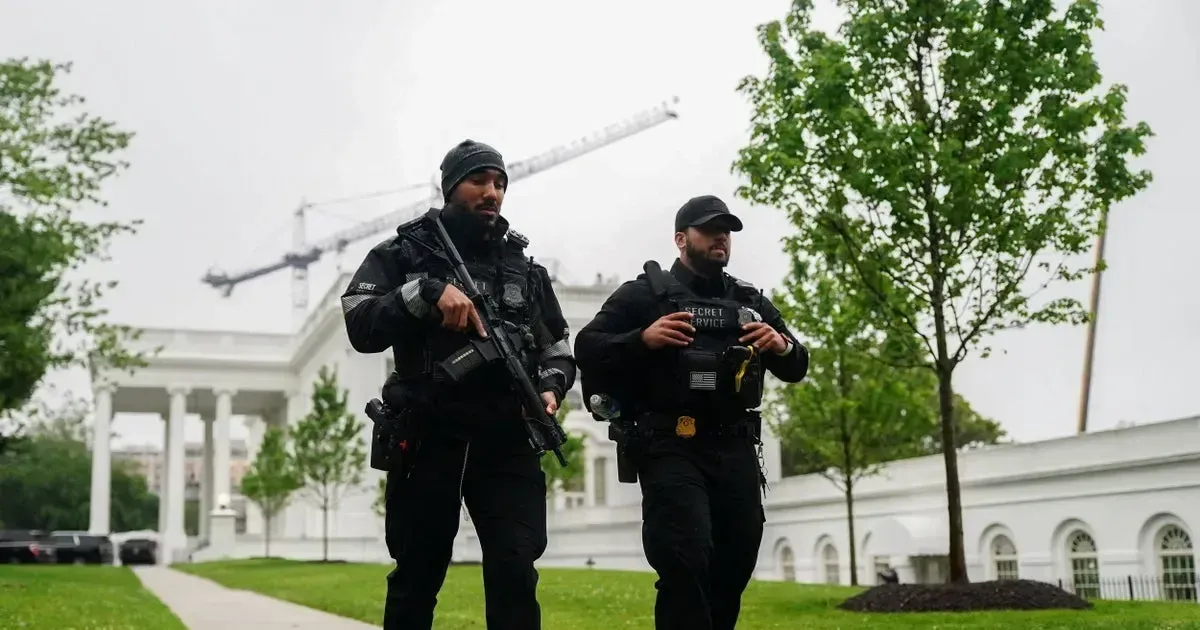
Secret Service agents engaged armed individuals near the White House on Saturday evening, triggering an immediate security lockdown of the entire complex. Donald Trump remained inside the executive residence while tactical teams established a defensive perimeter across the grounds. This security breach occurred on May 23, 2026, during a period of intense diplomatic activity involving foreign delegations. Records from local law enforcement confirm an enormous emergency response gathered at the intersection of Pennsylvania Avenue and 17th Street within minutes of the first reported discharge.
Reporters stationed on the North Lawn described a scene of sudden escalation as the sound of repeated weapons fire echoed through the mansion. Early accounts from witnesses suggest the initial volleys began near the outer fence line before moving toward the side of the building. Emergency sirens drowned out the usual evening noise in the capital as police vehicles blocked surrounding intersections. Security personnel ordered all personnel and press members to seek immediate cover inside the West Wing briefing room.
Gunfire totals varied between different observational points on the property. While reporters with The Independent counted approximately 20 shots, an Al Jazeera correspondent on the scene reported hearing more than 30 distinct rounds. These conflicting numbers suggest a prolonged exchange between security forces and the unidentified individuals involved. Law enforcement officials have not yet released a ballistic report to reconcile these discrepancies. Chaos erupted across the North Lawn as agents moved with drawn weapons.
Direct intervention by the Secret Service resulted in at least two people being shot near the mansion. Medical units arrived at the scene shortly before 11:00 PM to treat the injured parties under heavy guard. Federal agents have not confirmed the condition of these individuals or whether they were the primary aggressors in the exchange. The area remains cordoned off as forensic teams search for shell casings and other physical evidence. Investigators have not yet clarified the motive for the breach.
Donald Trump was actively working on negotiations for a potential deal with Iran when the gunfire interrupted the session. Sources close to the administration suggest the President was briefed immediately and moved to a secure location within the residence. The presence of international diplomatic concerns adds a layer of complexity to the investigation. FBI investigators joined the Secret Service on-site to assist in a comprehensive review of the security failure. This multi-agency response reflects the severity of the threat detected on the property.
Tactical Response and Mansion Lockdown
Security protocols for the executive mansion dictate a total freeze on movement whenever a kinetic threat is detected within the immediate perimeter. Agents deployed the long-range acoustic device and high-intensity lighting systems to disorient anyone remaining in the restricted zone. Because the shots were heard from the side of the house, tactical teams focused their attention on the lateral gates and pedestrian walkways. Every entrance to the complex was electronically sealed to prevent any secondary breach attempt. Perimeter teams conducted a sweep of the Lafayette Square area to ensure no additional threats persisted.
Personnel inside the White House remained under shelter-in-place orders for several hours. The protocol ensured that the President and his staff were insulated from any potential stray rounds or coordinated follow-up attacks. District of Columbia police assisted by expanding the exclusion zone to include several blocks of K Street and New York Avenue. Heavy weapons teams took up positions on the roof of the Treasury Building and the Eisenhower Executive Office Building. Visibility was still a challenge for observers as the sun set over the capital.
Investigation into Perimeter Breach and Ballistics
FBI technicians arrived to document the scene and collect video evidence from the extensive network of cameras surrounding the 18-acre complex. The discovery of 30 shots by some witnesses indicates that multiple weapons or high-capacity magazines may have been used. Officials are currently reviewing the background of the two individuals shot by the Secret Service to determine if they had prior interactions with law enforcement. Ballistic experts are mapping the trajectory of the rounds to see if any impacted the White House structure itself. Forensic teams marked dozens of locations where evidence was recovered from the pavement.
Inter-agency coordination remains the priority as the FBI takes the lead on the criminal aspect of the shooting. The Secret Service continues to conduct an internal review of how the individuals reached such proximity to the mansion before being neutralized. Security experts point to the Saturday evening timeframe as a period of higher vulnerability due to increased pedestrian traffic near the North Lawn. Surveillance footage from nearby hotels and office buildings is being subpoenaed to provide a 360-degree view of the lead-up to the event. The investigation into the weapon types used continues.
Perimeter Security Under Review
The escalation of violence at the doorstep of the executive mansion suggests a sophisticated threat environment that challenges standard standoff distances. Engaging suspects with lethal force so close to the North Lawn indicates that the Secret Service perceived an imminent danger to the President or the integrity of the residence. While the identities of the suspects remain under seal, the volume of fire reported by witnesses points to a level of aggression rarely seen in standard perimeter incursions. The timing, coinciding with sensitive Iran deal negotiations, raises the possibility of a coordinated attempt to disrupt high-level diplomacy or exploit a perceived window of distraction.
Security architecture in the capital must now account for the reality that the expanded fence line and increased patrols were insufficient to prevent a 30-shot engagement. Future protective measures will likely involve even stricter movement controls along Pennsylvania Avenue and the potential permanent closure of nearby pedestrian spaces. The event forces a reassessment of the balance between public access and the non-negotiable requirement for presidential safety. The Secret Service likely faces intense congressional scrutiny regarding the speed and efficacy of the initial detection. A definitive shift in the defensive posture around the White House is inevitable. The response will likely be reviewed against recent White House security incidents, because repeated perimeter breaches can change staffing and screening assumptions.