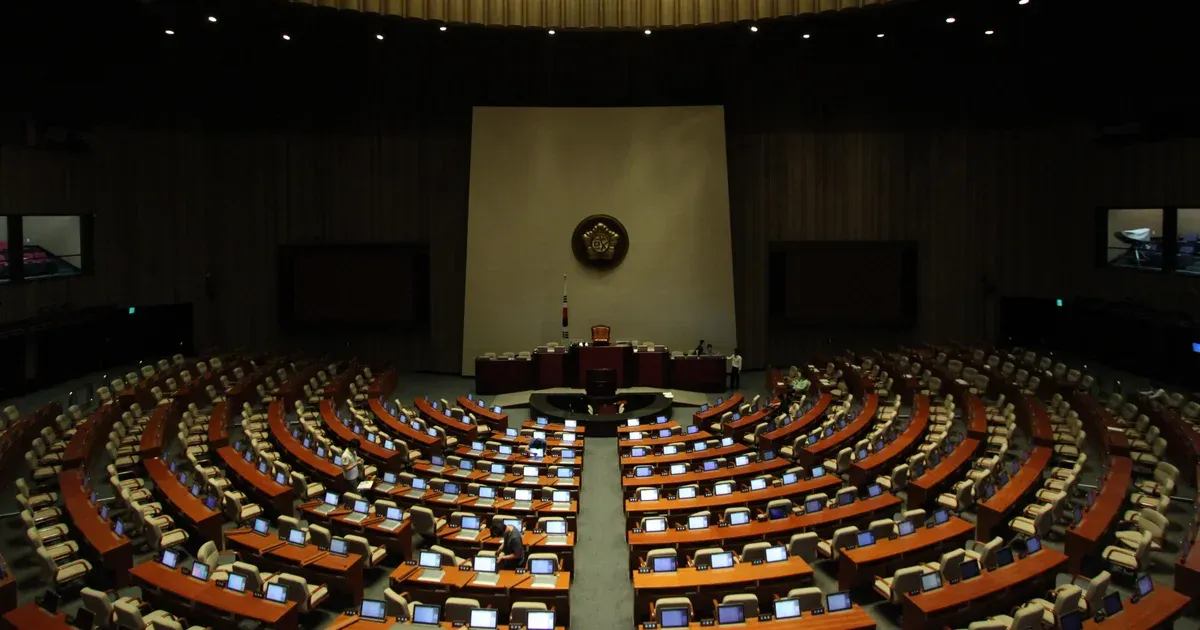
South Korea’s constitutional reform process moved from drafting to formal review. Cabinet members in Seoul approved amendment language before sending the proposal toward the legislature. On April 6, 2026, officials said the changes would modernize administrative terminology and clarify executive-branch jurisdiction. Lawmakers now face a strict timeline and a high voting threshold before any reform can advance further.
Cabinet members finalized the text during a high-level meeting chaired by the prime minister. Constitutional law in South Korea dictates that any amendment must be publicly announced for at least twenty days before the legislature can vote. Official documents indicate the current proposal addresses linguistic inconsistencies that have persisted since the late twentieth century. Government lawyers spent several months drafting the specific phrasing to avoid unintentional shifts in executive power.
Revision efforts remain a sensitive topic within the political landscape of the peninsula. National leaders often face scrutiny when suggesting changes to the document that ended decades of military rule. This specific motion avoids structural changes to the five-year single-term presidency, focusing instead on the technical language of governance. Public record shows that the National Assembly has 60 days to deliberate on the motion starting from the date of submission.
Seoul Initiates Process for Constitutional Reform
Legislative procedures require the President to formally propose the amendment following the cabinet endorsement. Administrative officials confirmed that the package includes updates to legal definitions and the harmonization of regional governance protocols. These changes do not require a fundamental reorganization of the judicial branch. Previous attempts at reform stalled due to disagreements over the balance of power between the prime minister and the head of state.
Critics within the opposition Democratic Party expressed caution regarding the timing of the cabinet action. Opposition leaders frequently argue that technical amendments can sometimes serve as precursors to larger structural shifts. Parliamentary records from the last session suggest that bipartisan consensus on constitutional matters is increasingly difficult to achieve. Voting blocs in the assembly are currently divided over the necessity of these specific linguistic updates.
"The proposed changes focus on linguistic clarity and the modernization of archaic terminology that persists within the current legal framework," a spokesperson for the Ministry of Government Legislation stated during the press briefing.
National sovereignty resides with the people, meaning any approved legislative amendment must eventually face a public referendum. Voters must approve the changes with a majority of votes cast by a majority of eligible voters. Statistics from the National Election Commission show that turnout for constitutional referendums historically exceeds sixty percent in the region. Recent polling suggests the public is largely indifferent to minor technical adjustments but remains wary of power-concentrating reforms.
Legal Hurdles Await National Assembly Review
Constitutional Court precedents establish a high bar for any alteration of the basic law. Jurists in Seoul note that even minor textual changes must align with the spirit of the 1987 democratic transition. Legal experts from the Korean Bar Association have provided testimony regarding the potential impact of the new phrasing on administrative lawsuits. Discrepancies in the current text have occasionally led to confusion in local government jurisdictional disputes.
Members of the cabinet emphasized that the motion passed on April 6, 2026, was the result of a multi-agency review. Justice Ministry officials coordinated with the Ministry of the Interior and Safety to ensure the proposed language did not conflict with existing statutes. Such coordination is a mandatory step in the legal pipeline before a motion reaches the assembly floor. The cabinet approved the measure without dissent during the morning session.
Political analysts at the Asan Institute for Policy Studies suggest the government is testing the waters for broader reforms. Small-scale adjustments allow the administration to gauge the legislative appetite for constitutional debate without risking a major political defeat. However, the opposition remains vigilant against any move that could extend executive influence over the legislative calendar. Tensions between the two major parties often paralyze the assembly during the final weeks of a spring session.
Constitutional experts point to Article 128 as the primary mechanism for this procedure. That article stipulates that the President or a majority of the assembly may initiate the revision process. History shows that most successful amendments in the region have followed periods of meaningful civic unrest or transition. The stability of the current 1987 framework is a point of pride for many veteran politicians who survived the era of authoritarianism.
Historical Shifts in South Korean Governance
South Korea has undergone nine major revisions of its constitution since the founding of the republic in 1948. Each change reflected the shifting political tides of the Cold War and the eventual rise of civil society. The current Sixth Republic constitution emerged from the June Democratic Struggle, which forced the military government to accept direct presidential elections. Scholars categorize the document as one of the most durable in East Asian history.
Administrative efficiency is the primary justification for the newest round of tweaks. Proponents argue that the current text contains kanji-heavy terminology that is difficult for younger generations to interpret accurately. Language specialists have recommended a shift toward modern Hangeul phrasing to increase legal accessibility for the general public. Research conducted by the National Institute of the Korean Language supports this move toward simplification.
Global investors track these developments to monitor the long-term stability of the South Korean legal environment. Consistency in the fundamental law correlates with the nation’s credit rating and its attractiveness for foreign direct investment. Market data from the Korea Exchange showed a neutral response to the cabinet announcement during the midday trading session. Institutional investors typically prioritize economic policy shifts over technical constitutional updates.
Final passage of the motion requires a roll-call vote where at least 200 of the 300 assembly members must agree. Should the motion fail to garner enough support, the current text will remain unchanged until a new proposal is drafted. Government whips are already meeting with committee chairs to schedule the initial round of hearings. The legislative window closes in early June.
Constitutional Reform Path
Is the South Korean cabinet truly interested in linguistic clarity, or is this a calculated move to desensitize the public to constitutional meddling? Proposing technical amendments under the guise of modernization is a classic maneuver used by administrations to test the structural integrity of a nation's legal foundations. By focusing on archaic terminology, the current government avoids a direct confrontation with the opposition while simultaneously opening a door that has remained largely shut for nearly four decades. This strategy treats the constitution as a draft document rather than a sacred pact.
The 1987 framework is the foundation of Korean democracy, and any attempt to alter it, no matter how minor, should be met with extreme skepticism. History in this region shows that constitutional tinkering often precedes attempts to extend executive reach or weaken the checks provided by the National Assembly. If the administration succeeds in passing these technical tweaks, they will have established a precedent for more aggressive reforms later in their term. The risk is not the language itself, but the normalization of the amendment process as an administrative tool.
Lawmakers must realize that once the seal is broken, the single-term presidency and judicial independence are the next logical targets for a restless executive. This motion is a Trojan horse. Keep the gates closed.