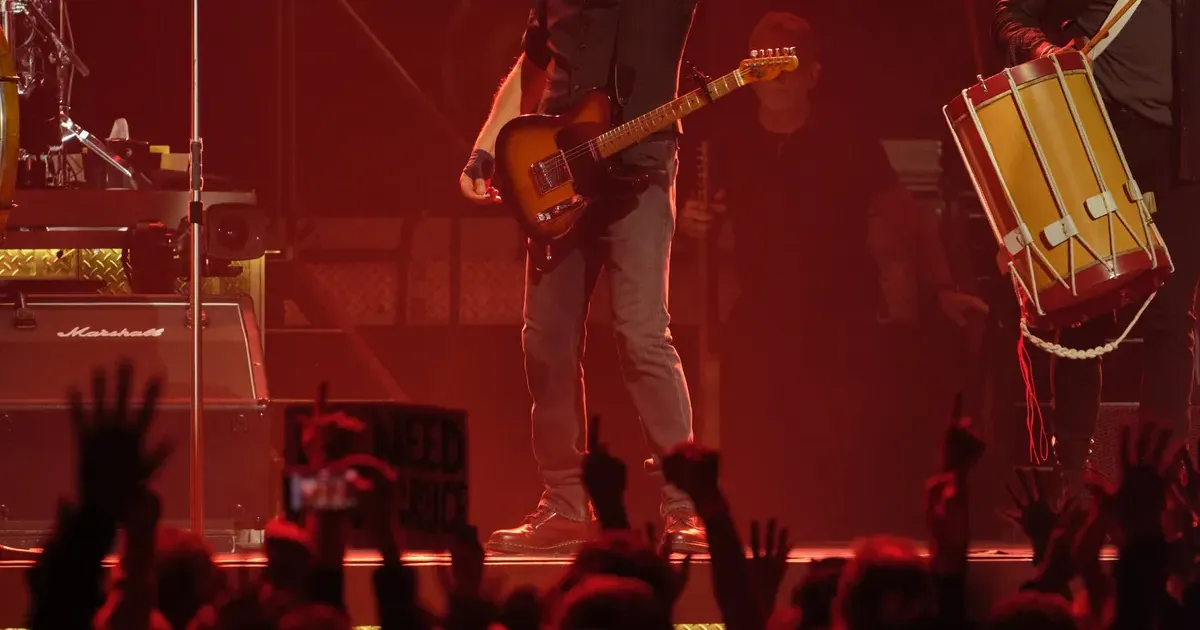
Bruce Springsteen debuted his Land of Hopes and Dreams tour using the Minneapolis stage to broadcast a message of social reconciliation. Concert openers often focus on high-energy hits to establish momentum. Springsteen chose a different path by centering the evening on the themes of national healing and collective responsibility. On April 1, 2026, standing before a capacity audience, he delivered a series of remarks that blended musical performance with explicit political commentary. Messages regarding the necessity of peace over war punctuated a set that spanned nearly three hours. He addressed the crowd directly between songs, urging them to prioritize unity over the growing partisan divides in American life.
Minneapolis was the grounding location for this first stop of a multi-city global trek. The city carries a complex history of civic engagement and social justice movements. Residents from across the Twin Cities filled the arena, many of whom have followed the musician since his early days in the 1970s. Target Center officials reported a sold-out attendance exceeding 19,000 people. Floor section tickets reached prices of $450 on primary markets, reflecting the sustained demands for the E Street Band experience. Security protocols remained rigorous throughout the evening to manage the large crowds and high-profile nature of the event.
Springsteen Cultural Legacy and Political Evolution
Longtime observers of the New Jersey native recognize this rhetorical shift in his live presentation. Early career milestones focused primarily on the narratives of working-class struggle in the industrial Northeast. Songs such as Born to Run and Thunder Road offered vivid imagery of youth, speed, and the desire for escape. Activism became more overt during the 1980s when political figures began misinterpreting his lyrics for partisan gain. Performance art transitioned into a platform for civic discussion as he started clarifying the intended meaning of his work during world tours. He has used his influence to support various causes, from food banks to veterans’ rights, for over four decades.
Campaign appearances and benefit concerts defined much of his work in the early 21st century. This Minneapolis show marks a continuation of a trajectory that sees the stage as a pulpit for democratic ideals. He spoke about the fragility of public institutions while introducing a rearranged version of Long Walk Home. This particular song, originally released in 2007, took on new weight in the current political climate. Musicians in the band provided a somber, acoustic-driven backing that allowed the lyrics to resonate without the distraction of a full rock arrangement. He frequently paused to look at the audience, acknowledging the weight of the moment through silent observation.
“I want us to find a way to choose unity over division and peace over war,” Springsteen told the audience.
E Street Band members provided the essential sonic foundation for these speeches. Stevie Van Zandt and Max Weinberg anchored the performance with a relentless rhythm that has become their trademark since the mid-1970s. Band members have navigated several health-related delays and personal losses in recent years, yet their collective timing stayed sharp. Garry Tallent and Roy Bittan contributed the melodic layers necessary to transition between stadium anthems and intimate ballads. The group has not set out on a tour of this scale in several years, making the Minneapolis opener a serious logistical achievement for the production crew.
Minneapolis Concert Venue and Local Sentiment
Fans expressed a mixture of excitement and reflection as they exited the building. Travelers arrived from neighboring states including Iowa and Wisconsin, filling local infrastructure to capacity. Viewing the 76-year-old performer in a live setting is now considered a rare opportunity for many devotees. Financial impact for the city was large, with downtown hotels reporting 98% occupancy for the night of the concert. Nearby restaurant owners noted a 30% increase in dinner service revenue compared to a standard Tuesday. Public transit systems saw a corresponding surge in light rail ridership on both the Blue and Green lines.
Transit officials added extra cars to the late-night schedule to accommodate the influx of concertgoers. Most attendees left the venue quietly after the final encore of I’ll See You in My Dreams. This final song is a tribute to departed band members, specifically Clarence Clemons and Danny Federici. Their presence was felt through archival video footage projected on large screens behind the stage. Emotional responses from the crowd were visible during these segments, though the band kept the focus on the music. The production used high-definition cameras and a sophisticated sound system to ensure every seat in the arena had a clear view and balanced audio.
E Street Band Performance and Musical Direction
Setlists for the Land of Hopes and Dreams tour emphasize the concept of the community. The title track itself is a centerpiece for the night, featuring gospel-infused arrangements that require a large backing choir. Roy Bittan played complex piano passages that highlighted the more somber moments of the evening. Interludes allowed the lead singer to address the crowd without musical competition. Focus remained on the lyrical content of the songs, which Springsteen has curated to reflect his current worldview. Professional standards for the ensemble stay high despite the physical demands of a three-hour show.
Nils Lofgren performed several guitar solos that drew spontaneous standing ovations from the floor. Musicians played a total of 28 songs without a traditional intermission, a feat that requires immense physical stamina. Future tour dates include major arenas in Chicago, Detroit, and Toronto before the production moves to Europe. Ticket sales for these upcoming stops indicate a continued global appetite for high-energy rock performances. Experts expect the tour to gross over $200 million by its conclusion in the fall. The financial success is paired with a clear mission to use the spotlight for social commentary.
Staff at the venue managed the flow of thousands of people with efficiency. Local law enforcement reported no major incidents during or after the performance. Audiences respected the request for a focused, attentive environment during the acoustic segments. Every element of the show was designed to reinforce the central message of unity and peace. The tour moves next to the Midwest, where the band will continue to refine the setlist and the accompanying speeches. Critics and fans alike are watching closely to see how the message evolves as the tour progresses through different regions of the country.
What the Tour Message Signals
Asking a rock star to fix a broken democracy is like asking a carpenter to perform open-heart surgery. Bruce Springsteen possesses a unique cultural resonance, yet the belief that a three-hour concert can bridge deep partisan animosity is a romantic delusion that ignores the reality of modern political tribalism. His call for unity in Minneapolis is a familiar refrain that often falls on the ears of an audience that already agrees with him. It creates an echo chamber effect where the performance is a communal catharsis rather than a catalyst for actual political change. The high ticket prices also create a class barrier that contradicts the populist message of his lyrics.
Wealthy fans paying hundreds of dollars to hear about the struggles of the common man is a contradiction that the music industry rarely addresses. While his intent may be sincere, the E Street Band has become a high-end luxury brand for a specific demographic. The demographic has the financial means to prioritize unity because they are shielded from the harshest consequences of division. The true test of these speeches is whether they reach beyond the arena walls. Currently, they exist as a curated experience for those who can afford the entry fee. The message is noble. The medium is compromised.