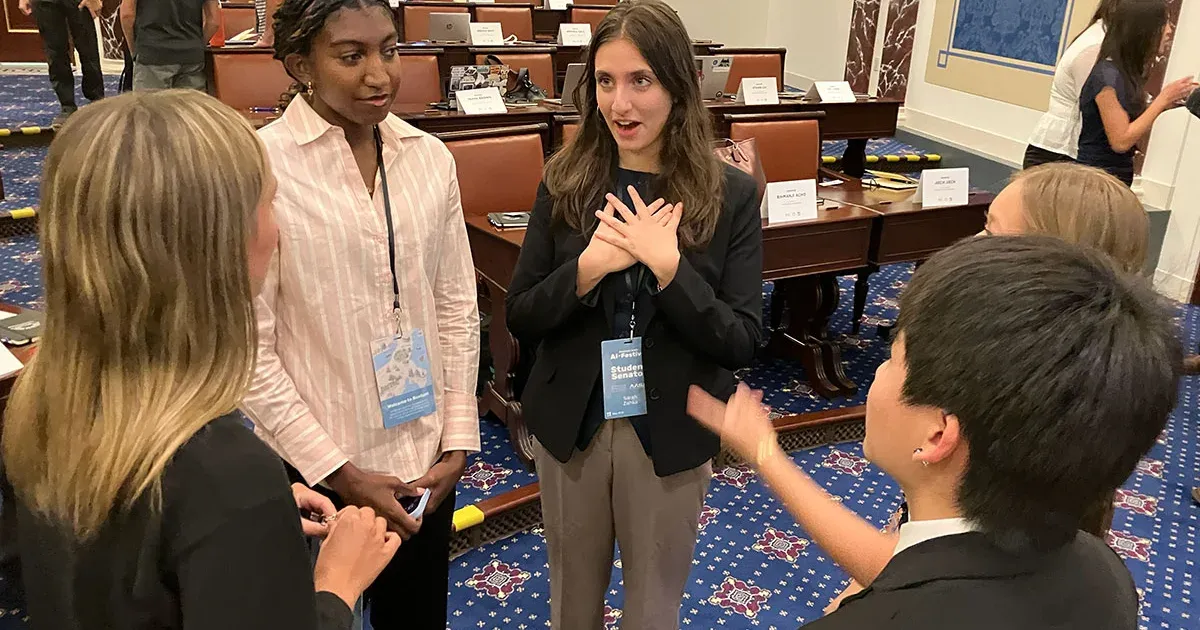
One hundred teenagers representing every U.S. state ended nearly three days of debate with a national proposal for how schools should govern artificial intelligence. Their vote treated classroom AI not as a single cheating problem but as a policy question involving students, teachers and the design of schoolwork. The 74 reported on July 24, 2026, that 83 delegates backed the proposal, 15 opposed it and two were absent.
Day of AI convened two students from each state at Boston's Edward M. Kennedy Institute, where they sat in a replica Senate chamber and finished with a Senate-style roll-call vote. MIT's RAISE initiative and the AASA superintendents' association were among the event's sponsors. The proposal is advisory rather than binding, and its full language was not public when the vote ended.
That absence matters because the students were responding to decisions already being made around them. Tatiyana Reaves, a 16-year-old from North Carolina, said a teacher gave her a zero after treating her use of the word "whilst" as evidence that AI had written her assignment. Her experience turns a broad debate about cheating into a practical issue of evidence, trust and a student's ability to challenge an accusation.
Students Separate Learning Support From Answer Production
The recommendations call for AI literacy from the point when students begin using classroom devices. Lessons would cover appropriate academic use as well as plagiarism, misinformation, system bias, privacy, hallucinations and environmental costs. The students also favored tighter limits for younger children while giving middle- and high-school students more room to make choices and learn from mistakes.
Several delegates drew the line by looking at what the student still has to do. Ethan Liu, a recent high school graduate from West Virginia, described using ChatGPT to build practice problems for test preparation. Dillian Campbell, a North Carolina senior, offered the other side: classmates photograph an assignment and ask a system to complete it. One use creates more work for the learner; the other removes the work that reveals whether learning happened.
Chase Johnson, a 15-year-old from Alaska, argued that teachers also have to change the task. Instead of assigning an essay that can be handed to a bot, he suggested research that ends with a presentation before classmates.
"You can't cheat your way out of that," Johnson said.
The distinction is more useful than a list of approved products. A study guide, a brainstorming prompt or step-by-step math help can support learning when a student remains responsible for the reasoning. The same tool becomes a substitute when it supplies the final answer, voice or artwork. Rules written around purpose and evidence can survive a software update more easily than rules built around a brand name.
Students also described costs outside ordinary homework. Missouri debater Lucia Herrera said competitors now ask ChatGPT for help answering questions about their cases, weakening the original voice the activity is supposed to test. Minnesota student Bihmanji Acho focused on people using AI as a therapist and the effect that substitution could have on human relationships.
Teacher Practice Belongs Inside the Same Policy
The delegates did not reserve scrutiny for students. They called for AI literacy among teachers, and some said they object when educators use automated systems to grade work. That concern already has a policy parallel: New York City schools placed limits on AI use in student grading earlier this year. A classroom rule loses legitimacy if it demands original student work while leaving the teacher's use of the same technology unexplained.
Gyimah Whitaker, superintendent of a 5,400-student Georgia district, said AI can pull students toward completion rather than mastery, a problem for project-based learning and International Baccalaureate work that depends on sustained thinking. Students in her district have even proposed consequences for teachers who repeatedly use AI to grade papers. Their position reframes fairness as a two-way obligation rather than a restriction imposed only on children.
Cynthia Breazeal, who directs MIT RAISE, pushed the argument beyond basic training. Schools may need assignments and teaching methods that require deeper engagement with the material, she said. That makes assignment design part of AI governance: a policy can prohibit shortcuts, but the work itself must still give students a reason to think, explain and defend what they know.
The 15 No Votes Set a Test for the Final Rules
The vote did not create a national standard, and the organizers kept both the draft and most of the debate from The 74. One Georgia delegate who voted against the proposal later said it did not fully meet the mark. Those limits prevent the 83 votes in favor from being treated as agreement on every clause, but they do not erase the areas students placed on the agenda: age, acceptable help, accusations, teacher conduct and the structure of assessed work.
The organizers expect the recommendations to become public within weeks of the Boston gathering. Their credibility will rest on whether a student can use the document to tell where assistance ends, how a disputed accusation can be challenged and whether the same principles constrain a teacher assessing the work. If the final text cannot answer those classroom questions, it will preserve the policy gap the students met in Boston.