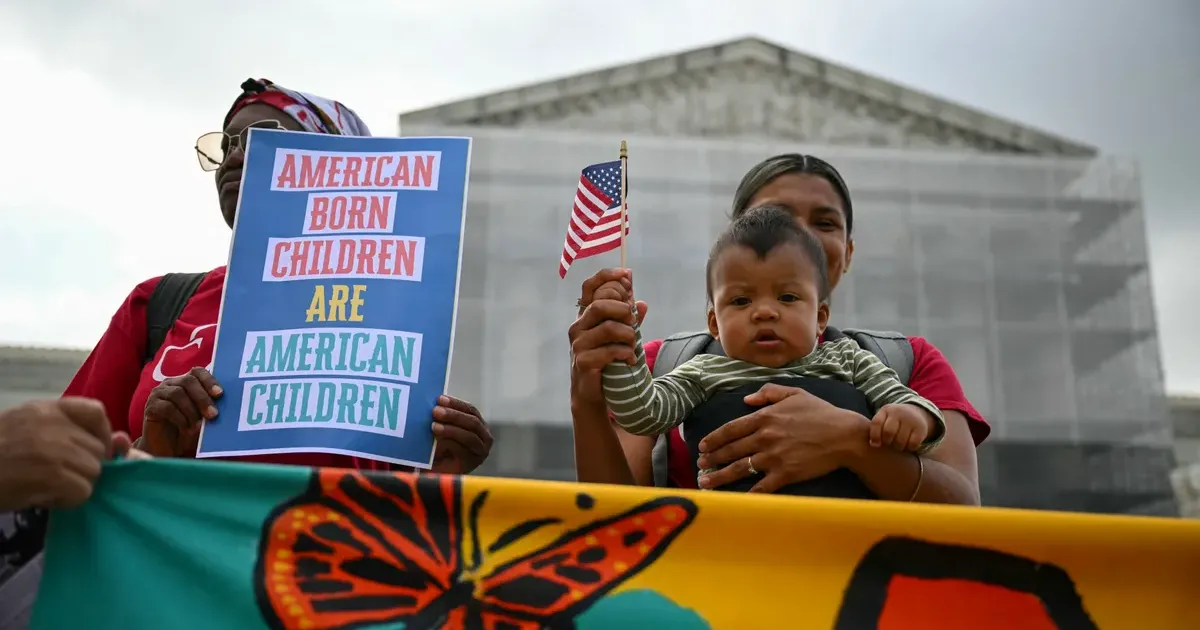
Supreme Court justices convened in Washington to examine the legality of an executive order that seeks to dismantle the long-established principle of birthright citizenship. President Trump issued the directive earlier this year, challenging the widely accepted interpretation of the 14th Amendment and setting up a legal confrontation over the core tenets of American identity. Legal scholars note that the administration intends to bypass the traditional legislative route, arguing that the executive branch possesses the authority to define the scope of jurisdiction for those born on domestic soil. By March 31, 2026, the dispute had moved from campaign rhetoric into a direct constitutional test.
Opponents of the measure have flooded the court with amicus briefs, asserting that the changes would violate over 150 years of judicial precedent and constitutional text. Birthright citizenship persists as a foundation of the post-Civil War legal framework, designed specifically to ensure that citizenship remains a matter of birth rather than government whim.
Justice Department lawyers argue that the framers of the amendment never intended for it to apply to the children of foreign nationals who are present in the country without legal authorization. They contend that the phrase "subject to the jurisdiction of it" implies a requirement of political allegiance that is not met by the children of non-citizens. This interpretation directly challenges the 1898 ruling in United States v. Wong Kim Ark, which held that a child born in San Francisco to Chinese parents was a citizen because of his birth location.
Legal experts suggest that overturning this precedent would create a class of stateless individuals within the United States, complicating decades of domestic policy. Congressional records indicate that the authors of the amendment sought to create a permanent and objective standard for national belonging.
Historical Foundations of the Fourteenth Amendment
Constitutional debates from the 1860s reveal a clear intent to move away from the restrictive definitions of citizenship that preceded the Civil War. Senator Jacob Howard, a key proponent of the amendment, explicitly stated that the provision would include all persons born in the United States who were not subject to a foreign power. Modern proponents of the executive order claim these historical records are being misinterpreted by contemporary courts. Meanwhile, archival research presented to the justices highlights how the law has historically been used to integrate various immigrant groups into the national fabric.
Records from the 19th century show that the 14th Amendment was essential in dismantling the legacy of the Dred Scott decision. Efforts to refine the definition of citizenship have appeared in Congress before, but none have succeeded in altering the fundamental right of birth.
Democratic leaders in the 1990s once entertained similar restrictions during a period of heightened concern regarding illegal immigration. Former Senator Harry Reid introduced legislation in 1993 that would have ended birthright citizenship, reflecting a bipartisan skepticism that has since largely vanished from his party. Public opinion at the time was much more divided than it is today, with many voters expressing concerns about the sustainability of open citizenship policies. Recent polling data from the New York Times indicates a shift in sentiment, with a broad majority of Americans now favoring the retention of the current system.
This evolution in public thought highlights the difficulty of implementing a unilateral change through executive action. Political analysts observe that the current administration is testing a legal boundary that even the most conservative legislatures of the late 20th century were hesitant to cross.
Administrative Burdens for American Families
Hospitals would be forced to transform into immigration screening centers for every newborn child under the proposed rules. Advocacy groups warned in reports submitted to the court that the administrative burden of verifying parental citizenship for every birth would be immense. Instead of the current streamlined process for obtaining social security numbers and birth certificates, parents would face a multi-tiered verification system. Projections from the Department of Health and Human Services suggest that these delays could prevent infants from accessing critical medical benefits during the first months of life. Newborns require immediate enrollment in insurance programs to cover standard postnatal care and vaccinations.
An end to birthright citizenship would mean a new layer of bureaucracy for all babies born in the US and could cause delays for health insurance and other benefits. Immigration advocates cited by NPR News emphasize that the impact would extend far beyond immigrant communities, affecting every family regardless of their legal status. State agencies responsible for essential records would require serious funding increases to handle the investigative requirements of the new policy. Unlike the current system, where a hospital record suffices for citizenship, the proposed order would require parents to provide proof of their own status before a child is recognized as a citizen. Legal filings suggest that this would lead to a backlog in the issuance of federal identification documents.
Every newborn in the country would essentially be treated as a foreign national until their parents proved otherwise to a federal satisfaction. The cost of implementing such a registry system could exceed $10 billion over the first five years of operation.
Political Evolution of Citizenship Policy
Supreme Court justices themselves are not immune to the historical weight of these laws, as their own family trees often reflect the benefits of birthright citizenship. Analysis of the current bench shows that several members are only two or three generations removed from ancestors who relied on clear citizenship pathways to achieve social mobility. History shows that the stability of these laws allowed immigrant families to invest in the American economy without fear of sudden deportation. Arguments inside the courtroom have touched upon these personal narratives, highlighting the human element of a seemingly technical legal dispute.
By focusing on the "glaring red line" mentioned by political observers, the court is essentially deciding if the president can rewrite the social contract by decree. Trump world sees this as a signature policy goal that must be defended at all costs.
Regardless of the ideological leanings of the individual justices, the procedural questions regarding executive power may weigh more heavily than the social implications. Previous rulings have consistently checked the ability of the president to unilaterally alter constitutional protections. Earlier this year, the court struck down the administration's tariff agenda, indicating a potential reluctance to grant the executive branch expansive new authorities. Beneath the surface of the citizenship debate lies a broader struggle over the separation of powers. If the court allows the executive order to stand, it would effectively grant future presidents the power to redefine any constitutional right through reinterpretation. Lawyers for the challengers argue that such a precedent would dismantle the very idea of a fixed constitutional order.
Constitutional scholars warn that reinterpreting the 14th Amendment through executive fiat invites a period of deep legal instability. Oral arguments concluded with a focus on whether the administration can justify a departure from 128 years of post-Wong Kim Ark jurisprudence. While the Justice Department insists that the 1898 decision was narrow in scope, most legal historians disagree with that characterization. Justices will likely issue a ruling by the end of the term in June, a timeline that places the decision in the middle of a heated election cycle. Many observers expect the ruling to be one of the most meaningful of the decade, regardless of the outcome.
Evidence from lower court proceedings indicates that the legal groundwork for this challenge has been in development for years. Arguments from the bench suggest that the court is sharply aware of the administrative chaos that would ensue if birthright citizenship were suddenly revoked. The final decision will determine the status of millions of future residents and the limits of presidential authority.
Citizenship Stakes Beyond Court
The case matters beyond immigration politics because citizenship is the administrative foundation for passports, benefits, schooling and family security. A narrower rule would force agencies to verify status in places that have long relied on birth records. That is why the practical burden is part of the constitutional fight. Even a legal victory for the administration would create new uncertainty for hospitals, states and parents who need immediate proof of a child's status.