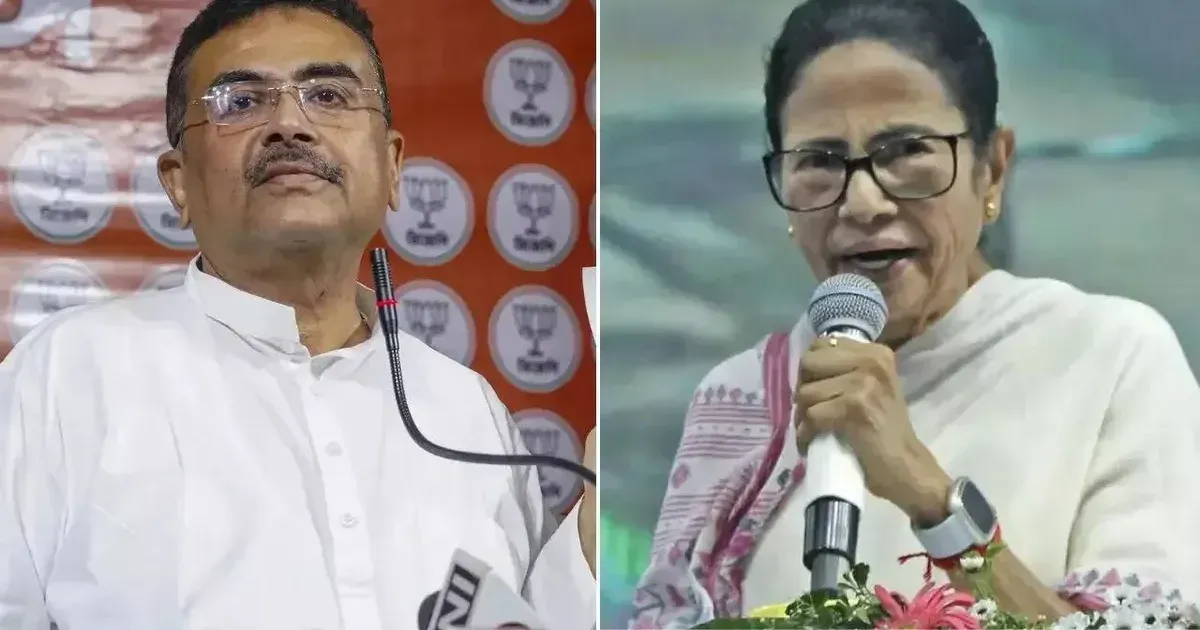
Suvendu Adhikari will take a direct shot at Chief Minister Mamata Banerjee in the upcoming West Bengal assembly elections. The Bharatiya Janata Party released its first list of 144 candidates for the state on Monday. Adhikari appears on the ballot for both Bhabanipur and Nandigram. This dual-candidacy move signals an aggressive attempt to unseat the Trinamool Congress leader on her home turf. The rivalry between Adhikari and Banerjee has defined the region's political friction since his high-profile defection from her party in late 2020. His decision to contest from Bhabanipur, Banerjee's traditional bastion in Kolkata, suggests the BJP intends to pin the Chief Minister down in her own constituency. Nandigram remains a symbolic battleground where the two previously locked horns in the 2021 election cycle. The BJP list includes other heavyweight names intended to broaden the party's reach across the diverse state. Dilip Ghosh, a former state president known for his polarizing language and organizational influence, will run from the Kharagpur Sadar constituency. Party leaders believe his presence on the ballot will stabilize the grassroots campaign in the western districts where the party previously struggled with internal coordination. But the stakes extend beyond individual rivalries as the state prepares for a two-phase election. Voters in West Bengal will head to the polls on April 23 and April 29. These dates will determine the legislative future of 144 seats out of the total assembly strength. The split schedule allows for the deployment of central security forces across unstable zones where electoral violence has occurred in previous years.
BJP Sets Direct Bengal Challenge
Selection committees within the BJP focused on rewarding loyalists while integrating newer defectors from local rival groups. This strategy places a heavy bet on anti-incumbency sentiment growing against the Trinamool Congress administration. Analysis of the list shows a concentration of candidates with strong local organizational ties rather than just national recognition. The party high command in New Delhi approved the names after weeks of deliberations involving internal surveys and feedback from district-level workers. Meanwhile, in Kerala, the saffron party released its first list of 47 candidates to challenge the established dominance of the Left Democratic Front and the United Democratic Front. Key leaders like Rajeev Chandrasekhar and K Surendran are among the primary names fielded to lead the charge. Chandrasekhar, a federal minister with a background in technology and investment, represents the party's attempt to appeal to urban, professional voters in the southern state. K Surendran will lead the campaign from his designated constituency while managing the statewide organizational machinery. The party seeks to capitalize on recent controversies surrounding state governance and fiscal management. Kerala traditionally oscillates between two major coalitions, but the BJP aims to turn the contest into a three-way fight in at least a dozen key urban centers.
The selection of Suvendu Adhikari for Bhabanipur shows our intent to take the fight directly to the seat of power in West Bengal.
For instance, Rajeev Chandrasekhar's entry into the state assembly race reflects a shift toward fielding candidates with administrative experience at the national level. His campaign will likely focus on central government development projects and the promise of integrating Kerala more deeply into the national economic structure. Political analysts observe that the party is moving away from purely ideological campaigning in Kerala toward a performance-based platform.
Bhabanipur Contest Raises Stakes
The Election Commission of India has finalized the schedule for the Kerala polls. Voters in the southern state will cast their ballots on April 9. Unlike the multi-phase approach in West Bengal, the Kerala elections will conclude in a single day of voting. This compressed timeline requires political parties to maximize their media outreach and ground mobilization simultaneously across all 14 districts. The BJP's southern strategy hinges on breaking the 10 percent vote share barrier that has historically limited its seat count. By fielding a Union Minister, the party sends a message that it views Kerala as a serious growth opportunity rather than a peripheral theater.
The selection of candidates for the 144 seats reflects a geographical balance between the northern tea gardens and the southern industrial belts. The BJP hopes that this distribution will prevent the Trinamool Congress from consolidating its hold on the rural vote. Each candidate was vetted for their ability to withstand the physical and political pressures of a long, two-phase campaign cycle.
According to Times of India, the counting of votes for both states will occur on May 4. The timeline ensures a cooling-off period between the final phase of voting in Bengal and the announcement of winners. Election officials have set up centralized counting centers with high-speed data links to provide real-time updates to the public. Each counting hall will be under constant surveillance to prevent any tampering with the electronic voting machines.
The focus now shifts to the ground campaign where candidates must convince a skeptical electorate of their vision for state governance. Rallies and town hall meetings are expected to dominate the schedule over the next five weeks. The BJP leadership has planned a series of visits by federal ministers to strengthen the local campaigns in both West Bengal and Kerala. These high-level interventions aim to provide a national perspective to local grievances and state-level policy debates.
Candidate Choice Turned Symbolic
Should we be surprised that the BJP is once again recycling the same tired strategy of parachuting central ministers and high-profile defectors into regional battles? The obsession with "star power" reveals a fundamental insecurity about the party's actual grassroots depth in states like Kerala and West Bengal. By forcing Suvendu Adhikari to fight on two fronts, the leadership is not showing strength; it is showing a desperate lack of alternative candidates capable of challenging the Trinamool Congress.
The assumption that a voter in Bhabanipur will be impressed by a defector's resume is an insult to the political intelligence of the Bengali electorate. In Kerala, the situation is even more transparently cynical. Rajeev Chandrasekhar is a capable administrator, but using him as a battering ram in a state that has repeatedly rejected the saffron ideology is a waste of federal talent. The party seems more interested in generating headlines about "heavyweight lists" than in actually governing these diverse regions.
If the BJP thinks these 144 names will magically dissolve the deep-seated cultural and political resistance they face, they are in for a rude awakening on May 4. It is not strategy; it is a gamble fueled by the hubris of a centralized high command that refuses to trust local leadership.