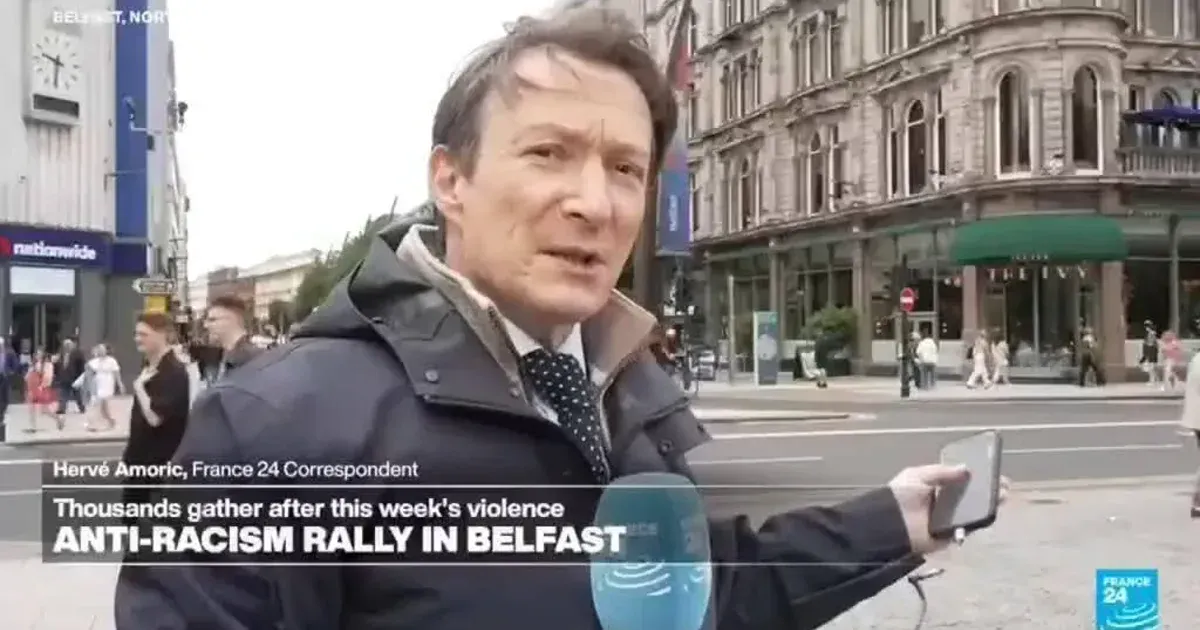
Belfast residents filled the city center to reject a week of anti-immigrant unrest, turning streets recently associated with disorder into a visible anti-racism rally. The demonstration drew community groups, trade unionists and families who wanted the city to answer violence with a public show of solidarity. The rally also became a test of civic language. Organizers tried to separate solidarity from retaliation.
The rally took place on June 13, 2026, after several nights of disorder linked to anger and misinformation following a stabbing. Organizers said the march was meant to make clear that immigrant communities should not be blamed for a criminal case or used as targets for wider political frustration.
Rally Organizers Condemn Targeted Violence
Speakers near Belfast City Hall denounced intimidation, property damage and attacks on businesses. Placards and chants focused on rejecting racism while asking authorities to protect neighborhoods that had been under pressure during the previous nights.
"Thousands of people on Saturday gathered for an anti-racism rally in the Northern Irish city of Belfast after unrest sparked by a horrific stabbing," France 24 reported from the scene.
Police maintained a visible presence around the march route and nearby flashpoints. The point was deterrence rather than confrontation: officers kept separation between the main rally and smaller groups of onlookers while allowing the demonstration to proceed.
That security posture mattered because Belfast had already spent days under pressure. A peaceful rally can still become vulnerable if counter-groups try to provoke clashes or if rumors online pull people toward confrontation. Keeping the route calm allowed the message of the march to stay in front of the images of disorder.
Belfast City Hall became the symbolic center of the response. The crowd size mattered because it challenged the impression that rioters spoke for the wider city. In a week shaped by fear, the rally gave civic leaders a different image to point to.
Misinformation Raised the Temperature
The unrest began after a stabbing case became the focus of anti-immigrant claims online. Early claims about identity and motive moved faster than verified information, creating the conditions for anger to spill into the streets before officials could establish a calmer public record.
That delay between rumor and verification is now one of the hardest public-safety problems for cities. Police can correct false claims, but the correction often arrives after the original post has already shaped anger. Community leaders therefore have to work on two fronts at once: calming streets and rebuilding trust in basic facts.
That pattern is now familiar across the United Kingdom and beyond. A serious crime becomes a political trigger, social platforms accelerate the most inflammatory version of events and local police are left managing both the original investigation and the disorder that follows. The civic cost is immediate: residents who had nothing to do with the case are forced to worry about their homes, shops and children.
Regional Stability Depends on Trust
Northern Ireland carries its own history of public-order strain, which makes any new unrest especially sensitive. Officials in Belfast, London and Dublin have to separate legitimate concern after violent crime from attempts to punish whole communities for the alleged actions of individuals.
The economic effect also matters. Repeated disorder can damage retail districts, discourage visitors and undermine the steady civic work that has helped Belfast present itself as a safer, more open city. The rally did not solve those problems, but it showed that the backlash to intimidation is organized and visible. For local officials, that public rejection gives room to act without treating the rioters as the city's dominant voice.
The harder test comes after the march. Authorities need transparent updates on the stabbing case, faster correction of false claims and consistent protection for immigrant residents. Without that, the next rumor can restart the same cycle.
The rally showed that the city has a civic counterweight to intimidation, but symbolism fades quickly if residents do not see follow-through. Belfast now needs enforcement against violence, support for damaged businesses and a public record clear enough to deny agitators the confusion they feed on.