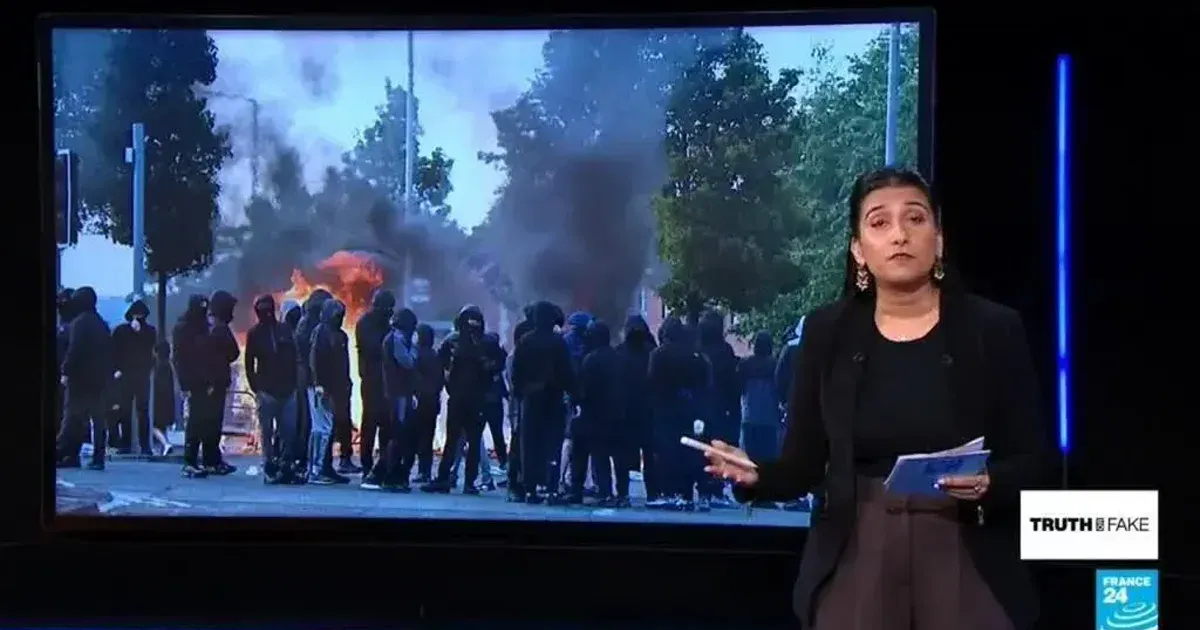
Police in Belfast are preparing for further disorder after a stabbing case became the center of anti-immigration mobilization. The immediate public-order problem is now broader than the criminal investigation that started it. Residents in affected areas have described a different kind of fear from ordinary protest: the sense that homes and businesses could be selected because of identity rather than conduct.
The unrest intensified around June 12, 2026, after false and outdated images circulated online. Those posts helped turn a local attack into a wider claim about migration, crime and public safety. That makes police communication especially important, because silence leaves space for rumor to become operational guidance for angry crowds.
Belfast Case Becomes Public-Order Flashpoint
Hadi Alodid, a Sudanese national, has been charged with attempted murder in the stabbing of Stephen Ogilvie. The charge is serious, but police and courts still have to handle it as a criminal case rather than a license for street violence. The Belfast case also sits inside a wider British debate over asylum policy, border routes and the Common Travel Area with Ireland. Community groups are trying to keep residents from being isolated by fear, especially families who believe they could be targeted because of ethnicity or religion.
The distinction matters. When a suspect's identity becomes the main fact shared online, the legal process can be overtaken by rumor, anger and collective punishment. Those policy disputes are real, but they do not change the standard for criminal evidence or the rights of communities not involved in the attack. The Good Friday Agreement context makes any proposal for harder border controls politically sensitive, even when immigration questions become louder.
The most dangerous accelerant has been false stabbing images. Digital investigators and journalists have described unrelated or outdated material being presented as current evidence from Belfast. Misinformation thrives when people are given a simple story before investigators can provide a verified timeline. That means officials cannot solve the unrest with one border slogan or one policing order.
That kind of misinformation changes crowd behavior. People who believe they are seeing live proof of wider attacks may move from protest to confrontation before official information catches up. Officials therefore need both street-level enforcement and rapid correction of viral claims that misidentify places, victims or perpetrators. The most durable response will likely combine prosecutions, local reassurance, faster fact-checking and pressure on platforms to slow recycled images.
False Images Accelerate the Violence
Police have faced attacks on vehicles, property damage and attempts to target neighborhoods associated with immigrant communities. Residents have also reported fear that ordinary movement could become unsafe during evening hours. Community leaders face their own test, because they must condemn the stabbing while also rejecting retaliatory attacks. If those pieces do not move together, the same pattern can return after the next high-profile crime.
“There will be no tolerance for rioters,” Prime Minister Keir Starmer said.
That distinction can be difficult to maintain online, where short clips and stripped captions often travel further than court facts. The hardest part for authorities is that success may look uneventful: fewer crowds, fewer rumors taking hold and fewer families feeling trapped indoors.
Prime Minister Keir Starmer's warning was designed to separate the prosecution of the stabbing suspect from the punishment of communities. The challenge is making that message move as quickly as the misleading posts. The next phase of the response will depend on whether police can prevent copycat gatherings and whether platforms reduce the reach of false material. That makes accurate information a security tool, not a public-relations accessory.
Belfast Police Face a Rumor-Driven Riot Cycle
The online layer complicates the response. Influential accounts can amplify partial claims to large audiences, while encrypted groups can move people toward new locations with little public warning. If the pattern holds, every new rumor could force officers to defend several neighborhoods at once. The coming court dates will also matter because verified proceedings can replace rumor with a more stable public record.
For police, the risk is an anti-immigration riot pattern that jumps from one city to another whenever a violent incident can be forced into a migration narrative. The attempted-murder charge will move through court at a pace that is slower than online reaction, and that mismatch is part of the public-order challenge. Until then, Belfast remains exposed to a cycle in which anger online can become movement on the street within hours.
The next few nights will test whether visible policing, rapid court action and clearer public information can slow the disorder. Police also have to protect the integrity of the case by avoiding statements that could prejudice proceedings while still correcting dangerous claims.
The legal case against Alodid will continue separately. The public-order case now facing Belfast is whether officials can stop misinformation from becoming a repeat trigger for violence. Local businesses face immediate costs from smashed windows, closures and staff safety concerns. Police will also have to separate online rumor networks from people who directly organized violence on the streets. Community leaders also have to rebuild confidence among immigrant families who may fear both street violence and online misidentification.