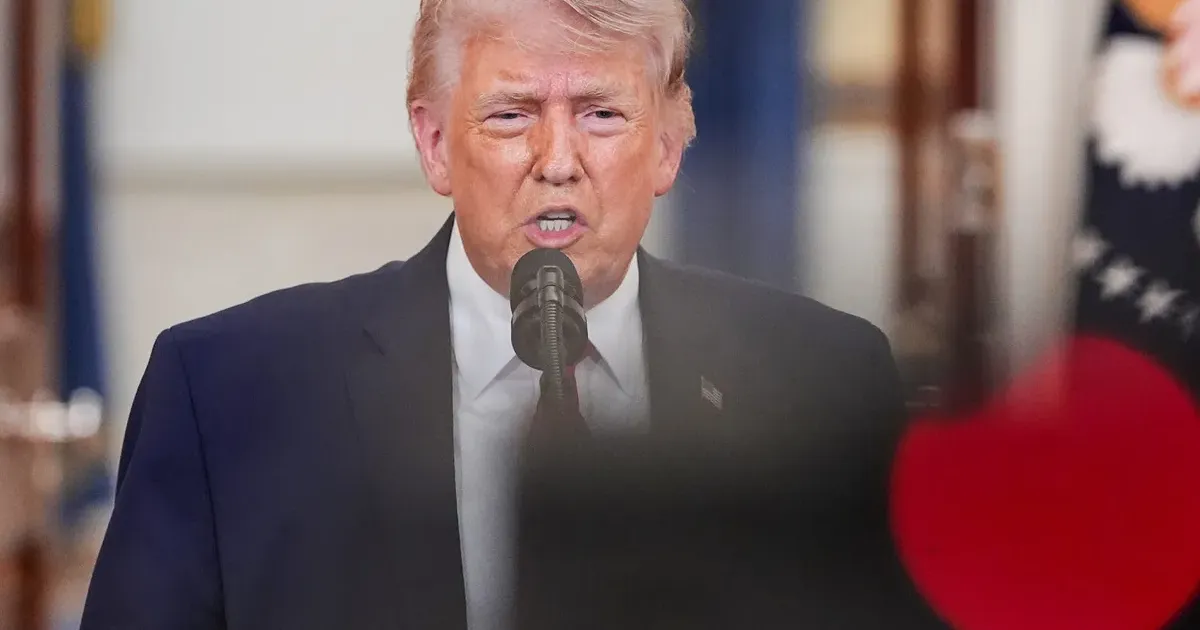
Donald Trump's Iran strategy keeps returning to one unresolved problem: the White House can explain why it wants to hit Iran, but it has struggled to explain what a stable finish looks like. The missing endpoint was visible in the April prime-time address, when Trump defended Operation Epic Fury and promised the United States would "finish the job." It is even clearer in July, after a broken ceasefire, renewed strikes, a reimposed blockade and rising concern over oil prices and U.S. weapons stocks.
The problem is not that military force has no effect. U.S. strikes can damage Iranian targets, disrupt command systems and pressure Tehran. The problem is that military pressure is not the same as a strategy for what comes after the next strike. Allies, markets and Congress are now judging the campaign by the gap between pressure and strategy.
The Speech Sold Force, Not an End State
The April address framed the war as necessary to stop Iran's nuclear ambitions and protect U.S. security. It gave the administration a direct-to-camera case for force, but it did not settle the larger policy question. Was success the destruction of specific facilities, the delay of enrichment, the reopening of Hormuz, a negotiated nuclear framework, regime pressure or a broader weakening of Iran's regional power?
Those are different goals. If they are blurred together, every new strike can be described as necessary and every failure can be described as unfinished work. Blurred goals can turn a limited campaign into an open-ended commitment without the public ever receiving a clean definition of victory.
July Made the Gap More Expensive
The July escalation sharpened the economic side of the problem. The renewed blockade, Iranian threats to energy exports and fresh attacks around the Gulf kept oil markets focused on risk. Trump's abandoned 20% Hormuz cargo-fee idea also showed how quickly improvisation can unsettle shippers, allies and investors.
Markets do not need to decide who is morally right in the war. They need to know whether cargo can move, insurance can be priced and energy flows can stabilize. If the answer remains unclear, the cost moves into crude, freight, inflation expectations and corporate planning long before the White House claims a political win.
Allies Need More Than Pressure
European and Asian partners have not all viewed the Iran campaign the same way. Some share the concern over Iran's nuclear program and shipping threats. Many are less willing to be pulled into a U.S.-led escalation whose legal basis, exit conditions and command structure keep shifting.
Allied cooperation matters because it is not decorative. It affects basing, intelligence, sanctions enforcement, maritime security, air-defense support and post-strike diplomacy. A unilateral strike can be ordered quickly. A durable regional settlement usually cannot be built by one capital acting alone.
Congress Has a War-Powers Problem to Face
Congress cannot treat the campaign only as a background foreign-policy dispute. Lawmakers have to deal with funding, oversight, legal authority and political accountability. If U.S. forces keep striking, blockading or preparing for new targets, Congress will be pressed to say whether it has authorized the scale of the conflict now underway.
The oversight questions are basic: what evidence supports the stated nuclear threat, what targets are being prioritized, what metrics show progress, what protects civilians and shipping, and what conditions would end the campaign. Support for pressure on Tehran does not remove the need for those answers.
The Defense Base Is Part of the Story
The war is also testing U.S. military stockpiles and the defense industrial base. Reporting around Trump's defense-technology push has pointed to pressure on weapons inventories, including missile and interceptor supplies. Stockpile pressure turns the Iran campaign into more than a regional crisis. It becomes a question about whether the United States can sustain one fight while preserving readiness for other theaters.
The stockpile issue matters for China, Ukraine, Taiwan, NATO and the Gulf at the same time. A strategy that consumes scarce munitions without a clear endpoint has to prove that the operational gains justify the readiness cost. Otherwise, tactical success in Iran can create strategic strain elsewhere.
Power Still Needs a Finish
Trump's approach rests on speed, force and personal pressure. Those tools can change a battlefield. They do not automatically produce settlement terms, stable shipping routes, lower oil prices or allied confidence. As the White House pushes without a defined endpoint, the campaign starts to look more like a test of endurance than a display of decisiveness.
The question is not whether the United States can strike Iran. It can. The unresolved test is whether it can translate force into a durable outcome that markets, allies, Congress and regional governments can understand. Until that answer is clear, the Iran strategy will keep looking less like a completed operation and more like a bill still being written.