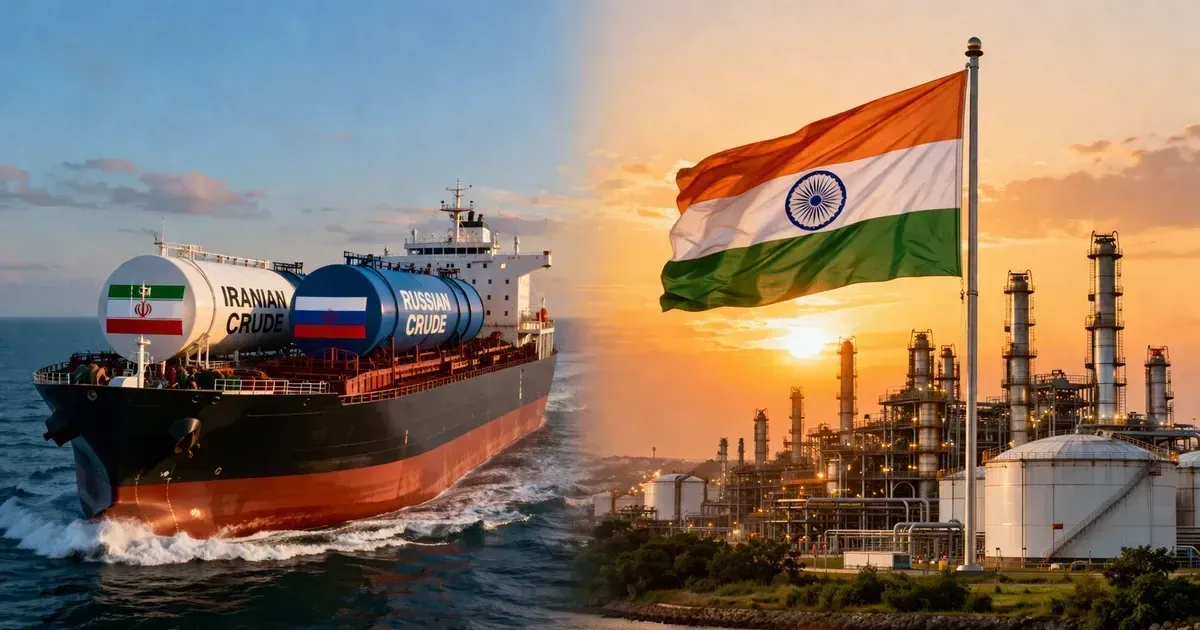
India's energy planners moved into emergency review after Washington ended sanctions flexibility. Refiners now face a narrower field of lawful supply options. The waiver decision narrowed options for refiners that had relied on flexible sourcing. On April 16, 2026, New Delhi officials initiated an emergency review of energy procurement following the White House announcement that temporary sanctions exemptions for crude imports had expired.
Refiners across the subcontinent spent the last twenty-four hours assessing the legal status of tankers carrying millions of barrels of Siberian Light and Iranian Heavy grades. While the U.S. previously permitted these transactions to ensure global price stability, the current administration is shifting toward total enforcement. This policy change forces New Delhi to choose between its economic interests and its standing with Western financial regulators. Global benchmark prices for Brent crude jumped by 2.4% immediately after the news reached the London and New York exchanges.
Indian Energy Strategy Faces Sudden Disruption
State-run entities including Indian Oil Corporation and Bharat Petroleum Corporation Limited have relied on Russian barrels for nearly 40 percent of their total intake over the last two years. These purchases, often made at a steep discount to international benchmarks, provided a buffer against domestic inflation. Moscow used this trade to maintain its federal budget despite Western efforts to isolate the Kremlin. Experts from DW News indicate that the expiration of these waivers is a deliberate attempt by the U.S. Treasury to close remaining loopholes in the price cap mechanism.
Logistical hurdles are mounting for dozens of vessels currently at sea. India must now determine if it can provide sovereign insurance or if it will require these ships to turn back before entering territorial waters. Tehran remains defiant, suggesting that its exports will continue through clandestine channels regardless of American mandates. Market analysts at the Times of India report that the volume of oil currently in transit exceeds 15 million barrels. Such a major amount of crude creates a legal vacuum for ports that are unprepared for the sudden revocation of permits.
The Times of India reported that the U.S. would not extend waivers for Russian and Iranian oil already at sea, affecting countries such as India that secured supplies during the temporary relief.
Energy security in South Asia depends heavily on these shipments arriving at Gujarat and Maharashtra ports. If these tankers are turned away, the resulting supply gap could drive local fuel prices to record highs. Prime Minister Narendra Modi has previously emphasized the necessity of diverse energy sources to fuel the nation's rapid industrial growth. Washington is now testing that resolve by narrowing the available options for affordable energy.
Tighter Enforcement Limits Russian and Iranian Supply
Sanctions enforcement teams in the U.S. Department of State have increased their monitoring of the so-called shadow fleet. These aging vessels frequently engage in ship-to-ship transfers to hide the origin of their cargo. By ending the waivers, the American government is effectively blacklisting the financial intermediaries that enable these trades. Russian exporters had previously used a network of Dubai-based and Hong Kong-based firms to process payments in currencies other than the dollar. These networks now face secondary sanctions that could freeze their remaining assets in the global banking system.
Tehran’s oil ministry claims that its production capacity will not be affected by the move. By contrast, historical data shows that Iranian exports typically drop by 300,000 barrels per day whenever the U.S. tightens maritime oversight. Private refiners in India, such as Reliance Industries, have historically been more cautious than their state-owned counterparts regarding sanctions compliance. These corporations may halt all Iranian and Russian purchases immediately to protect their access to the American financial market.
Moscow's revenue from oil exports hit an estimated $100 million per day in the first quarter of 2026. This move by the U.S. seeks to slash that figure by making the logistics of delivery prohibitively expensive. Ships carrying Russian oil must now pay far higher premiums for Protection and Indemnity insurance. Most Western insurers refuse to cover these vessels without proof that the oil was purchased below the G7 price cap. Verification of these price points has become a primary focus for investigators in the U.S. Treasury.
Strategic Shift in Washington Sanctions Policy
American officials argue that the period of transition provided to the Global South was sufficient to find alternative suppliers. Countries like Guyana, Brazil, and the United Arab Emirates have increased their production, but their crude often carries a higher price tag than sanctioned barrels. The U.S. State Department maintains that ending the waivers is necessary to degrade the military capabilities of both Russia and Iran. National security advisers in the White House believe that the diplomatic friction with New Delhi is a necessary cost of this geopolitical objective.
Transitioning away from cheap Russian crude requires India to renegotiate long-term contracts with Middle Eastern producers like Saudi Arabia and Iraq. These negotiations often take months and involve complex trade-offs regarding refining margins. Baghdad has signaled a willingness to increase exports, yet it lacks the immediate surplus to replace every Russian barrel. Smaller refineries in southern India are particularly vulnerable to these sudden shifts in the supply chain. These facilities lack the storage capacity to weather a prolonged interruption in deliveries.
Global Logistics Networks Absorb Potential Shocks
Vessels currently positioned in the Persian Gulf and the North Sea are adjusting their routes in anticipation of further regulatory updates. Tracking data suggests that several tankers have already changed their destination to ports in Southeast Asia. This shift suggests that China may be willing to absorb the excess capacity that India is forced to reject. Beijing has consistently ignored U.S. sanctions, providing a reliable outlet for both Russia and Iran. Such a divergence in policy creates a fragmented global oil market where two distinct pricing tiers exist simultaneously.
Port authorities in Mumbai and Kochi have received instructions to verify the insurance documentation of all incoming tankers with increased scrutiny. Any vessel unable to provide legitimate Western-backed insurance or a valid U.S. waiver will be denied entry. The directive creates a serious backlog of ships waiting for clearance in the Arabian Sea. Shipments of Iranian condensate are specifically mentioned in the new enforcement guidelines. Indian Oil Corporation scheduled its next board meeting for Monday.
Energy Buyers Lose Flexibility
Washington is essentially daring New Delhi to choose between cheap energy and its diplomatic partnership with the West. The strategy assumes that India is a subordinate partner in the Indo-Pacific alliance rather than a rising superpower with its own distinct national interests. By forcing this ultimatum, the U.S. risks alienating a critical ally at a time when regional stability is already unstable. The American administration risks assuming that it can still dictate the terms of global trade to the world's most populous nation. Such arrogance often leads to unintended consequences in the form of accelerated de-dollarization and the strengthening of alternative trade blocs like BRICS.
Prime Minister Modi has spent years cultivating a reputation for strategic autonomy. Yielding to Washington now would not only damage the Indian economy but also undermine his domestic political standing. The White House likely underestimates the willingness of India to establish its own insurance and payment systems to bypass Western gatekeepers. If New Delhi chooses to ignore these sanctions, the U.S. will be forced to either impose penalties on a friendly democracy or admit that its primary geopolitical weapon has become blunt and ineffective. The policy leaves the State Department with a difficult choice if India resists.
The age of the unilateral waiver is over, but the age of American dominance in energy markets is fading right along with it. The outcome will depend on whether Washington can enforce the policy without driving India toward alternative financial and energy networks.