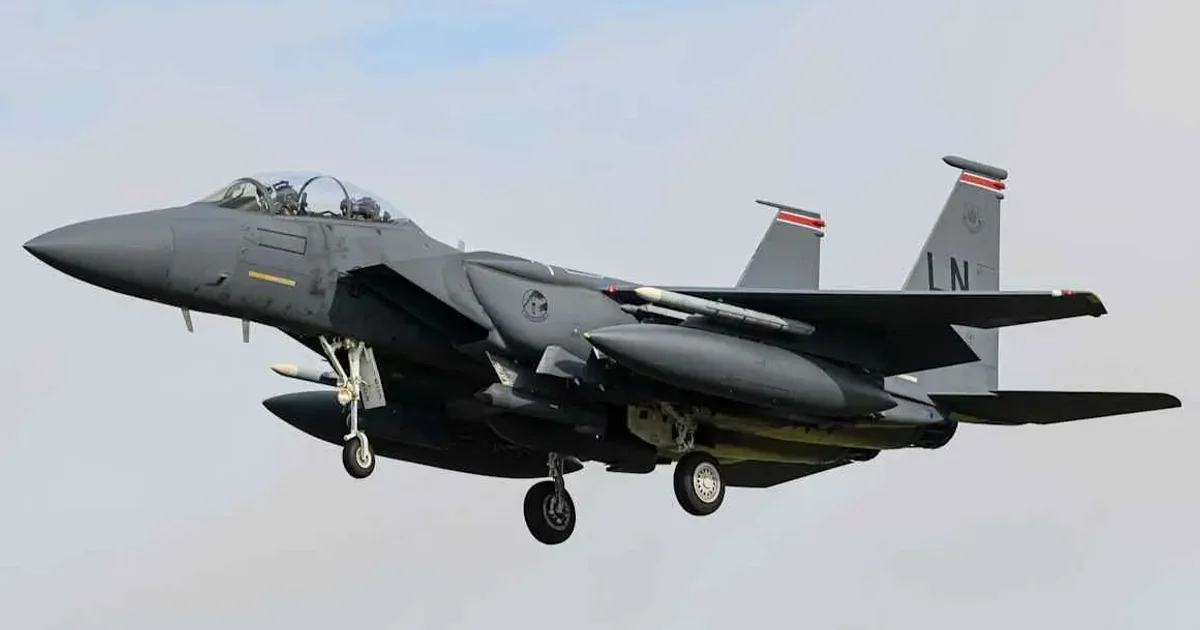
Rescue personnel extracted one American aviator after an F-15E Strike Eagle fell behind enemy lines in Iran. Officials at the Department of Defense confirmed the recovery operation while acknowledging that a second crew member is still missing. The April 3, 2026, incident turned a successful rescue into a broader test of American air operations over Iran. The extraction occurred in the early hours of the morning following reports that Iranian surface-to-air batteries successfully targeted the dual-role fighter jet. Tehran military spokesmen released footage of what they claim is the crash site, showing charred metal and structural ribs consistent with the Boeing-manufactured airframe. The state-run Tasnim News Agency, which maintains close ties to the Islamic Revolutionary Guard Corps, claimed that its homegrown air defense systems tracked and neutralized the intruder. Iranian media outlets circulated images of the wreckage across social media platforms to strengthen domestic narratives of military prowess.
Search and rescue teams used HH-60W Jolly Green II helicopters and C-130 Hercules aircraft to reach the coordinates of the first pilot. Pentagon officials have not disclosed the specific location of the crash, citing the ongoing sensitivity of the efforts to locate the second officer. Defense sources suggest the missing crew member likely ejected before the airframe struck the ground.
Military leaders previously maintained that American forces held undisputed air superiority over the region. Recent losses challenge this assessment. Even with sophisticated electronic warfare suites, American jets face a densifying network of Iranian radar and missile batteries. Intelligence reports indicate that Iran has deployed mobile units like the Khordad-15 and the Bavar-373 to counter high-altitude threats.
Search Operations Expand for Missing Crew Member
Combat search and rescue units are currently scouring rugged terrain to locate the second aviator. The teams operate under constant threat from local militias and Iranian regular forces patrolling the perimeter of the impact zone. Low-light conditions and the mountainous geography of the Iranian interior complicate the visual identification of parachutes or signaling devices.
CENTCOM declined to provide specific coordinates for the ongoing rescue mission. Logistical hubs in Iraq and Kuwait are providing support for the mission, which involves coordinating multiple layers of air cover to protect the rescue helicopters. Commanders have ordered additional drone surveillance to monitor Iranian troop movements near the suspected location of the missing pilot. Thermal imaging from orbiting platforms is being used to detect heat signatures in the cold highland environment. One official, speaking on condition of anonymity, stated that the recovered pilot is in stable condition and undergoing medical evaluation at a secure facility. The pilot provided initial debriefing data regarding the sequence of events leading to the aircraft loss. Flight data suggests the jet was operating at a standard mission altitude when the engagement occurred.
Iranian Air Defenses Challenge US Superiority
Tehran maintains that its radar networks can detect even low-observable aircraft through passive sensor arrays and multi-static radar configurations. While the F-15E is not a stealth platform, its integrated defensive systems are designed to jam conventional tracking signals. The successful strike on a $100 million aircraft indicates a significant improvement in Iranian targeting algorithms and missile kinematics. Previous denials from the military command aimed to discredit Iranian propaganda, yet the current physical evidence of wreckage makes those dismissals difficult to sustain. Discrepancies between Iranian claims and American confirmations often stem from the time required to verify crew status. On Thursday, the command insisted that all aircraft were accounted for, though the situation changed rapidly over the subsequent 24 hours.
Technological analysts believe the weapon used in the shoot-down may have been a variant of the Sayyad-3 missile. The solid-fuel interceptor is capable of hitting targets at distances exceeding 120 kilometers. Deployment of the systems in mobile configurations allows Iranian forces to create unexpected "engagement zones" that catch pilots off guard during routine sorties.
The F-15E Strike Eagle is a backbone of the United States Air Force inventory, capable of carrying up to 23,000 pounds of ordnance. Powered by two Pratt & Whitney F100-PW-229 engines, the jet reaches speeds over Mach 2.5. Its APG-70 radar allows the crew to detect ground targets from long ranges, making it an ideal platform for the precision strikes currently being conducted across Iranian territory.
Internal systems rely on the Tactical Electronic Warfare Suite to identify and categorize incoming threats. If a missile lock is detected, the jet automatically deploys flares and chaff to confuse the seeker heads of incoming projectiles. Iranian forces appear to be using frequency-hopping techniques to bypass standard countermeasures.
Commanders are now re-evaluating flight paths and mission profiles to minimize exposure to known missile sites. The loss of a sophisticated fighter jet forces a shift in how the Air Force conducts suppression of enemy air defenses. Instead of direct overflights, the military may rely more heavily on standoff weapons launched from outside the range of the Sayyad batteries.
Ground-based observers in Iran reported seeing the aircraft on fire before it impacted the earth. Video clips filmed on mobile phones show a distinct orange plume trailing the jet as it spiraled toward a valley. The visual records provide a harrowing account of the final moments of the flight and confirm that the airframe suffered catastrophic structural failure upon impact.
Pilot Rescue Shows Air War Exposure
Is the era of American air invincibility finally over in the Middle East? The loss of an F-15E Strike Eagle over Iran suggests that the Pentagon's confidence in a "permissive environment" was nothing more than a dangerous delusion. For years, the military-industrial complex has marketed these platforms as the pinnacle of engineering, yet they are being brought down by an adversary that has spent decades perfecting the art of asymmetric air defense. The rescue of one pilot is a tactical success, but the failure to protect the aircraft itself is a strategic embarrassment that cannot be ignored.