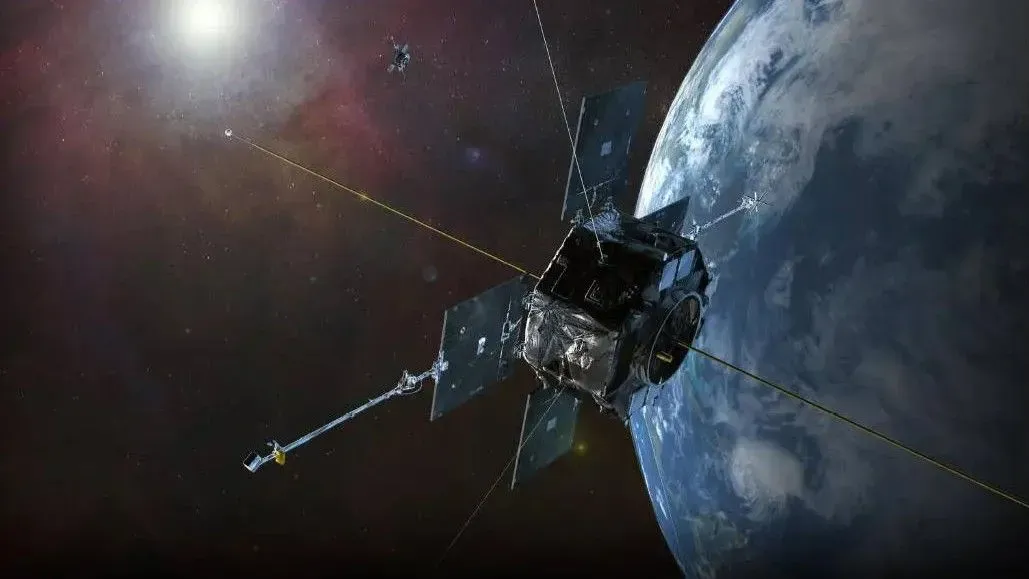
Van Allen Probe A Will Re-enter Atmosphere Tonight
NASA expects the 1,300-pound Van Allen Probe A to re-enter Earth’s atmosphere on Tuesday evening. Intense solar activity accelerated the orbital descent.
◆
Key Points
☼ AI-Generated Summary
◆Van Allen Probe A is scheduled for an uncontrolled re-entry at 7:45 PM EDT on Tuesday.
◆The 1,323-pound satellite is falling early due to atmospheric expansion caused by high solar activity.
◆While most of the craft will incinerate, some high-density metal fragments may survive to the surface.
◆NASA and Space Force maintain that the statistical risk to human life is negligible.
Share
Solar Fury Forces Early Descent
Tuesday evening marks the end of a long journey for one of the most hardworking scientific instruments in Earth’s orbit. NASA confirmed that Van Allen Probe A, a 1,323-pound spacecraft launched in 2012, will plummet through the atmosphere at approximately 7:45 PM EDT. Orbital decay typically happens over decades, yet this specific satellite is coming home much sooner than engineers originally projected. Intense solar activity during the current solar cycle expanded the upper reaches of our atmosphere, creating extra drag that slowed the craft and lowered its altitude.
Space Force tracking stations have monitored the descent for weeks, refining the impact window as the probe dips into denser air. Launched as part of a twin mission to study the radiation belts surrounding our planet, the probe has outlived its primary mission requirements. Now, it is a victim of the very space weather it was designed to observe. Solar flares and coronal mass ejections increase the density of the thermosphere. When the atmosphere swells, satellites in low Earth orbit encounter more resistance, causing their orbits to degrade rapidly.
NASA officials emphasize that the risk to people on the ground is extremely low. Most of the 600-kilogram vehicle will vanish in a blaze of friction-induced heat. Still, some components are built to withstand the rigors of space, including high-melting-point materials like titanium and stainless steel. Small fragments of these components could survive the fiery passage and strike the surface.
Scientists expect the majority of the debris to land in the ocean. Earth is mostly water, and the statistical probability of a human being struck by space junk remains lower than the chance of being hit by lightning twice. This Tuesday re-entry is final data point for a mission that revolutionized our understanding of the cosmic environment near home.
Mechanics of Atmospheric Friction
High-velocity re-entry turns the surrounding air into a superheated plasma. As Van Allen Probe A hits the atmosphere at several miles per second, the kinetic energy must go somewhere. Friction converts that energy into thermal energy, reaching temperatures hot enough to melt aluminum structures in seconds. Most modern satellites are designed to break apart at specific altitudes to maximize the surface area exposed to heat, ensuring total incineration.
Engineers at the Johns Hopkins University Applied Physics Laboratory, which built and operated the probes, intentionally lowered the orbit years ago to ensure a controlled eventual disposal. They did not want the craft to become a permanent fixture in the orbital graveyard. While the Sun accelerated the timeline, the outcome remains within the parameters of the original decommissioning plan.
This mission provided the first high-resolution maps of the radiation belts, revealing a third, temporary belt that appears during solar storms. Before these probes, our understanding of the Van Allen belts was based on limited data from the 1950s. The harsh radiation in these regions can fry the electronics of GPS satellites and endanger astronauts on the way to the Moon or Mars.
Tracking Orbital Debris in 2026
Space Force personnel at the 18th Space Defense Squadron are currently the primary observers of the probe’s final hours. They use a global network of radars and optical telescopes to predict the exact re-entry point. Predictions are notoriously difficult because the orientation of the tumbling satellite changes its drag profile. If the probe hits the atmosphere broadside, it slows down faster than if it enters nose-first.
Re-entry predictions usually carry an error margin of about 10 percent of the remaining time in orbit. Six hours before the event, the window of impact still spans thousands of miles. Only in the final minutes, as the craft begins to break up, does the precise location become clear.
Most of the hardware consists of instruments like the Relativistic Electron Proton Telescope and the Magnetic Electron Ion Spectrometer. These tools were essential for measuring the high-energy particles trapped by Earth’s magnetic field. Now, they are destined to become glowing streaks in the night sky.
Legacy of the Van Allen Mission
Fourteen years of operation provided a wealth of knowledge about how the Sun interacts with Earth. The Van Allen probes discovered that the belts are much more dynamic than previously thought. They do not just sit there; they breathe, expanding and contracting in response to the solar wind.
Data from the mission showed that the inner belt is relatively stable, while the outer belt is a chaotic environment where particles are accelerated to nearly the speed of light. This information is key for the design of future spacecraft. If we know exactly where the radiation is most intense, we can build better shielding or plan trajectories that avoid the worst zones.
NASA shut down the probes in 2019 after they ran out of fuel for their thrusters. Without fuel to maintain their orientation or boost their orbit, they were left to the mercy of gravity and atmospheric drag. The sister craft, Van Allen Probe B, will meet a similar fate in the coming years.
Risk Assessments and Global Realities
International space law dictates that the launching nation is liable for any damage caused by falling space objects. Since NASA is a US government agency, the United States would be responsible if a piece of Probe A hit a house in Australia or a ship in the Atlantic. Such incidents are rare, but not unknown. In 1978, the Soviet satellite Kosmos 954 scattered radioactive debris across northern Canada, leading to a massive cleanup operation and a diplomatic crisis.
Van Allen Probe A carries no radioactive material, making it a much cleaner re-entry. The primary concern is the physical impact of a surviving fragment. Some heavy engine parts or fuel tanks are strong enough to make it through. If you happen to be under the flight path, you might see a bright fireball, but the odds of a piece landing in a populated area are slim.
Modern space agencies are facing increasing pressure to adopt more sustainable practices. Such a includes including enough fuel at the end of a mission to perform a deorbit burn that targets a specific, uninhabited area like the South Pacific. Because the Van Allen probes were launched over a decade ago, their end-of-life plan relied more on natural decay than precision targeting.
Tuesday night is closing chapter for a mission that looked into the heart of the storm surrounding our planet.
Everything we know about the radiation environment that modern society depends on for communication and navigation was refined by these two small probes.
As the first one vanishes tonight, it leaves behind a legacy of safety for every satellite that follows.
The Elite Tribune Perspective
Relying on luck remains the primary strategy for international space agencies when massive hardware falls from the sky. NASA and the Space Force offer soothing statistics about the low probability of a strike, but these numbers ignore the cumulative risk of a congested orbital environment. We are currently playing a global game of Russian roulette with our upper atmosphere. If a 1,300-pound satellite is pushed down early by solar activity, it proves our control over these multi-million dollar assets is tenuous at best. The scientific community praises the Van Allen mission for its data, yet they remain silent on the irresponsibility of launching objects without a guaranteed, powered disposal system. We should not be satisfied with the answer that most of it will probably burn up. A truly advanced spacefaring civilization would not leave its trash to fall randomly on the heads of the taxpayers who funded it. Until we mandate that every launch includes a dedicated deorbit engine, we are simply littering on a cosmic scale and hoping the flames of the atmosphere hide our lack of foresight. Let this re-entry be the final time we accept maybe as a safety standard.