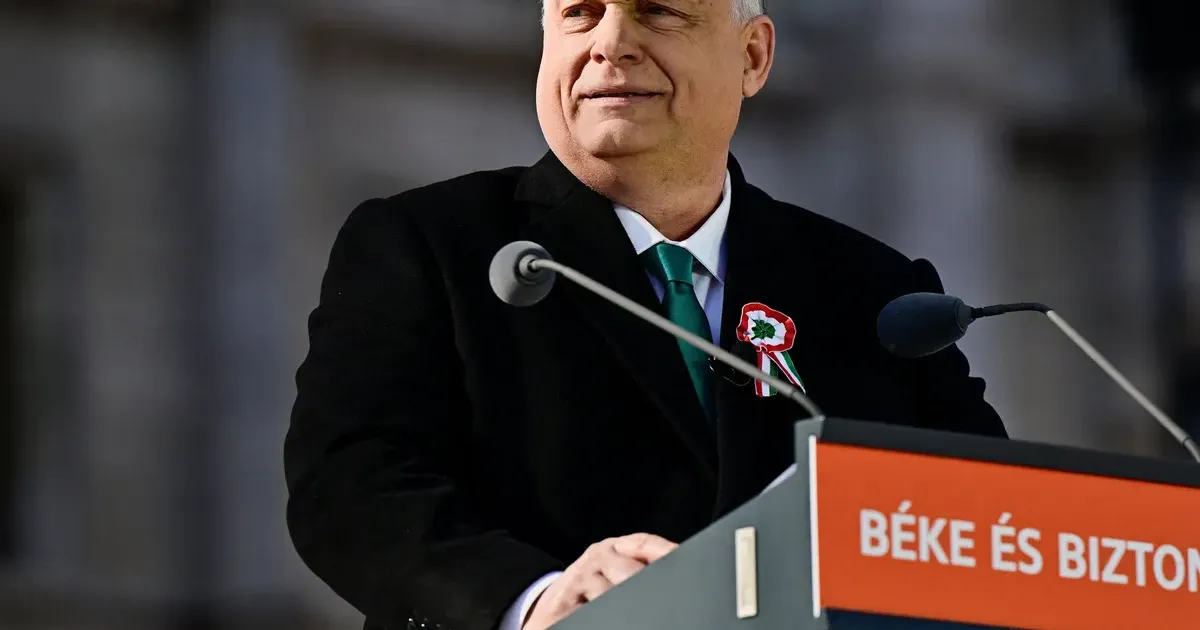
Prime Minister Viktor Orban entered the European Council summit on March 19 with a clear mandate to obstruct a €90 billion aid package for Ukraine. Financial negotiations in Brussels have reached a stalemate as the Hungarian leader links his veto to energy security and domestic political survival. Russia's invasion of Ukraine has entered its fifth year, leaving Kyiv reliant on this massive loan to stabilize its economy and maintain its defense against Moscow's forces. But the release of these funds depends on unanimous consent from all 27 member states, a requirement Orban is currently exploiting to extract concessions.

Publicly, the Hungarian government argues that the loan is reckless and lacks a clear strategy for peace. Behind the scenes, the dispute centers on the flow of crude oil through the Druzhba pipeline, which is still a lifeline for the Hungarian economy.

European leaders spent the morning attempting to convince the Hungarian delegation to soften its stance. Many diplomats expressed frustration with the tactic of holding foreign aid hostage to resolve bilateral energy disputes. Budapest has insisted that Ukraine must restore full transit rights for Lukoil, a Russian energy giant that previously supplied a major portion of Hungary's oil. Ukraine restricted these flows earlier this year, citing sanctions compliance and a desire to limit Russian oil revenues. Orban has transformed this technical disagreement into a central pillar of his foreign policy.

He claims that Ukraine is blackmailing his country by threatening its energy security. Kyiv maintains that it is simply enforcing international sanctions against a belligerent state. The result is a total paralysis of European financial support at a moment when the front lines are increasingly unstable.

Druzhba Pipeline and Energy Security

Energy flows from Russia to Central Europe have long been a source of geopolitical tension. The Druzhba pipeline, one of the longest in the world, carries oil thousands of miles to refineries in Hungary and Slovakia. While much of Europe has successfully diversified its energy sources, these two nations remain heavily dependent on the southern branch of the network. Ukraine holds the literal and metaphorical valve, a fact that the government in Kyiv has increasingly utilized as leverage.

The 2026 restrictions on Lukoil were designed to squeeze the Kremlin, yet the immediate impact was felt most acutely in Hungarian refineries. Viklot Orban quickly labeled the move an act of aggression against a fellow European Union member. This specific grievance now is the primary justification for blocking the €90 billion loan. Hungarian officials have stated that they will not even discuss the aid package until the oil begins to flow without interruption.

Refinery operators in Hungary warn that their stockpiles are dwindling. Without the Lukoil volumes, the country must rely on more expensive imports through the Adriatic pipeline from Croatia. Costs for Hungarian consumers would rise sharply, a political liability Orban is desperate to avoid. He has pointed out that EU rules allow for certain exemptions on pipeline oil for landlocked countries. Slovakia has echoed these concerns, forming a rare regional bloc that challenges the broader European consensus on Ukraine. The two nations argue that their economic stability is being sacrificed for a war they believe cannot be won.

In fact, Orban has consistently called for an immediate ceasefire, a position that aligns more closely with Moscow than with his Western allies. The Druzhba pipeline has become a symbol of the continent's unfinished decoupling from Russian energy.

Orban Uses Ukraine Aid for Election Leverage

Internal politics in Hungary are driving the intensity of this blockade. Voters will head to the polls on April 12 to elect a new parliament, and Orban is facing a more unified opposition than in previous cycles. He has framed himself as the only leader capable of keeping Hungary out of the conflict. Campaign posters across the country depict opposition figures as puppets of Brussels and Washington who want to send Hungarian soldiers to the front. By blocking the Ukraine loan, Orban is signaling to his base that he puts Hungarian interests first.

He uses the dispute to validate his narrative of a country under siege from both the East and the West. This strategy has proven effective in rural strongholds where suspicion of international institutions remains high. For one, the Fidesz party has seen a slight bump in recent internal polling following the announcement of the veto. The election is less than a month away.

Opposition leaders in Hungary have condemned the move as a dangerous gamble with the country's reputation. They argue that Orban is isolating Hungary within the European Union and leaving it vulnerable to future retaliation. Even so, the Prime Minister remains undeterred by threats of Article 7 proceedings, which could theoretically strip Hungary of its voting rights. He knows that such a process is slow and requires a level of consensus that is currently missing among member states. His focus is entirely on the April 12 vote.

He has linked the survival of the Hungarian economy directly to his ability to stare down the bureaucrats in Brussels. The €90 billion loan is merely a prop in a larger domestic drama. Every day the aid is delayed is a headline for state-controlled media to broadcast his defiance. He has made it clear that no movement will occur before the election results are finalized.

Slovakia Joins Hungary in Regional Opposition

Slovakia has emerged as a critical ally for Hungary in this specific confrontation. Prime Minister Robert Fico shared a stage with Orban earlier this week to denounce the Ukrainian oil restrictions. Fico has also stopped his country's military aid to Kyiv, marking a sharp departure from the previous Slovak administration's policy. The two leaders have found common ground in their skepticism of the war's duration and cost. Slovakia's reliance on the Druzhba pipeline is nearly as high as Hungary's, making the energy issue a shared priority. Together, they represent a major obstacle to European unity.

While other nations like Poland and the Baltic states push for more aggressive support for Ukraine, the Central European duo provides a buffer for those who are quietly weary of the financial burden. The coordination between Budapest and Bratislava has caught many in the European Commission by surprise. It complicates the effort to isolate Orban, as he no longer stands alone.

The European Union cannot function as a system where the security of one member is traded for the geopolitical ambitions of another regarding a non-member state.

Diplomacy in the hallways of the summit has been described as icy. French and German officials have reportedly held private meetings with Fico to see if his support for Orban can be peeled away. For instance, the promise of new infrastructure investments or energy subsidies might sway the Slovak leader where ideological appeals fail. Yet Fico's own domestic mandate is built on a similar populist platform to Orban's. He has little incentive to back down and risk being seen as a subordinate to Brussels. The partnership between the two leaders has effectively doubled the leverage of the anti-aid faction.

They are now coordinating their voting blocks on a range of issues, from migration to judicial reform. This synchronization suggests that the blockade is not just a temporary tactic but part of a broader strategy to reshape EU priorities. The consensus model of the European Union is being tested to its breaking point.

European Union Crisis Over Unanimity Rules

Brussels remains trapped in a structural dilemma of its own making. The requirement for unanimity on foreign policy and budget matters gives any single nation the power to halt the entire bloc's agenda. Critics of this system argue that it is outdated and leaves the Union vulnerable to internal sabotage. Several member states have called for a move toward qualified majority voting on certain financial packages. But changing the voting rules itself requires a unanimous vote, creating a circular logic that Orban is happy to exploit. He views the veto as his most potent weapon in a lopsided power dynamic.

Without it, Hungary would have little say in the direction of the continent's largest economy. The current crisis has reignited the debate over a multi-speed Europe, where smaller groups of nations could move forward with aid packages without the consent of the entire group. The approach would bypass the Hungarian veto but could also signal the beginning of the Union's fragmentation.

Financial markets have begun to react to the prolonged uncertainty. The Ukrainian currency has faced renewed pressure as the €90 billion loan remains in limbo. International investors are closely watching the European response, as the loan is intended to be backed by the interest earned on frozen Russian assets. The inventive financial mechanism was supposed to be a centerpiece of the G7's strategy to support Ukraine without direct taxpayer funding. If the EU cannot agree on the legal and political structure for the loan, the entire plan could collapse.

Separately, the United States has expressed concern that European infighting is undermining the global coalition. Washington has provided significant aid but expects Europe to take the lead on long-term economic reconstruction. The delay is not just a problem for Kyiv but an embarrassment for the G7. Every hour of negotiation in Brussels is an hour of respite for the Russian military. The deadline for the first tranche of the loan passed last Friday.

The Elite Tribune Perspective

Democratic institutions often die from a surfeit of politeness. The European Union has spent years treating Viktor Orban as a wayward child who might eventually return to the liberal fold if given enough time and subsidies. The perspective is a delusion. Orban is not an accidental obstructionist but a shrewd practitioner of transactional illiberalism who recognizes that the EU’s procedural rules are his greatest asset. By holding a €90 billion lifeline for a war-torn nation hostage to a domestic election and a pipeline dispute, he has exposed the fundamental fragility of the European project.

The Union is currently a collective of 27 nations where the smallest and most recalcitrant can dictate terms to the most powerful. It is not a functioning democracy; it is a suicide pact disguised as a consensus. Brussels must stop negotiating for the 10 percent of Orban’s cooperation and start building the legal mechanisms to bypass him entirely. If the EU cannot provide the financial tools necessary for a neighbor’s survival, it ceases to be a relevant geopolitical actor. The April 12 election in Hungary should not be the ticking clock that decides the fate of Ukraine.

Sovereignty for the many should never be held ransom by the narcissism of the few.