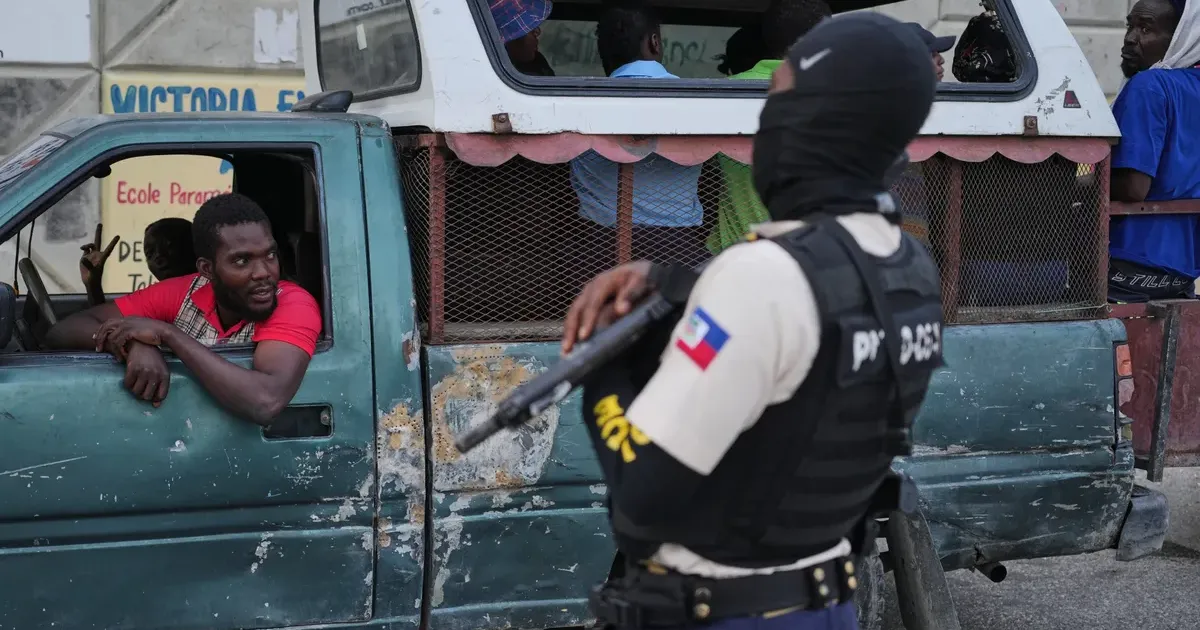
Central Haiti is now facing a security collapse that extends beyond one town. The violence matters because the state has lost routine control in areas civilians still need to cross. The immediate question is whether security forces can reopen basic routes. Petite-Rivière de l'Artibonite transformed into a scene of chaotic warfare on March 30, 2026, as entrenched gangs battled local self-defense groups for territorial control of the central Haitian town. Gunfire erupted before dawn when members of a criminal network launched a coordinated assault on residential neighborhoods. Residents of Petite-Rivière de l'Artibonite reported seeing dozens of homes engulfed in flames while the conflict spilled into the central marketplace. This specific surge in violence indicates a geographical shift in the nation's security crisis as urban gangs expand their reach into the agricultural heartland.
Smoke from burning structures rose above the Artibonite Valley throughout the day. Local witnesses described a brutal environment where civilian vigilantes, armed with machetes and handguns, attempted to repel gang members equipped with high-caliber automatic rifles. Reports from the ground confirm that the casualty count rose steadily as the morning progressed. Medical facilities in the region, already suffering from chronic supply shortages, struggled to manage the influx of gunshot victims and burn patients. Public order disappeared entirely by midday.
Artibonite Valley Becomes Center of Gang Expansion
Criminal organizations previously confined to the slums of Port-au-Prince now prioritize the control of the Artibonite region due to its strategic importance. Control over this territory allows gangs to extort the nation's primary rice-producing hub and hijack transport trucks on the Route Nationale 1. The lack of a permanent police presence in Petite-Rivière de l'Artibonite created a vacuum that armed groups were eager to fill. Armed actors view the valley as a lucrative source of revenue through kidnapping and illegal taxation of farmers. One farmer reported losing his entire harvest to gang-enforced tolls before the current outbreak of fire and bloodshed.
Agricultural production in the region has plummeted since the gang known as Gran Grif began its expansionist campaign. Estimates suggest that $200 million in potential economic output is lost annually because of insecurity in the northern and central provinces. Farmers often abandon their fields to avoid targeted killings or recruitment drives by gang leaders. The loss of these crops directly impacts food security in the capital, where prices for staples like rice and beans have tripled over the last eighteen months. Instability in the Artibonite department has displaced thousands of families who now seek refuge in makeshift camps. These displaced persons often lack access to clean water or sanitation, creating conditions ripe for the spread of cholera. Local aid organizations remain overwhelmed by the scale of the displacement. Security concerns prevent most international NGOs from operating effectively outside the capital city. The United Nations has documented a sharp rise in human rights abuses throughout the province, including summary executions and gender-based violence used as a tool of intimidation.
Vigilante Groups Rise Against Armed Criminal Networks
Frustration with state inaction led to the rise of the Bwa Kale movement, a decentralized vigilante effort to hunt down suspected gang members. In Petite-Rivière de l'Artibonite, these local defense committees serve as the only line of protection for many neighborhoods. The vigilantes often rely on primitive weapons and sheer numbers to face down gangs. While some residents view these groups as heroes, others fear the cycle of extrajudicial killings will only lead to further societal breakdown. Violence begets violence in a town where the judicial system has ceased to function.
The police station is empty and our homes are turning to ash, so we have no choice but to fight these killers with our bare hands or die in our beds.
A spokesperson for a local civil society group provided this statement to regional reporters as the fighting intensified. Their words reflect the desperation of a population that feels completely abandoned by the central government. Vigilante justice often results in the public lynching of suspects, sometimes based on mere rumors of gang affiliation. These acts of retribution further complicate the work of any future peacekeeping mission. Every neighborhood now has its own checkpoint and its own rules of engagement.
Humanitarian Crisis Deepens in Rural Haitian Provinces
Hospitals in the central region operate at a fraction of their capacity. Staff members often stay home out of fear for their safety, leaving only a handful of nurses to manage dozens of trauma cases. Essential medicines like antibiotics and painkillers are frequently unavailable on the local market. Wounded combatants and civilians alike often die from treatable infections due to the lack of sterile environments. The road to the nearest major hospital in Saint-Marc is frequently blocked by gang barricades, making medical evacuations nearly impossible.
Supply chains for basic goods have collapsed across the Artibonite department. Small-scale traders who once moved goods between towns now refuse to travel for fear of kidnapping. This isolation has turned Petite-Rivière de l'Artibonite into a series of disconnected enclaves. Families ration their remaining food supplies while waiting for a lull in the shooting. Hunger is a weapon used by gangs to force local compliance.
State Failure Leaves Local Communities to Arm Themselves
The Haitian National Police remains severely underfunded and outgunned by the criminal cartels. Officers assigned to rural outposts frequently find themselves abandoned without ammunition or radio support. Many police units have retreated to the capital, leaving the provincial towns to their fate. This retreat is not merely a tactical move but a symptom of a collapsing state structure. Government officials in Port-au-Prince have issued statements condemning the violence, yet no reinforcements have arrived in the Artibonite Valley. The lack of intervention reinforces the perception that the rural population is expendable.
International efforts to stabilize the country have yet to produce real results on the ground in Petite-Rivière de l'Artibonite. Discussions regarding a multinational security support mission continue in foreign capitals while the death toll in central Haiti climbs. Skepticism toward foreign intervention remains high due to previous failed missions. Local leaders argue that any security force must prioritize the rural provinces if the nation is to avoid total disintegration. The focus on Port-au-Prince allows gangs to consolidate power in the north.
Criminal networks now use the town as a base for operations that reach as far as the border with the Dominican Republic. They have established sophisticated command structures that mimic military organizations. Their intelligence networks often include local residents who are coerced into providing information on vigilante movements. Success for the gangs means the permanent displacement of the legitimate local government. By the evening of March 30, 2026, the gangs held the majority of the town's strategic intersections.
Haiti State Capacity Test
Sovereignty is a polite fiction in a nation where the police station is a tomb for the rule of law. The recent bloodletting in Petite-Rivière de l'Artibonite is the logical conclusion of a decade of institutional decay and the systematic neglect of Haiti's rural provinces. By allowing criminal cartels to seize the nation's agricultural engine, the central government has effectively signed a slow-motion death warrant for its own population. It is no longer a localized skirmish; it is the final stage of state collapse where the distinction between a criminal gang and a governing body has completely evaporated.
The international community's obsession with stabilizing Port-au-Prince while ignoring the Artibonite Valley is a strategic blunder of historical proportions. You cannot save the head of a state while its heart is being devoured by parasites. If the Artibonite falls permanently to gang rule, Haiti loses its ability to feed itself, ensuring that any future transition to democracy will be built on the bones of a starved and broken populace. The rise of vigilante justice is not a sign of civic strength, but the last gasp of a society that has realized no one is coming to save it. Expect the violence to migrate further north as gangs seek to control the ports. The window for a meaningful security intervention is closing. Without a large, localized surge of force in the central provinces, the Artibonite will remain a charcoal-colored graveyard. The state has failed.