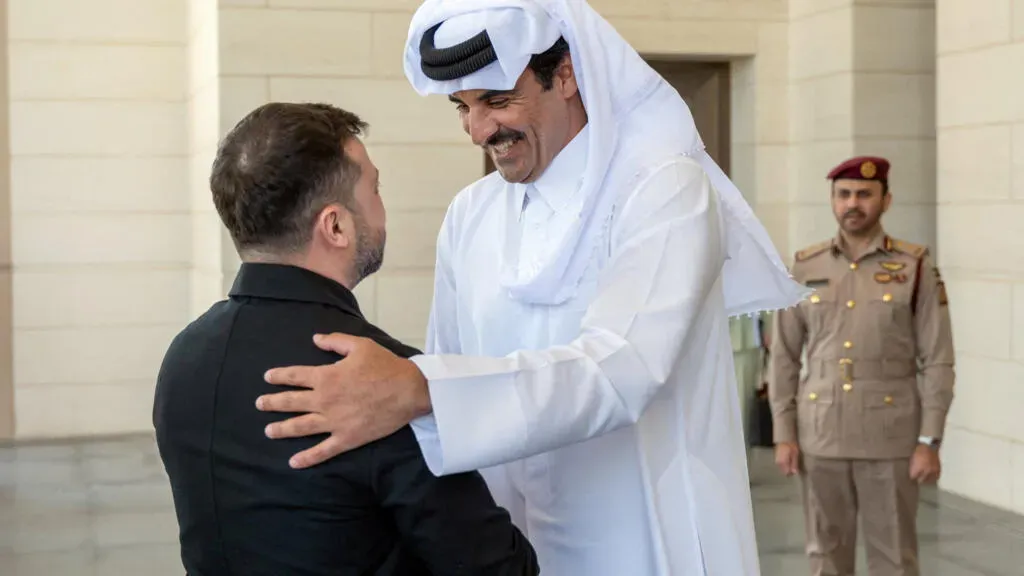
Ukraine is exporting battlefield experience as diplomacy. Gulf governments are reading Iranian drone threats through Kyiv’s air-defense lessons. Volodymyr Zelensky announced on March 30, 2026, that Ukraine finalized several defense agreements with Gulf nations seeking to reduce threats from Iranian drone technology. Kyiv leveraged years of experience intercepting Shahed series unmanned aerial vehicles to secure commitments for high-end air defense interceptors. These discussions concluded after a multi-day tour of the region where Ukrainian officials met with leadership in Riyadh and Abu Dhabi. Military cooperation between Eastern Europe and the Arabian Peninsula has intensified as Tehran continues to supply hardware to multiple conflict zones.
President Volodymyr Zelensky stated that Ukraine will share technical data and combat methodologies for neutralizing low-cost loitering munitions. Success in downing such threats remains a priority for the Saudi Arabia and the United Arab Emirates, both of which have faced repeated incursions. Ukrainian technicians possess unique telemetry data gathered from thousands of successful interceptions over the past four years. This technical intellectual property has become an essential diplomatic currency for a nation still fighting a war of attrition against Russian forces.
Direct military exchanges represent a shift in how Ukraine manages its international security relationships. Previously, the administration relied almost exclusively on NATO members for hardware and training. Expanding the network to include the Gulf Cooperation Council indicates a diversification of strategic partnerships. Both parties share a common objective in degrading the efficacy of Iran and its drone export industry.
Energy Market Chaos Forces New Diplomatic Overtures
Global oil prices surged following the commencement of United States military operations against Iran earlier this month. Brent crude climbed past $120 per barrel, creating severe budgetary constraints for European economies and the Ukrainian war effort. High fuel costs have complicated logistics for frontline units and increased the price of basic goods in Kyiv. Strategic analysts in the region report that the volatility has reached levels not seen since the initial invasion of 2022.
Zelensky addressed the economic instability by proposing an energy-specific ceasefire with Moscow. Proposals include a mutual halt to strikes on refineries and electrical grids to stabilize global production. Russia has not formally responded to the suggestion, although its energy exports continue to reach global markets through alternative channels. Deteriorating infrastructure in both nations has made the cost of continuing the energy war increasingly prohibitive for all participants. This collaboration builds upon previous initiatives, such as the recent Zelenskyy signs UAE defense pact to counter Iranian drone technology.
President Volodymyr Zelensky stated that "any deal should also benefit Ukraine" in exchange for sharing critical drone defense secrets.
Market observers suggest that any pause in infrastructure attacks would provide immediate relief to global supply chains. Financial institutions in London and New York have noted that the ongoing conflict in the Persian Gulf has compounded the risk factors already present in Eastern Europe. Simultaneously, Ukraine remains focused on maintaining its domestic coal and gas production to survive the upcoming winter months. Energy security has become as serious a front as the physical trenches in the Donbas region.
Zelensky Proposes Strategic Energy Ceasefire with Russia
Diplomatic efforts to secure a partial truce come at a time when traditional peace talks have stalled. US involvement in the Iran conflict shifted international attention away from the situation in Ukraine, leaving Kyiv to seek independent pathways toward de-escalation. Ceasefire terms would specifically target the protection of power plants and oil terminals rather than a full cessation of hostilities. Military planners view this as a way to preserve civilian life while the war of maneuver continues on the ground.
International observers expressed skepticism regarding the feasibility of such a limited agreement. Past attempts at localized truces have frequently collapsed within days of implementation. Ukraine insists that international monitors would be required to verify compliance at key energy nodes. Without such oversight, the risk of one side using the pause to rearm or relocate assets remains a primary concern for high-ranking officials.
Geopolitical pressure from the Global South has also influenced the proposal for a targeted ceasefire. Many developing nations rely on the stability of the energy market to prevent internal economic collapse. Pressure from these capitals has forced Kyiv to adopt a more flexible posture regarding infrastructure protection. Neutrality from these states is often contingent on the continued flow of affordable energy resources across the Black Sea.
Impact of US Military Action against Iran on Global Security
Military engagement between Washington and Tehran has fundamentally altered the calculus for Ukrainian victory. Logistics routes through the Mediterranean and the Red Sea face constant disruption, slowing the delivery of essential supplies to Ukraine. Pentagon resources are now split between two theaters, potentially reducing the volume of aid available for the spring offensive. Military hardware that was originally earmarked for Kyiv is being diverted to secure shipping lanes in the Gulf.
Conflict in the Middle East has emboldened Russia to increase its drone production capacity. Intelligence reports suggest that Moscow and Tehran have expanded their manufacturing cooperation despite the ongoing US strikes. Ukrainian forces must now prepare for a new generation of unmanned aerial vehicles that incorporate lessons learned from the current war. Defense deals with Gulf states offer an essential data link to track these technical advancements in real-time.
Security in the 21st century relies on the rapid exchange of information and hardware across traditional alliance boundaries. Ukraine has transformed into a primary exporter of military intelligence while remaining a primary importer of heavy weaponry. Success in the current diplomatic push will determine if Kyiv can maintain its defense of the homeland while the world's superpowers focus on the Persian Gulf.
Stability in Eastern Europe is now closely linked to the containment of Iran and its regional proxies. Diplomatic circles in Brussels and Washington are closely monitoring the implementation of these new Gulf agreements. Every intercepted drone over Riyadh provides data that could eventually save a power station in Kyiv. The technological war has no borders.
Air Defense Diplomacy
Gulf governments want air-defense tools that have been tested against the systems they fear. Ukraine can offer that experience in a way traditional arms sellers cannot.
For Kyiv, the agreements also widen diplomatic support beyond Europe and North America at a moment when missile defense remains urgent.