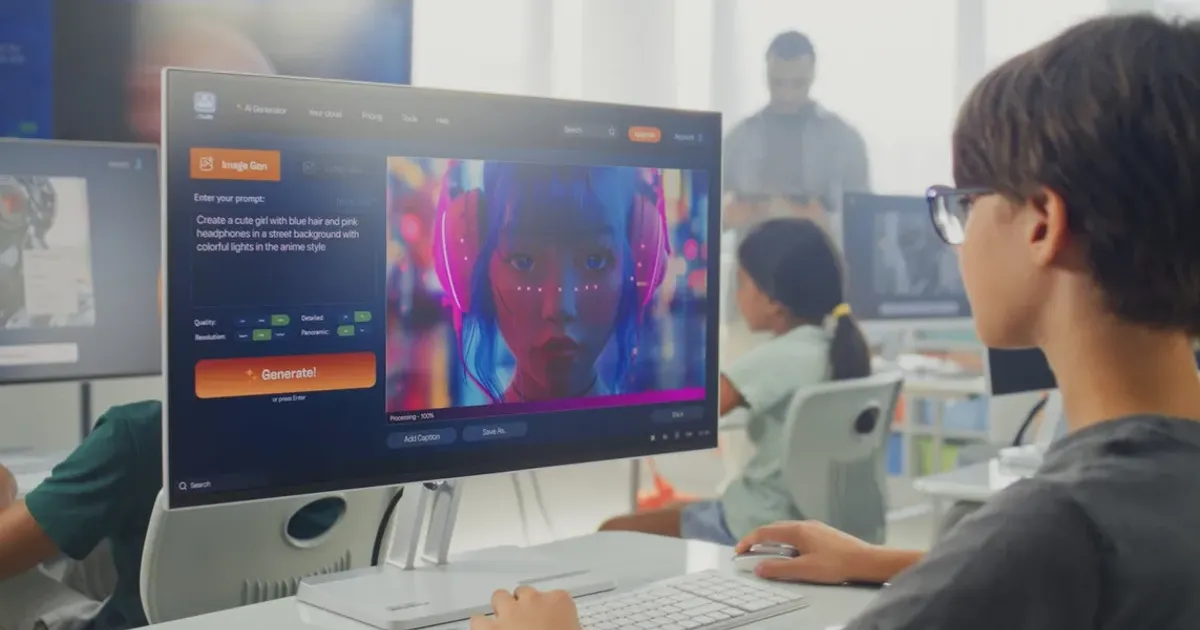
The old promise that every student simply needed to learn to code is being tested by generative AI. Schools are not abandoning computer science. The question now is what kind of technical learning remains valuable when software can produce code on demand.
The answer is not to replace coding with prompting. It is to make coding education less shallow. Syntax still matters, but it cannot be the main prize. Students need enough technical grounding to understand systems, test output, explain failures and decide when a polished answer is wrong.
Syntax Is No Longer The Center
The first wave of school coding lessons often began with simple commands and visible results. That gave many students a useful entry point, but it also encouraged districts to treat programming languages as the durable skill. AI tools expose the weakness in that approach. If a model can generate a working snippet, memorizing the snippet's surface form is less valuable than understanding whether it solves the right problem.
That does not make programming obsolete. It changes the emphasis. Debugging, decomposition, abstraction and pattern recognition become more important because they help students judge machine output instead of accepting it. A student who can explain why a program fails is better prepared than one who can only produce code that appears to run.
Teachers Still Need A Clear Use Case
EdSurge's March 2026 reporting captured the hesitation inside schools. In a two-year research project with teachers, including engineering and computer science teachers, researchers found that AI uptake remained minimal because many educators still struggled to identify a clear universal classroom use case.
That hesitation is not simple fear of technology. It is a curriculum problem. AI interfaces change quickly, while school systems need lessons that are worth teaching for years. A classroom cannot rebuild its standards every time a vendor changes a sidebar or releases a new model. Durable concepts have to sit underneath the tools.
Verification Becomes The Core Skill
The most important classroom shift is from producing every line by hand to understanding enough to verify, improve and challenge the output. That still requires coding. It also requires logic, data literacy, ethics, domain knowledge and communication.
A student should be able to ask: What assumptions does this program make? What input breaks it? What data does it use? What bias might it carry? Does the answer match the problem, or only the prompt? Those questions are central to programming as well as science, journalism, business and public life.
Assessment Has To Change
If homework can be outsourced to a chatbot, assessment has to move closer to process. Teachers need more oral explanation, code review, debugging under supervision, design notes and reflection on why one solution was chosen over another. The point is not to ban tools from every lesson. The point is to make sure students can still think when the tool is unavailable or wrong.
Recent K-12 AI research points in the same direction: tools are more promising when they foster independent reasoning rather than replace it. That should be the standard for classroom use. If a tool helps a student see structure, test ideas or get feedback, it may support learning. If it simply hands over an answer before the student understands the problem, it is a shortcut around the lesson.
AI Education Should Be Broader Than Prompting
Schools should be cautious about turning prompt writing into the next narrow vocational fad. Prompt habits will change as interfaces change. Reasoning habits will last longer. Students need to understand algorithms, data flows, model bias, privacy, automation and the limits of prediction.
That broader version of computer science is more useful than a race to teach the newest interface. It prepares students to use AI tools, question them and understand the systems behind them. It also makes AI education less dependent on which company owns the classroom platform this year.
The Learn-To-Code Slogan Was Too Small
The learn-to-code slogan was too small for the world it helped create. It treated code as the job, when the real job is disciplined thinking about machines, people and consequences.
AI makes this gap impossible to ignore. Students do not need to become extensions of a software license. They need to become the people who can tell the machine what matters, test what it returns and notice when the answer is fluent but false.