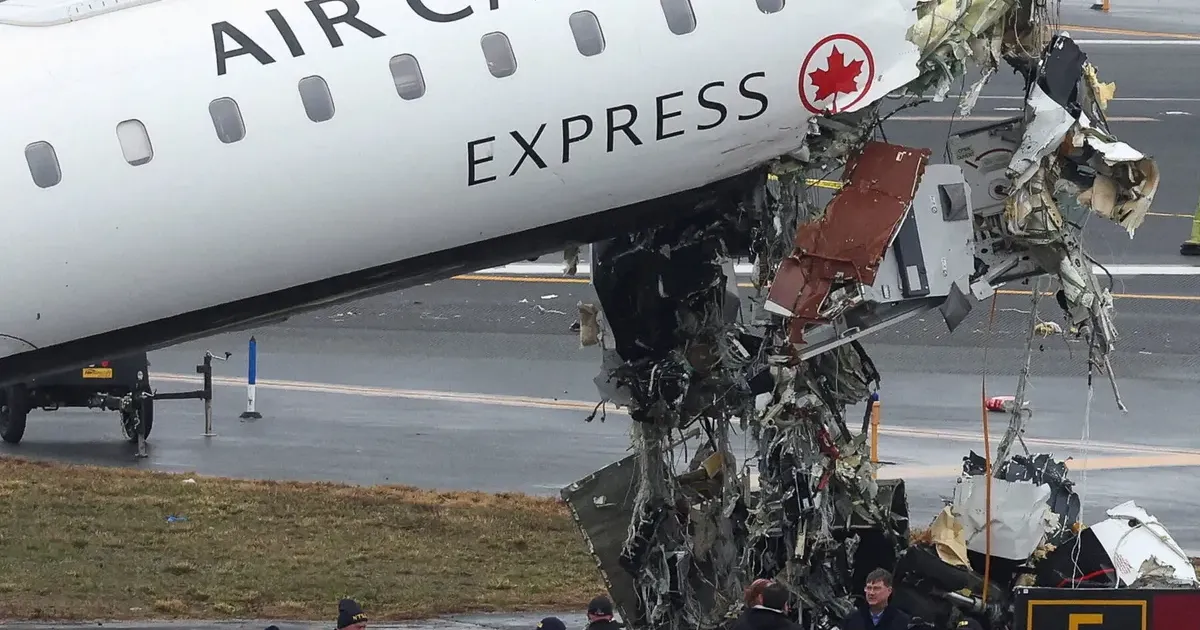
The LaGuardia investigation is not a routine landing accident. It is a runway-surface safety case: a regional jet landing at night, an airport firefighting vehicle crossing Runway 4 and a warning sequence that appears to have arrived too late to keep the two out of the same space.
According to the National Transportation Safety Board's preliminary account, Jazz Aviation LP flight 646, doing business as Air Canada flight 8646, was landing at LaGuardia Airport on March 22, 2026, when the CRJ-900 collided with Rescue 35, an Oshkosh Striker 1500 aircraft rescue and firefighting vehicle. The flight had arrived from Montreal. The captain and first officer were killed. Thirty-nine people were transported to hospitals, and six serious injuries were reported.
This information is preliminary and subject to change.
The caveat is essential. The NTSB has not reached a final probable-cause finding. But the early shape of the case is already clear enough to define the safety question: how did an emergency vehicle and a landing passenger aircraft end up on the same active runway at the same time?
The Crossing Is the Center of the Case
The key issue is the runway crossing, not the length of the runway or a simple loss of control after touchdown. A vehicle movement on an active runway is supposed to be protected by clear instructions, readbacks, surveillance, alerting and controller awareness. Those layers exist because a landing aircraft close to touchdown has very little time to respond to a conflict that suddenly appears ahead.
Preliminary reporting and radio-account descriptions have focused on the clearance sequence: the fire truck was moving in response to another aircraft issue, the vehicle group was cleared to cross, and urgent stop instructions followed. The gap between those steps is what investigators will have to measure precisely. Seconds decide outcomes in a runway-incursion case. A few seconds can be the difference between an uncomfortable stop and a fatal collision.
A Landing Crew Had Almost No Margin
A CRJ-900 on short final is already committed to a narrow set of options. The pilots are configuring the aircraft, monitoring speed, judging the runway, following tower instructions and preparing for touchdown. If a heavy vehicle enters the runway environment late in that sequence, the crew's escape choices shrink quickly.
None of this decides fault. It explains why surface movement control carries such weight. The safer system is the one that prevents the conflict from developing, not the one that hopes a landing crew can see it, process it and avoid it in the last moments. Once the truck and the aircraft are both in the runway path, the accident chain has already passed through several defenses.
LaGuardia Makes Surface Discipline Nonnegotiable
LaGuardia's compact layout, heavy traffic and intersecting operational demands make ground discipline essential. Firefighting and rescue vehicles have to move quickly when an aircraft needs help, but speed cannot erase runway protection. Emergency response and runway separation have to work together, especially at a crowded airport where delays, radio workload and vehicle movements can stack up fast.
The investigation will need to examine controller workload, phraseology, vehicle position awareness, surface surveillance, alert timing and the equipment available to both controllers and drivers. It will also have to ask whether procedures for aircraft rescue and firefighting vehicles gave enough protection when a response route crossed an active arrival runway.
The Human Cost Keeps the Question Sharp
Technical language can make runway safety sound abstract. This crash was not abstract. Two pilots died while operating a scheduled international passenger flight. Dozens of people were taken to hospitals. Passengers and crew who expected a normal arrival instead became part of a runway-collision investigation.
A narrow explanation would be inadequate. If the final report points only to one mistaken clearance, one missed call or one late warning, it will still have to explain why the surrounding system did not catch the error sooner. Aviation safety improves when investigations separate individual actions from the system that made those actions dangerous.
The Probe Has to Follow Every Failed Layer
Runway safety fails before impact. It fails when one layer assumes another layer will compensate: a controller assumes the vehicle path is protected, a driver assumes the clearance is valid, an alert comes after the margin has disappeared, and a landing crew is left with no practical room to solve a problem created on the ground.
The NTSB's final work should therefore have consequences beyond LaGuardia. U.S. aviation has already been under pressure from serious runway-incursion concerns, and busy airports cannot treat surface conflicts as rare paperwork problems. The question is not whether everyone involved intended to operate safely. The question is why the defenses at LaGuardia allowed a fire truck and a landing airliner to converge on Runway 4. Until that is answered in operational detail, the lesson remains unfinished.