Alice Springs police faced a crowd angered by a child's death and by the suspect's hospital treatment. The use of rubber bullets made the case a public-order crisis as well as a murder investigation. Community grief, customary-law demands and hospital safety collided in one volatile night. Authorities now have to protect both the legal process and a town under strain. Alice Springs police used rubber bullets and tear gas after a crowd gathered outside the hospital treating a man accused in the death of five-year-old Kumanjayi Little Baby. The unrest erupted late on April 30, 2026, after Jefferson Lewis was taken to Alice Springs Hospital under police guard following a vigilante beating. Police leaders are also trying to separate grief over the child's death from actions that could endanger patients and staff. That distinction is difficult in Alice Springs, where longstanding tensions over policing, youth safety and Indigenous justice already shape public reaction to violent cases.
Police said Lewis was wanted over the alleged abduction and killing of the child, whose body was found on Thursday after she was reported missing from an Indigenous community near Alice Springs. Local anger intensified after residents found Lewis before officers could complete the arrest, a development police said turned the search for a suspect into a volatile street confrontation. He was beaten unconscious, then moved by police to the hospital for treatment. The sequence left investigators handling both the child's death and a separate outbreak of mob violence against the suspect.
The hospital quickly became the center of the confrontation that night. Its role as both a treatment site and a guarded custody point made the scene unusually sensitive for police and medical staff.
Hospital Confrontation
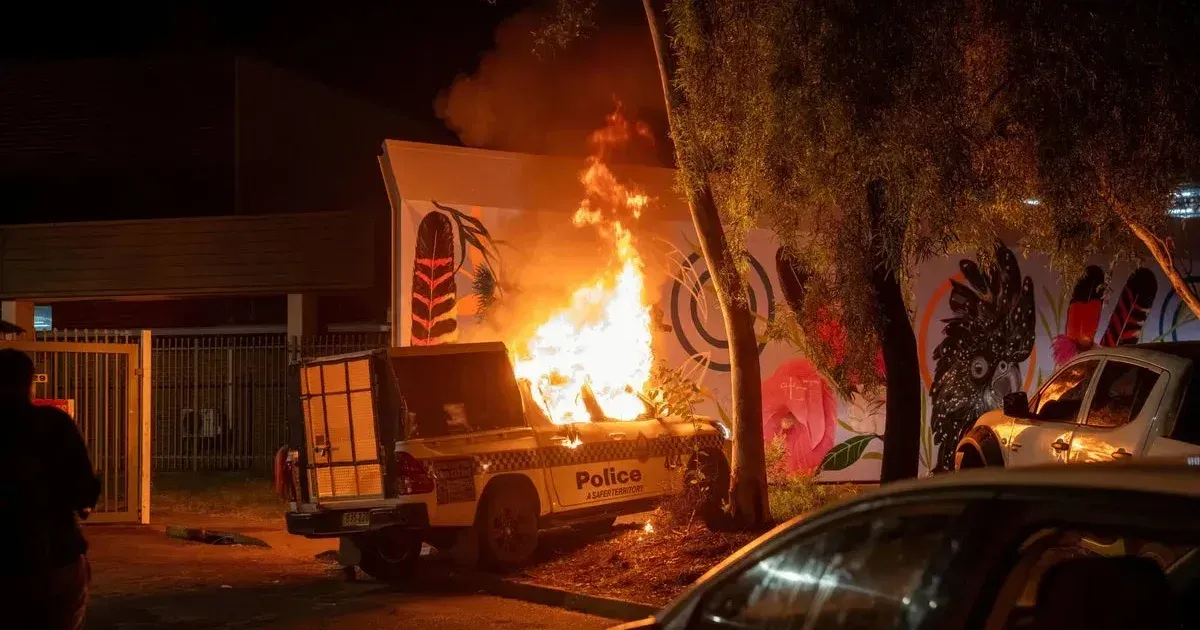
Hundreds of people converged outside the medical facility demanding that Lewis face so-called payback under customary law, a form of punishment that can include spearing or beating. The crowd damaged police vehicles and pushed against security lines as officers tried to keep the hospital operating and protect other patients inside the facility. Police fired rubber bullets and deployed tear gas to disperse the most aggressive parts of the crowd and create space around the entrance.
Video and local reporting from the scene showed projectiles thrown toward police lines, fires burning near emergency vehicles and tear gas drifting through the hospital precinct. The confrontation added pressure to medical staff and emergency crews already working under a heavy police presence. Authorities later moved Lewis away from Alice Springs to Darwin, about 1,500 kilometers to the north, for his safety and continued detention.
Lewis is expected to face charges in connection with the child's death, but officials have stressed that the allegations must proceed through the justice system. The case has touched deep grief in the Northern Territory, where cultural mourning practices mean the child is publicly referred to as Kumanjayi Little Baby rather than by her given name. That convention reflects family and community protocols around speaking about a deceased Indigenous person.
The violence also exposed the strain on public order in a town already dealing with long-running concerns over crime, policing and trust between authorities and Indigenous residents. Police commanders described the scenes as severe disorder and warned that further attacks on emergency workers or hospital property would bring arrests. Community leaders urged residents not to let anger over the child's death turn into additional harm or undermine the prosecution ahead.
By Friday, emergency services were maintaining patrols around the hospital and central Alice Springs while investigators prepared the next steps in the criminal case. Officials said the priority was to protect witnesses, medical personnel and the suspect while preserving evidence for prosecutors. The public safety operation remained focused on preventing another confrontation around Lewis's custody. Police also had to keep access routes open for ambulances, staff changes and patients with no connection to the criminal case.
Regional Stakes
The Alice Springs violence shows how quickly a criminal investigation can become a public order crisis when grief, fear and distrust converge. The killing of a child created immediate demands for justice, but the attack on Lewis and the hospital riot risk complicating the legal case that authorities now have to bring. If witnesses are intimidated, emergency workers are injured or evidence is disrupted, the community's anger could make the path to accountability harder rather than faster. The movement of Lewis to Darwin also shows that officials are treating his custody as a security issue, not just a routine detention.
For Northern Territory officials, the challenge is to separate legitimate mourning from vigilantism without appearing indifferent to the underlying loss. A visible, lawful process will matter as much as the police response on the streets. The town now needs both a credible prosecution and enough restraint to keep one death from triggering a wider cycle of renewed violence in Alice Springs.