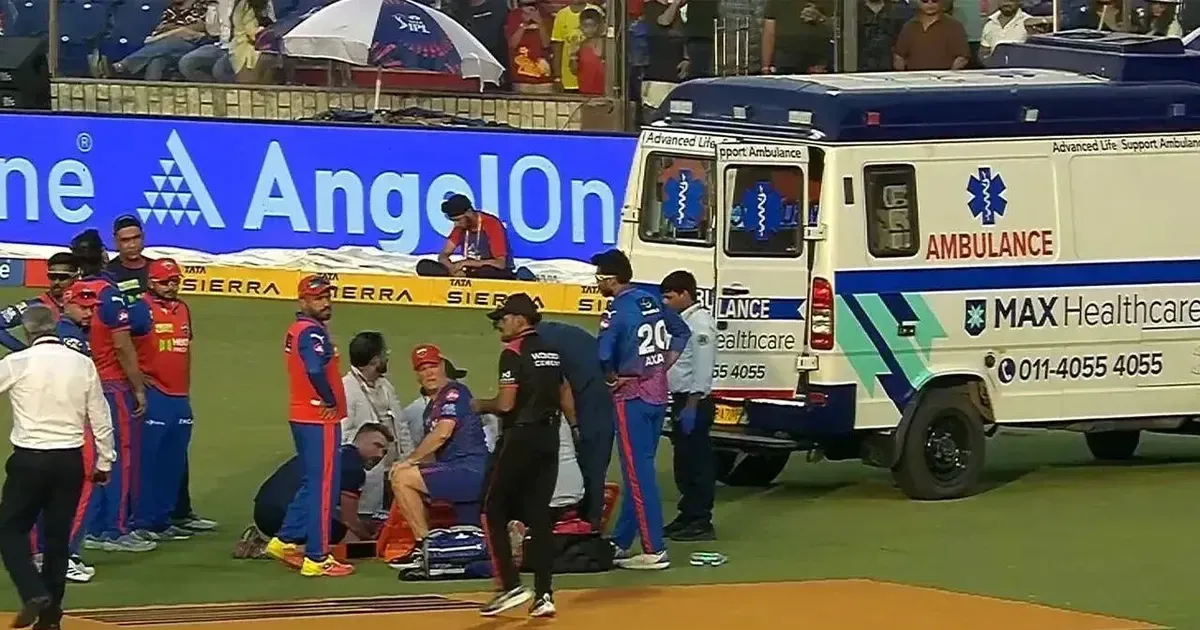
Lungi Ngidi left the field in an ambulance on April 25, 2026, after suffering a severe head injury during a match between the Delhi Capitals and Punjab Kings. Chaos gripped the stadium as players signaled frantically for the stretcher. South African pace bowler Ngidi had been attempting a difficult catch when the incident occurred, leaving teammates and opponents visibly shaken by the lack of movement from the athlete. Medical teams reached the player within seconds, but the severity of the impact required immediate evacuation to a local neurological facility.
Spectators at the Delhi Capitals home ground fell silent as the vehicle entered the playing surface. The injury took place in the third over of the Punjab Kings innings. Impact occurred when Ngidi, stationed at mid-off, tracked a high ball struck by the batsman Arya. Tracking the ball backward, the fielder appeared to lose his footing or spatial orientation, resulting in a violent landing that impacted his cranium against the turf. Early reports from the sideline indicated a loss of consciousness, though official confirmation of his status is still pending.
Mechanical Breakdown of the Ngidi Head Injury
Axar Patel delivered a full ball on the stumps that Arya slashed high toward the mid-off region. Ngidi immediately pivoted to pursue the catch, maintaining his gaze on the leather sphere as it reached its apex. Axar Patel watched from the follow-through as his teammate collapsed. Direct impact with the ground seemed to cause the most serious damage. Unlike standard collisions between players, this was a solitary accident involving gravity and the high velocity of a retreating fielder.
Medical responders used a neck brace and a spinal board before moving the pacer into the waiting ambulance. Broadcasters shifted their cameras away from the huddle of players, a standard protocol when life-threatening injuries are suspected. Delhi Capitals captain Rishabh Pant stayed close to the medical staff throughout the process, providing information on what he observed from his position behind the stumps. Teammates huddled in small groups, some covering their faces as the reality of the situation took hold.
Official match reports said the ball went high toward mid-off, where Ngidi ran back to attempt the catch.
Cricket officials now face a crisis of confidence regarding the current medical oversight. Professional leagues globally have tightened concussion protocols, yet the physical environment of the IPL often presents unique challenges. High heat, intense lighting, and the sheer speed of the T20 format increase the risk of such spatial errors. South Africa’s national team management has already requested a full briefing from the Punjab Kings medical liaison to understand the long-term implications for their premier fast bowler.
KL Rahul Sustains Scoring Pace for Punjab Kings
KL Rahul maintained his composure at the non-striker’s end throughout the lengthy delay. His performance on April 25, 2026, had been the primary narrative of the evening before the medical emergency shifted the focus. Rahul had already dispatched three boundaries in the opening two overs, demonstrating the clinical form that has defined his season. Punjab needed 180 runs to secure a victory, and their captain seemed intent on anchoring the chase with his characteristic technical precision.
Rahul’s ability to refocus after such a distressing event drew quiet praise from analysts in the commentary box. Concentration is a finite resource in elite sport, and a twenty-minute pause for an ambulance evacuation tests the mental fortitude of even the most seasoned veterans. Punjab Kings continued their innings with a somber efficiency, though the atmosphere in the stadium had fundamentally changed. Every run scored by Rahul felt secondary to the updates being circulated via mobile devices regarding Ngidi’s condition.
Delhi Capitals now must navigate a major void in their bowling attack. Ngidi has been a foundation of their powerplay strategy throughout the 2026 season. Losing a strike bowler of his caliber disrupts the tactical balance of the entire squad. Substitutions in the IPL are governed by strict regulations, and the franchise will likely need to petition the BCCI for a replacement if the injury is as career-threatening as it appeared on the field.
Delhi Capitals Face Immediate Roster Challenges
Franchise owners and coaches gathered in the dugout to discuss the immediate future of the team’s defensive line. Depth in the pace department is often the difference between a playoff spot and a mid-table finish. Delhi had invested heavily in Ngidi during the previous auction, viewing him as the perfect foil for their domestic spin talent. Without his pace and bounce, the mid-overs strategy becomes predictable for opposing batsmen who are looking to exploit the smaller boundaries of the capital city venue.
Scouting departments are already reviewing available talent in the international pool. Finding a player with Ngidi’s specific skill set mid-season is a difficult task for any management group. Most elite bowlers are already under contract or recovering from their own regional commitments. The financial implications are also large, as the insurance payouts for such injuries rarely cover the competitive loss of a marquee player. $11 billion in league valuation does not easily translate into immediate talent replacement during a crisis.
Internal discussions within the Delhi camp suggest a pivot toward a more spin-heavy attack in the coming weeks. Such a move would rely on the pitch conditions favoring slow bowlers, which is not always a guarantee in the latter half of the tournament. Coaches must decide whether to promote a domestic youngster or risk an overseas signing who has not yet acclimated to the local environment. Performance data from the training nets will likely dictate the next move for the struggling franchise.
Board of Control for Cricket in India Safety Standards
Safety advocates within the sport are calling for a review of the boundary depth and turf hardness at all IPL venues. Injuries like the one sustained by Ngidi are often worsened by the density of the soil used in the outfield. Modern stadiums prioritize fast outfields to encourage high-scoring matches, but this comes at the cost of player cushioning during falls. The balance between entertainment and athlete safety is currently skewed toward the former.
International cricketers have expressed varying levels of concern regarding the intensity of the IPL schedule. Over 70 matches are played in a condensed window, leading to mental and physical fatigue that contributes to accidents. Fatigue slows reaction times and impairs the peripheral vision required to judge high catches. While the league generates record revenue, the human cost of the spectacle is beginning to manifest in increasingly frequent medical emergencies.
Player unions may use the Ngidi incident to bargain for better health coverage and mandatory rest periods. Current contracts offer little protection for players who suffer long-term neurological damage. The precedent set by other professional contact sports suggests that litigation could be on the horizon if the league does not proactively address these vulnerabilities. For now, the cricketing world remains focused on the recovery of one of its most respected fast bowlers.
Ngidi Injury Exposes IPL’s Failure to Put Player Safety First
Questions regarding player safety usually surface only after a body hits the turf. The IPL remains a force of commercial interests where the physical well-being of the athlete is often treated as a secondary operational cost. Lungi Ngidi’s injury is a blunt indictment of an ecosystem that prioritizes the velocity of the game over the safety of the participants. While fans celebrate the athleticism of a sliding catch or a backward-running grab, the underlying risks are rarely reduced by the governing bodies. The BCCI will likely issue a sanitized press release promising a review that leads nowhere. History shows this cycle before in global sports, where the optics of concern outweigh the substance of reform. If the league truly cared about its assets, it would mandate softer outfields and more rigorous mid-season neurological screenings. They will not do this because it threatens the pace of play and the bottom line. It is a cynical calculation that assumes there will always be another young bowler ready to take the place of the fallen. Strategic failure in roster management also looms large. Delhi Capitals banked their season on a fragile pace battery, and now they are paying the price for that lack of contingency planning. KL Rahul’s Punjab Kings might have won the match, but the sport lost its dignity on April 25. Expect the league to push the narrative of Ngidi’s "bravery" to distract from the systemic neglect of player safety. The reality is far less noble. Brace for a legal battle if Ngidi's career is over.