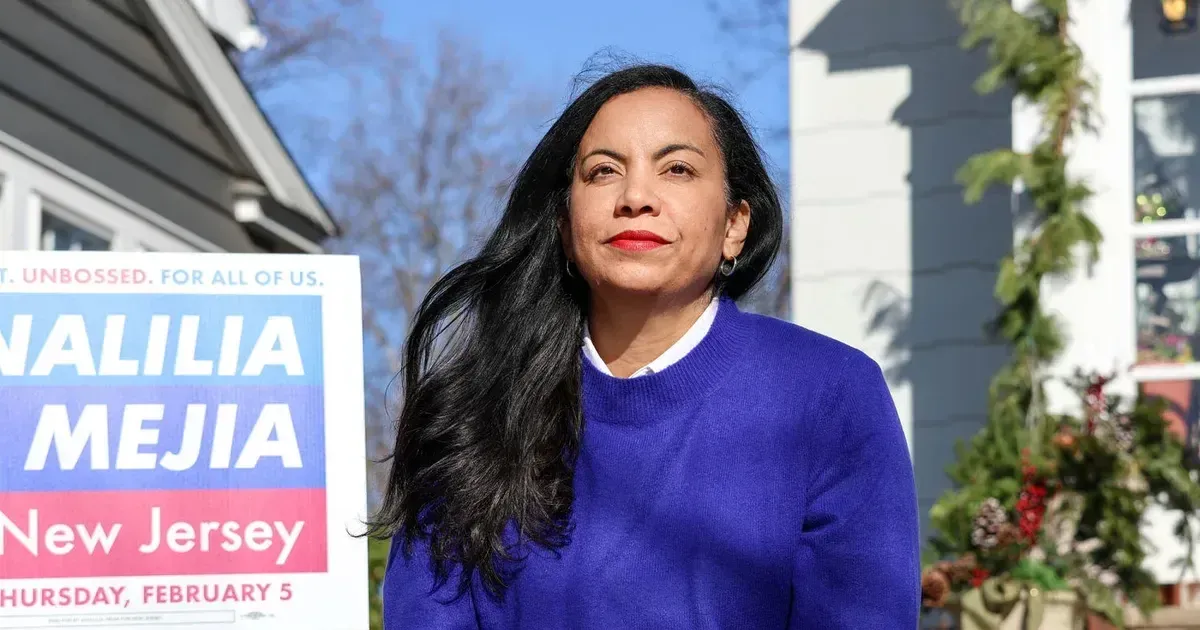
New Jersey’s special election gave progressives a concrete win in a heavily watched district. Analilia Mejia won a seat in the United States House of Representatives on April 17, 2026, as election officials in New Jersey’s 11th Congressional District confirmed her victory over Republican Joe Hathaway. Her success ensures that Democrats retain control of the suburban seat vacated by Mikie Sherrill, who resigned to serve as the governor of New Jersey. Voters in the northern New Jersey district backed Mejia, a former national political director for the 2020 presidential campaign of Senator Bernie Sanders. Returns showed Mejia leading by a wide margin shortly after polls closed at 8 p.m. Eastern Time.
Republican challenger Joe Hathaway struggled to gain traction in a district that Sherrill carried by 15 points in 2024. Despite national GOP efforts to capitalize on a thin House majority, the suburban electorate stayed firmly within the Democratic column.
Mejia Secures Progressive Foothold in New Jersey
Mejia entered the general election with serious momentum from her February primary performance. She navigated a crowded field of 11 candidates, eventually edging out former Representative Tom Malinowski. While Malinowski campaigned as a centrist capable of appealing to moderate Republicans, Mejia drew support from the progressive wing of the party. Her victory mirrors a broader national trend where left-leaning organizers have successfully challenged established moderates in blue-leaning jurisdictions. Campaign finance records indicate that Mejia relied heavily on small-dollar donations rather than corporate political action committees. This financial strategy aligned with the endorsements she received from leading figures like Senator Bernie Sanders and Representative Alexandria Ocasio-Cortez.
Voters in the 11th District, which covers parts of Morris, Essex, and Passaic counties, responded to a platform focused on economic relief and healthcare protection. Mejia often spoke about the affordability crisis facing New Jersey families during her stump speeches. Her background as a labor organizer connected in working-class pockets of the district, even as she maintained support in wealthier suburban neighborhoods. Local observers noted that Mejia effectively translated her experience as a national political director into a grassroots operation that prioritized door-to-door engagement.
Democratic National Committee Chair Ken Martin praised the result as a validation of the party’s focus on kitchen-table issues.
“I know she'll fight to lower costs, protect health care, and tackle the affordability crisis head-on,” Democratic National Committee Chair Ken Martin said.
The Republican Party viewed the NJ-11 special election as a potential opportunity to expand a fragile House majority. Joe Hathaway, the GOP nominee, attempted to frame the race as a referendum on the national economy and immigration policies. He campaigned on a platform of fiscal restraint and border security, hoping to appeal to the district’s historical Republican roots. However, the demographic shifts that have transformed northern New Jersey over the last decade favored the Democratic incumbent's successor. Hathaway faced an uphill battle in a district where Sherrill had built a powerful coalition of suburban women and college-educated professionals. Republican strategists had hoped a low-turnout special election might allow their base to outweigh the Democratic plurality.
Republican Efforts Fail in Blue Leaning District
Election results indicate that Hathaway failed to make the necessary inroads with independent voters. Mejia’s double-digit lead suggests that the suburban backlash against the current GOP platform persists in the New York City metropolitan area. National Republican groups provided limited financial support to Hathaway, perhaps sensing the difficulty of flipping a seat that has trended blue since 2018. Mejia’s win reinforces the difficulty the GOP faces in recapturing the affluent suburbs that once served as its primary power base. Data from the Associated Press showed that Mejia performed exceptionally well in the Essex County portion of the district, where turnout remained high for a special contest.
Sherrill’s departure for the governor’s mansion created a vacuum that many expected a moderate to fill. Mejia’s ascent indicates that the ideological center of the Democratic Party in New Jersey is shifting toward the left. This transformation follows the primary victory of democratic socialist Zohran Mamdani in the 2025 New York City mayoral race. Like Mamdani, Mejia successfully argued that a bold progressive agenda could win over a diverse coalition of voters. Her platform included calls for expanded social programs and aggressive climate action, positions that critics previously labeled too extreme for suburban districts.
Success in NJ-11 provides the Democratic Party with a needed boost as it prepares for the 2026 midterm elections. Mejia will serve the remaining eight months of the current term before facing voters again in November. Her presence in the House likely adds another vocal member to the progressive caucus, potentially complicating the path for leadership on bipartisan legislation. Analysts suggest that her win might embolden other progressive challengers to target moderate incumbents in upcoming primaries.
Sanders and Ocasio-Cortez Influence Shapes Outcome
National progressives view the NJ-11 result as a major win for their movement. Bernie Sanders and Alexandria Ocasio-Cortez both campaigned for Mejia, highlighting her role in the 2020 Sanders campaign. These endorsements helped Mejia consolidate the youth vote and activist energy that typically wanes during special elections. Mejia’s victory proves that the Sanders brand of politics can thrive outside of traditional urban centers. It also demonstrates that the progressive infrastructure, built over several election cycles, is now capable of winning in affluent suburban landscapes. The victory in New Jersey suggests that the influence of the party’s left flank is expanding geographically.
Establishment Democrats had initially expressed concern that Mejia’s primary win would put the seat at risk. They feared her progressive stances would alienate the moderate voters who supported Sherrill’s more centrist approach. Mejia proved these fears unfounded by maintaining a broad coalition during the general election campaign. She focused her messaging on corporate accountability and healthcare access, themes that bridged the gap between different factions of the party. Her ability to hold the district with a margin similar to Sherrill’s 15% victory in 2024 suggests that the Democratic brand in the district is resilient regardless of the candidate’s ideological leanings.
Hathaway’s campaign struggled to define Mejia as a radical in the eyes of the electorate. His attempts to link her to the most controversial aspects of the progressive agenda failed to resonate with voters who were more concerned about local economic issues. The GOP candidate’s defeat leaves the party with fewer paths to a comfortable House majority. Republicans must now reassess their strategy for the 2026 midterms, particularly in suburban districts that continue to reject their messaging. Mejia’s win is a reminder that the suburban realignment remains a meaningful hurdle for the Republican Party.
New Jersey Result Signals Progressive Strength
Do progressive victories in safe blue harbors truly indicate a national sea change, or only a local realignment of the activist class? Establishments often ignore the groundswell until the primary ballot box snaps shut. Mejia is a specific brand of politics that persists despite moderate resistance, yet her ascension proves that moderate incumbency provides no shield against a disciplined ground game. Party leaders must now calculate whether they can survive a House caucus that grows more ideological by the month. The suburban coalition built by Sherrill faces a stress test under Mejia's leadership. If the left continues to purge centrist voices, the Democratic Party risks alienating the very donor base that funded its resurgence.
Power demands pragmatism, a trait often absent in the rhetoric of the growing socialist wing. Mejia will enter a House where her ideological purity will meet the reality of a fractured legislative process. While her victory is a win for the progressive movement, it is a warning for the Democratic establishment. They can no longer assume that wealthy suburbs are the exclusive domain of the center-left. Mejia did not just win; she replaced a moderate icon with a Sanders acolyte without losing a percentage point of support. This reality should terrify every moderate Democrat sitting in a safe seat.
Ideological shifts are rarely clean. The tension between the donor class and the activist base will likely intensify as Mejia takes her seat. Her first eight months will be a performance for the national stage, aimed at proving her brand of politics is sustainable. If she fails to deliver real results for the 11th District, the primary challenge in 2026 will be swift. The voters of northern New Jersey are notoriously demanding. They have traded a centrist workhorse for a progressive firebrand. Whether they get a legislator or a professional protester is the only question that matters now. The answer will begin to emerge in November.