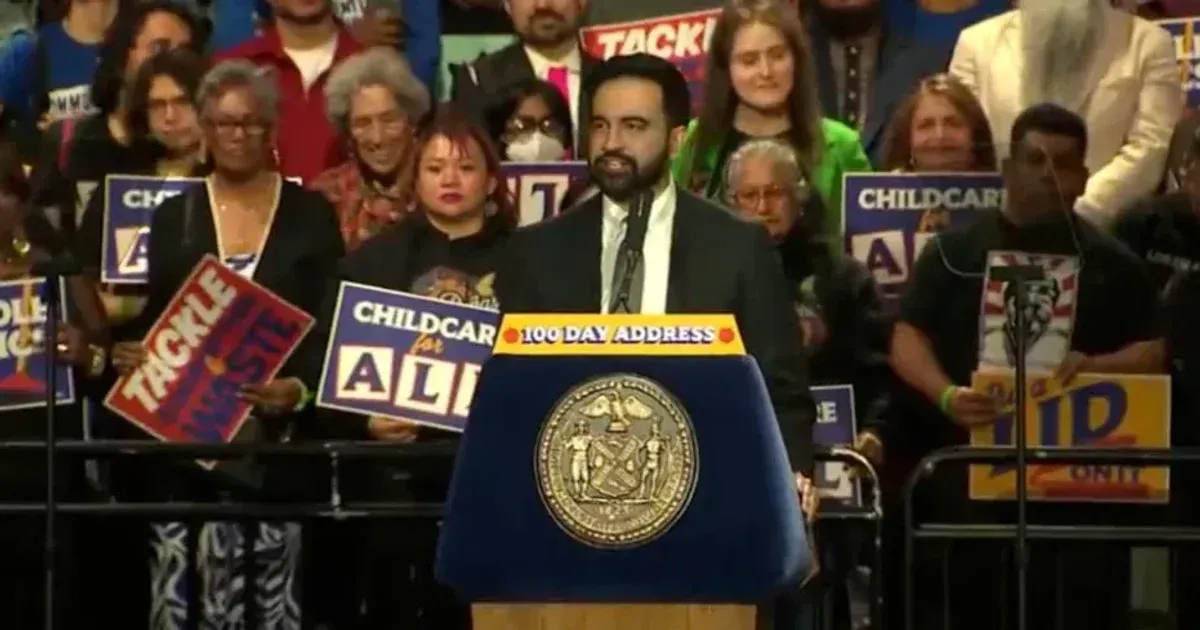
Mayor Zohran Mamdani used his first 100 days to frame New York City as a test case for democratic socialist local government. Critics in the real estate and retail sectors contend that the mayor is overextending the municipal budget. Joined by Senator Bernie Sanders on April 13, 2026, he pointed to child care funding, public grocery plans and landlord enforcement as proof that City Hall can intervene directly in household costs. Municipal spending has increased to accommodate new investments in sanitation and aging infrastructure. Mamdani, however, framed these costs as necessary corrections for years of private-sector neglect. He explicitly addressed ideological opposition by referencing Margaret Thatcher and her critique that socialists eventually run out of other people's money. Mamdani argued that the current economic environment requires a socialist to clean up the mess left by previous administrations. Sanders echoed this sentiment by noting that Mamdani is the first mayor to introduce him by speaking proudly about democratic socialism. Their alliance is a shift in the political alignment of the Democratic Party in the largest city in the United States.
Public Grocery Plan Tests the Market
Addressing rising food costs stands at the center of the mayoral agenda for the next four years. Mamdani proposed opening five publicly owned and affordable grocery stores by the end of his first term. One location will be established in each of the five boroughs. The first of these state-run markets is scheduled to open in 2027.
Business advocacy groups argue that these stores will create unfair competition for private retailers who operate on thin margins. The mayor countered that private markets have failed to provide affordable options in specific neighborhoods. He maintains that government intervention is the only way to ensure food security for low-income residents. Sanders called the New York experiment an inspiration for the national progressive movement.
Operational details for these stores remain under development by the city government. Questions persist regarding whether the city will manage the supply chains directly or contract with existing wholesalers. The administration has not yet released a full fiscal impact report for the grocery store initiative.
Child Care Funding and Budget Strain
Universal child care became the most immediate policy achievement for the new administration. Mamdani fulfilled his campaign promise to fund the program by his eighth day in office. The $1.2 billion investment aims to provide free care for every child in the city regardless of the immigration status of the parents. Mamdani and Representative Alexandria Ocasio-Cortez have actively encouraged undocumented families to enroll their children in these pre-K programs.
Opponents of the program point to the potential disruption of the private daycare market. Many small businesses in the sector fear they cannot compete with a free government service. There are also concerns that the heavy taxation required to sustain the program will drive high-income residents out of the city. Mamdani has dismissed these fears by arguing that a well-funded social safety net attracts talent and stabilizes the workforce.
“This is the first time I was ever introduced by someone who talked proudly about democratic socialism,” Sanders said. “And it feels great.”
Budget analysts note that the child care program relies on projected tax revenues that may fluctuate with the national economy. If tax receipts fall, the city may face difficult choices between cutting services or increasing the debt load. Mamdani has prioritized these social services over the traditional fiscal conservatism favored by his predecessors.
Real estate interests have become a primary target for the mayor's legal team. Mamdani announced that his administration is pursuing aggressive legal action against landlords accused of neglecting maintenance or violating rent regulations. This strategy marks a departure from the mediation-heavy approach of previous City Hall occupants. The mayor has signaled that his office will use every available municipal power to protect tenants from displacement.
Landlord associations claim that the mayor is scapegoating property owners for a housing shortage caused by restrictive zoning and high construction costs. They argue that increased litigation will discourage investment in the housing stock. Mamdani has countered by increasing the budget for housing inspectors and legal aid for tenants. He believes that the city must take an adversarial role against what he describes as predatory real estate practices.
Infrastructure and sanitation have also received significant increases in the most recent budget cycle. The city has increased the frequency of trash collection and accelerated the timeline for subway station accessibility projects. These investments are funded through a combination of city revenue and state grants. Mamdani views these services as fundamental rights rather than negotiable budget items.
Fiscal Risk Behind the Socialist Agenda
Mamdani is gambling with the credit rating of a city that cannot print its own currency. By leaning into the socialist label and prioritizing billion-dollar social mandates in his first 100 days, he has set a course that assumes perpetual revenue growth or a radical shift in the tax base. The alignment with Sanders is more than a political photo opportunity. It is a signal to the financial markets that the pro-business era of Michael Bloomberg and Eric Adams is over.
History suggests that municipal socialism faces its greatest test during the inevitable credit cycle downturn. When tax receipts from the financial sector inevitably dip, Mamdani will be forced to choose between his ideological commitments and the harsh reality of municipal insolvency. The decision to exclude immigration status from child care eligibility is a particularly bold move that challenges federal norms and invites a showdown with national political figures. This administration is operating on the belief that the government can replace the market as the primary provider of essential services without triggering an exodus of capital. Whether the bond markets tolerate this remains the central question for the 2027 fiscal year. The era of the activist city is here.