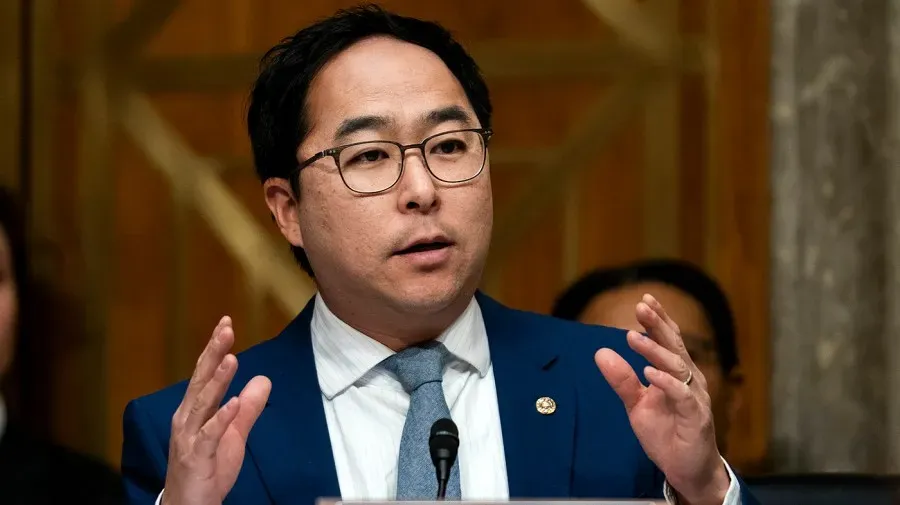
Senator Andy Kim urged House leaders to take up the Senate's Department of Homeland Security funding bill after weeks of airport disruption, unpaid TSA work and political deadlock over immigration enforcement. The New Jersey Democrat argued that Congress already had a workable off-ramp: a Senate-approved measure funding most of DHS, including the Transportation Security Administration, while leaving the most contentious ICE and border-policy fight outside the immediate airport crisis.
The dispute had moved beyond Capitol Hill procedure. TSA officers were working through missed paychecks, airport lines were lengthening in major hubs and travelers were being pulled into a shutdown they did not cause. Kim's central point was practical: if the House allowed a vote on the Senate bill, enough lawmakers were likely to support reopening critical homeland security functions.
The Senate Bill Split The Fight
The Senate's late-March measure passed by voice vote and funded most of DHS during a partial shutdown that had stretched since mid-February. Its political weakness was also its practical appeal. It did not resolve the full immigration-enforcement fight. It reopened the agencies where public harm had become immediate while leaving ICE and parts of border enforcement for another vehicle.
Democrats wanted limits and accountability measures tied to immigration enforcement after enforcement controversies. Republicans wanted a broader DHS package that kept ICE and CBP inside the same funding structure. The Senate bill separated the urgent payroll problem from the larger ideological fight. House Republican leaders rejected that separation at first, and the shutdown continued.
TSA Pay Made The House Delay Visible
TSA officers became the face of the standoff because they were essential enough to be required at work but not protected from the pay disruption created by the appropriations lapse. The longer the shutdown ran, the more airport staffing became a daily public measure of congressional failure. Absences, resignations and morale problems did what procedural speeches could not: they made the budget fight visible at security checkpoints.
Kim's pressure carried particular weight. New Jersey travelers rely heavily on Newark Liberty International Airport and the wider New York-area aviation network. A national TSA disruption lands quickly in that region through long lines, missed flights and staffing strain. For a New Jersey senator, the shutdown was not an abstract committee dispute. It was an operations problem affecting constituents in real time.
ICE Deployments Changed The Symbolism
The administration's decision to send ICE personnel to airports sharpened the argument. Supporters framed it as continuity planning while TSA staffing was strained. Critics saw a deeper distortion: immigration-enforcement officers being inserted into civilian airport spaces because Congress had failed to pay the people trained for passenger screening.
ICE agents are federal law-enforcement officers, but they are not a substitute for TSA's screening workforce. They may assist with support tasks, visibility or crowd management. They cannot erase the specialized work of checkpoint screening, baggage inspection and passenger flow. The deployment therefore became a symbol of Washington's workaround habit: avoid the payroll solution, then improvise around the damage.
Five Weeks Became The Indictment
Kim later said, "Five weeks."
When the House eventually passed the Senate bill weeks later, Kim's criticism sharpened. The basic legislative path had existed before the damage fully accumulated. What delayed it was not the absence of a vehicle, but the decision to use homeland security funding as leverage in a wider battle over immigration power.
That timing made the eventual resolution look less like a breakthrough than a belated admission. If the same bill could pass after weeks of disruption, then the lost time belonged in the accountability ledger. TSA workers, airport passengers and other DHS employees had absorbed the cost of a political delay that Congress already knew how to end.
Shutdowns Are Bad Security Policy
Critical staffing budgets should not be hostage to unresolved enforcement fights. Congress can debate ICE authority, border funding and civil-liberties limits directly. But when that fight stops TSA officers from being paid, the public pays through weaker airport operations and a more chaotic travel system. A budget standoff becomes a security experiment.
The Senate bill did not settle every policy dispute, and it was not designed to. It was a pressure valve for a department whose unfunded pieces were already bending. Kim was right to frame the House vote as a choice. The longer House leaders waited, the more normal it became to patch a broken TSA payroll system with emergency orders and non-TSA personnel. Security agencies become less accountable when Congress turns funding into brinkmanship and then asks the executive branch to improvise around the mess.