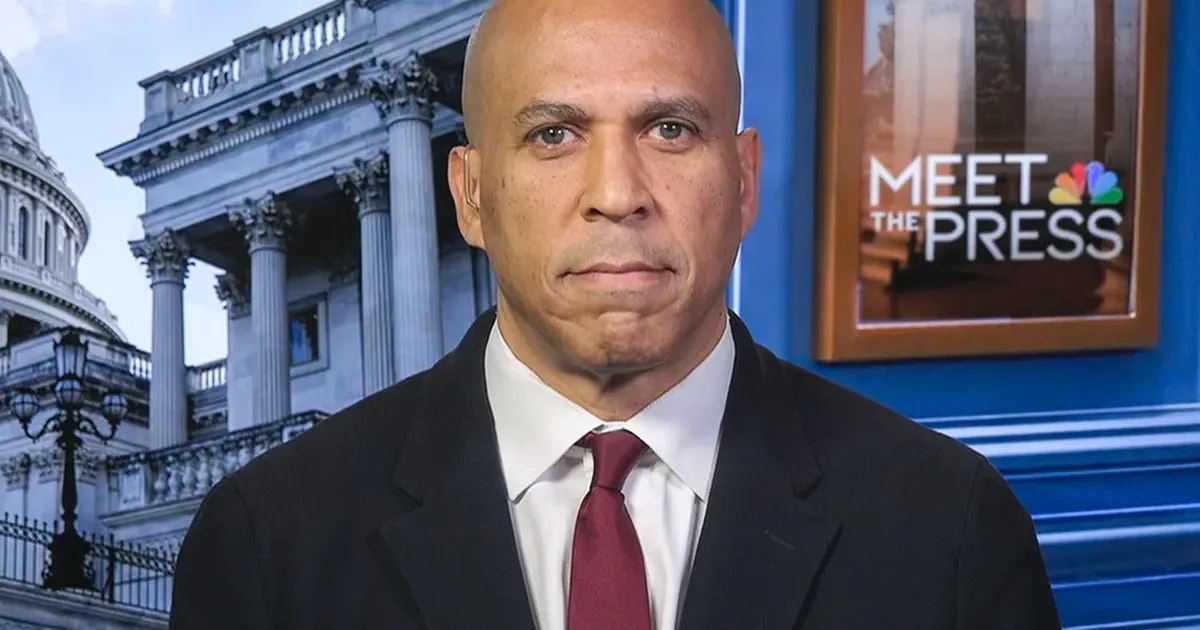
Senator Cory Booker did not announce a 2028 presidential campaign on Meet the Press. He did something more careful: he refused to close the door while reminding viewers that he is running for another Senate term in New Jersey in 2026.
The New Jersey Democrat told Kristen Welker that another White House bid remains possible, but he framed the immediate obligation around his state. That balance is the whole story. Booker wants to remain visible in the next Democratic presidential conversation without making his Senate reelection look like a waiting room for national ambition.
The Answer Was Designed To Travel
Booker has already run once. His 2020 campaign leaned on unity, empathy and moral repair, then ended before the early contests could turn that message into delegates. In 2026, he is speaking from a different position: a senior senator, a former presidential candidate, a newly married public figure and one of the Democrats trying to define what comes after the party's Trump-era defensive posture.
Booker said he was "definitely not ruling it out."
That answer kept donors, activists and reporters listening. It also avoided the arrogance of treating a New Jersey Senate seat as already settled. Booker said he hoped voters would support him for another six years. The phrasing preserved his state-level obligation because a national run would be less credible if it looked detached from the state that keeps giving him the platform.
His Party Critique Was The Real Signal
The 2028 line drew attention, but Booker's more pointed move was his criticism of the Democratic Party. He said the party had failed the moment, called for generational renewal and argued that Democrats had built too small a coalition for challenges such as Trump administration policy, artificial intelligence and economic disruption.
That language was not neutral self-help rhetoric. It put Booker inside a larger fight over Democratic leadership, Chuck Schumer's future, progressive frustration and the party's habit of defining itself around opposition to Trump. Booker was not presenting himself only as a friendly senator who might run again. He was suggesting that the party needs a different emotional and strategic register.
The Senate Record Cuts Both Ways
Booker's clearest national case still starts with the Senate. Criminal justice reform remains part of his identity, and his work on food, agriculture and corporate concentration gives him a route into economic populism that is less familiar than his older language of compassion. His 25-hour-and-five-minute Senate speech against Trump administration policies also helped revive the idea that he can hold a national stage alone.
But the Senate is a difficult launchpad. Votes become attack ads. Compromises become purity-test evidence. Speeches can show stamina and conviction, but they do not prove executive control. Governors in a 2028 field can point to budgets, emergencies, agencies and concrete state-level fights. Booker would have to make legislative work feel like power rather than process.
New Jersey Comes First Or The Pitch Weakens
The 2026 race is not a procedural step. It is the test that comes before any presidential calculation. If Booker wins convincingly while showing visible attention to New Jersey, he can argue that national ambition grows from local trust. If the Senate campaign feels secondary, Republican opponents and Democratic skeptics will have an easy line: he is asking voters for six years while looking two years ahead.
His marriage to Alexis Lewis also entered the NBC interview, giving the exchange a familiar campaign texture. Family support, future strain and public reassurance are part of presidential politics. But biography will not decide whether Democrats want him. The bigger issue is whether Booker can connect his personal optimism to a theory of governing power.
Admiration Is Not A Nomination
Booker remains one of the party's better-known communicators. He can talk about faith, race, democracy, food systems, policing and technology without sounding trapped in one ideological lane. That range is valuable in a crowded Democratic field.
His problem is that many Democrats admire him without having chosen him when they had the chance. A second campaign would need to explain what has changed since 2020: the country, the party, the candidate, or all three. It would also need a more specific economic story and a clearer argument for how Democrats should use power when institutions are under pressure.
Leaving the door open was easy. The demanding work is making the door matter. Booker can still be a serious 2028 figure, but only if his Senate race, party critique and national message start sounding like one argument rather than three separate ambitions.