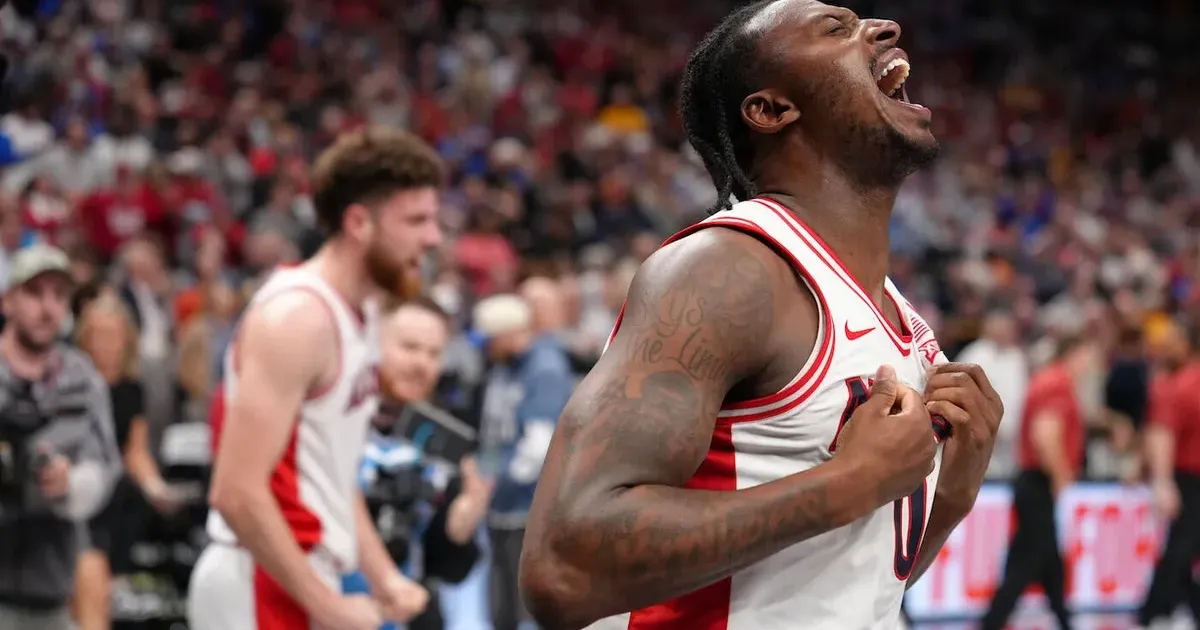
Kansas City fell into a momentary, deafening silence Friday night before the floor itself seemed to vibrate under the pressure of 19,000 screaming fans. Arizona Wildcats guard Jaden Bradley crossed half-court with 4.2 seconds remaining, his eyes locked on the rim while the LED-infused glass floor beneath him pulsed with a digital countdown. He pulled up from the right elbow, a contested jumper that hung in the air long enough to feel like an eternity for the Cyclone faithful. The ball rattled around the cylinder, caught the glass, and dropped through as the backboard glowed crimson.
Arizona survived a grueling Big 12 semifinal showdown, defeating Iowa State in a finish that instantly redefined the 2026 postseason narrative. The victory propels the Wildcats into their first conference championship game since joining the league, a transition that many analysts predicted would be fraught with physical hurdles. Iowa State defenders stood in a state of paralysis, staring at the basket as the Arizona bench emptied onto the court. This victory secured a top-two seed for the Wildcats in the upcoming national tournament.
Arizona found rhythm early through high-post entries, testing a Cyclone defense that led the nation in turnovers forced during the regular season. But Iowa State responded with a 12-2 run in the second half, fueled by transition buckets and a raucous traveling fan base that turned the T-Mobile Center into a midwestern outpost for Ames. The lead changed hands 14 times in the final ten minutes alone.
Jaden Bradley and the Final Possession
Bradley finished with 22 points, but none were more significant than the final two delivered as the clock expired. His ability to handle the pick-and-roll against a blitzing Iowa State scheme allowed Arizona to stay within striking distance despite 15 team turnovers. Arizona coach Tommy Lloyd opted not to call a timeout after the Cyclones took a one-point lead on the previous possession. He trusted his veteran guard to make a play in the open floor.
The ball dropped.
Iowa State coaches had prepared for a drive to the basket, yet Bradley chose the mid-range pull-up, a shot that modern analytics often discourages but postseason pressure frequently demands. Statistics from the 2026 season show that Bradley shot 44 percent from that specific area on the floor. His footwork remained precise even as two defenders closed the gap. The game ended with a 78-77 scoreline that mirrored the parity seen across the conference all year.
Iowa State Defensive Pressure and Tactical Standoff
Cyclones head coach T.J. Otzelberger utilized a defensive rotation that squeezed the Wildcats for much of the evening. They denied the entry pass to the block, forcing Arizona to play a perimeter-heavy game that initially favored the Iowa State backcourt. Tamin Lipsey provided the offensive spark for the Cyclones, tallying 18 points and 8 assists while directing a half-court offense that maximized every possession.
Still, the physicality of the Big 12 tournament took its toll on the Iowa State frontcourt in the waning minutes. Foul trouble limited their ability to contest shots without yielding free throw opportunities. Arizona capitalized by attacking the rim in the bonus, drawing 24 fouls over the course of 40 minutes. The officials allowed a high level of contact, a common characteristic of postseason play in this particular league.
"After three days of talk about a light-up glass court, the league got back to basics and was rewarded with an instant epic Friday night," according to CBS Sports.
Iowa State fans left the arena in a stunned silence that contrasted sharply with their pre-game energy. Their team held a three-point lead with less than a minute remaining, but a missed front end of a one-and-one free throw opened the door for Arizona. Success in March often hinges on these microscopic failures. The Cyclones now await their seeding, likely remaining a lock for a top-four spot despite the heartbreaking loss.
Big 12 Tournament Technology and Market Impact
Tournament organizers introduced a high-tech LED glass court this year, a move intended to blend entertainment with athletic performance. Sensors embedded in the glass track player movement in real time, projecting advanced metrics directly onto the playing surface for the live audience. While some traditionalists expressed skepticism, the visual data provided a clear picture of how much ground Jaden Bradley covered during his game-winning sprint.
Networks reported record-breaking viewership for the semifinal round, citing the matchup between two top-ten programs as a primary driver. The Big 12 has aggressively marketed itself as the deepest basketball conference in the country since absorbing four former Pac-12 members. Advertisers paid a premium for 30-second spots during the final four minutes of the broadcast. In fact, internal league data suggests this game outperformed the previous year's final in total household reach.
Commercial interests have heavily influenced the tournament atmosphere in Kansas City. The integration of betting odds on the LED floor caused a stir among some integrity advocates, though the league maintains all regulations are being followed. This technological push aims to attract younger viewers who are accustomed to data-rich sports consumption. The glass surface also provides better grip than traditional hardwood, according to equipment managers on site.
Arizona Transition to the Big 12 Conference
Arizona entered the league with a reputation for high-octane offense and West Coast flair. Critics wondered if they could handle the defensive grinders typical of the Midwest, but the Wildcats have adapted by increasing their emphasis on rebounding and interior toughness. They out-rebounded the Cyclones 38 to 31, a margin that proved decisive in a one-point game.
Wildcats fans traveled in significant numbers, filling the bars around the Power and Light District and challenging the local dominance of Big 12 mainstays. The cultural shift for the program has been swift. They have traded late-night tip-offs in the desert for high-stakes battles in the American heartland. Arizona has won 28 games this season, including five against ranked opponents in their new conference home.
Preparation for the championship game begins immediately, with the Wildcats facing a quick turnaround before Saturday night. The training staff focused on recovery protocols involving cryotherapy and hydration to combat the fatigue of a physical semifinal. Depth will be the deciding factor in the final round. Arizona utilized nine players in the rotation against Iowa State, keeping their primary scorers fresh for the closing stretch.
The Elite Tribune Perspective
Empty spectacles usually define modern college athletics, but Friday night offered a rare reprieve from the gimmickry of the new Big 12 era. Commissioner Brett Yormark spent millions on a light-up glass floor that at bottom functions as a giant billboard, yet the athletes on the court rendered the flashing lights irrelevant. Jaden Bradley did not care about the LED countdown pulsing beneath his sneakers, and the fans in the rafters were not looking at the real-time betting odds projected on the baseline. They were watching a pure display of competitive will that no amount of Silicon Valley hardware can replicate.
The irony is that the league spent years trying to manufacture "moments" through tech and branding, only to have the most authentic result come from a standard mid-range jumper. Arizona proved they belong in this conference by winning a game that felt like a street fight rather than a digital exhibition. If the Big 12 wants to be the premier basketball brand, it needs to stop hiding the product behind neon distractions and let the quality of play speak for itself. The glass court is a toy, but the rivalry between these programs is real.
This game was a win for the sport, but a loss for those who think basketball needs a motherboard to stay relevant.