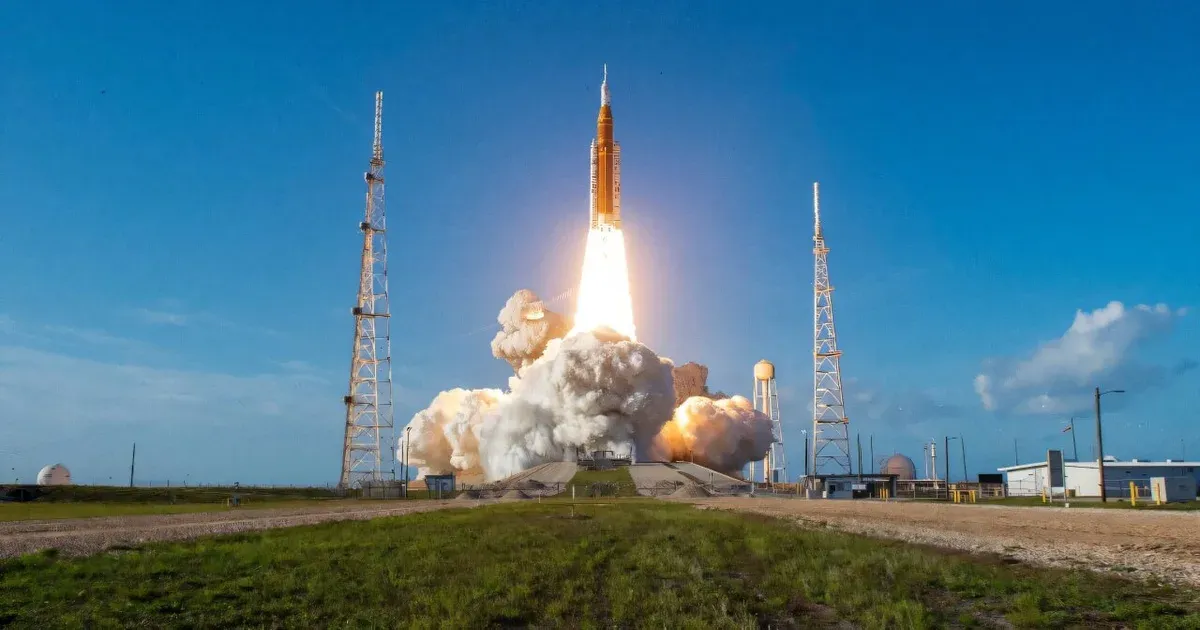
NASA technicians monitored the Orion spacecraft on April 2, 2026, during the first crewed lunar mission in half a century. While the primary propulsion systems performed as expected, the four-person crew encountered immediate challenges with the onboard life support hardware. Flight controllers in Houston worked through the night to address a malfunction in the waste management system that complicated the initial transit phase. Artemis II is a departure from the automated testing of its predecessor, placing human lives at the center of a complex deep-space trajectory.

Commander Gregory Reid Wiseman led the team consisting of Victor Glover, Christina Koch, and Jeremy Hansen into a high Earth orbit to verify system integrity before committing to the lunar injection. Initial telemetry indicated the NASA Space Launch System performed flawlessly during the ascent from Kennedy Space Center. Solid rocket boosters provided the necessary thrust to escape the atmosphere before the core stage separated. Friction between the mission timeline and hardware reliability appeared early when the crew reported issues with the urine collection assembly.

Waste management failures in a cramped capsule present more than an inconvenience for the astronauts. Reliability of these systems is a requirement for the duration of the 10 days required to complete the loop around the moon. Engineers noted that a valve in the system failed to actuate properly, requiring the crew to use backup collection methods while a permanent fix was discussed. This specific technical hiccup highlights the difficulties of maintaining human habitability in a vacuum where every liter of fluid must be carefully managed. Failure to resolve the issue would not jeopardize the return flight, but it would sharply degrade crew comfort and health protocols.

Artemis II Waste Management System Malfunctions

Spacecraft plumbing remains one of the most difficult engineering hurdles for long-duration spaceflight. Documentation from previous missions indicates that liquid waste processing requires constant pressure differentials that are difficult to maintain in microgravity. The NASA Orion capsule uses a universal waste management system designed to be more compact than those used on the International Space Station. Reports from the capsule on Wednesday suggested a blockage or mechanical failure inhibited the system's ability to process liquid waste efficiently. Astronauts reported the problem shortly after the first sleep period ended.

Ground teams at the Johnson Space Center spent several hours simulating the failure in a high-fidelity mockup to provide the crew with troubleshooting steps. Success in deep space often depends on the ability of the crew to perform manual repairs on hardware designed for automation. Wiseman and his crew used a series of bypass valves to maintain partial functionality. While the primary toilet remained partially operational, the incident forced a shift in the daily schedule. Priorities moved from scientific observation to hardware maintenance during the critical transit period.

Historical data from the Apollo era shows that similar issues plagued earlier explorers, often leading to contamination within the cabin. Modern systems are designed to be closed-loop, yet the complexity of these machines introduces new points of failure. Engineers believe the specific malfunction originated in the separator pump. This pump is responsible for pulling air and liquid apart in a weightless environment. Without it, the system cannot function without risking leaks into the electronics bays. Constant monitoring of the cabin atmosphere became a secondary priority to ensure no particulates escaped the containment unit.

European Space Agency Opens NASA Contract Talks

Geopolitical shifts in space exploration emerged simultaneously with the technical reports. Josef Aschbacher, head of the European Space Agency, indicated that his organization is now seeking a more leading role in future missions. European contributions currently center on the service module, which provides power and propulsion for the Orion spacecraft. A revamp of the American lunar program has prompted European officials to reassess their investment and demand higher-level participation in landing attempts. Success for the current flyby provides the leverage Europe needs to secure these seats.

The European Space Agency will negotiate future participation in NASA missions after the US space agency revamped its lunar program.

Negotiations will likely focus on the Lunar Gateway, a planned space station that will orbit the moon. European nations provide the habitation and refueling modules for this station, giving them meaningful bargaining power. Aschbacher noted that the current mission proves the viability of international hardware in the harshest environments. While the United States provides the primary launch vehicle, the success of the mission depends entirely on the European-built service module. These interdependencies define the current landscape of lunar exploration.

Financial commitments from ESA member states have increased by several billion euros over the last budget cycle. This funding supports the development of the Argonaut lunar lander, which Europe hopes will eventually carry its own astronauts to the surface. Pressure from China and its international partners has accelerated the timeline for these negotiations. NASA officials expressed a willingness to discuss future manifest changes, provided that the Artemis II mission concludes without a major safety incident. The outcome of these talks will determine who walk on the moon by the end of the decade.

Orion Spacecraft Technical Specifications and Performance

Performance metrics for the Orion spacecraft indicate that the thermal protection system and radiation shielding are functioning within the expected margins. The spacecraft must endure extreme temperature fluctuations as it moves from the sunlight into the moon's shadow. Solar arrays mounted on the service module have successfully tracked the sun, maintaining a full charge on the internal batteries. Communication with the Deep Space Network persisted despite the distance, allowing for real-time video downlinks of the crew. These technical successes outweigh the minor setbacks encountered in the cabin.

Radiological sensors aboard the craft are monitoring the crew's exposure as they pass through the Van Allen radiation belts. Data are critical for planning the longer-duration Artemis III and IV missions. Thick shielding in the Orion walls protects the astronauts from solar particle events. During the transit, the crew conducted experiments on how radiation affects biological samples in deep space. Results from these tests will inform the design of future lunar habitats. Despite the hardware issues, the scientific objectives of the mission stay on track.

Propulsion systems used the European service module engines to execute the final burn for the lunar trajectory. The burn placed the craft on a free-return path, meaning that Earth's gravity will naturally pull the capsule back even if the main engine fails. Precision in this maneuver was absolute, with less than a 0.5% margin for error. Fuel reserves stay high, providing the mission directors with options for trajectory corrections if the waste management issues worsen. Reliability in the propulsion sector provides a necessary buffer for the failures in the life support sector.

Logistics of the First Lunar Flyby Since Apollo

Mission logistics for a crewed flyby require a global network of tracking stations and recovery assets. The $4.1 billion cost of the launch covers not only the hardware but also the thousands of personnel involved in the flight. US Navy ships are already moving toward the predicted splashdown coordinates in the Pacific Ocean. Weather patterns are being monitored to ensure a safe recovery of the Orion capsule. A flyby mission lacks the complexity of a landing, but it carries higher risks during the high-speed re-entry phase.

Food supplies and oxygen reserves were calculated to last 14 days, providing a four-day cushion for emergencies. The crew follows a strict exercise regimen to combat the muscle atrophy associated with microgravity. Maintaining morale is a logistical priority for the flight surgeons on the ground. Communication sessions with family members provide a psychological anchor for the crew as they move further from Earth. Every kilogram of weight on the spacecraft was debated during the design phase to maximize the efficiency of the SLS rocket.

Navigational updates are beamed to the capsule every six hours to account for gravitational perturbations from the sun and Earth. The free-return trajectory is a classic maneuver that relies on the physics of orbital mechanics. It eliminates the need for a second engine burn to return home, making it the safest option for a first crewed test. Scientists expect the crew to reach the far side of the moon within the next 48 hours. Once there, they will be out of contact with Earth for several minutes as they pass behind the lunar disk.

The Elite Tribune Strategic Analysis

Washington maintains a monopoly on lunar prestige while expecting its allies to provide the plumbing. The current tension between NASA and the European Space Agency is not merely a budgetary dispute but a fundamental struggle over the future of planetary sovereignty. While the American space agency relies on the European Service Module to keep its astronauts alive, it continues to hoard the coveted lunar landing slots for its own domestic pilots. The transactional relationship is beginning to fray as Europe recognizes its own essential role in the Artemis architecture. The waste management failure on Artemis II is a convenient metaphor for the messy reality of these partnerships.

Europe has outgrown its role as a junior contractor. By leveraging the current technical hiccups and the success of their hardware, ESA officials are effectively holding the future of the Lunar Gateway hostage. They know that without European modules, the American dream of a permanent lunar presence evaporates. NASA's revamped program, which required these new negotiations, proves that the US cannot go it alone. The geopolitical center of gravity in space is shifting toward a more balanced, albeit more disputed, international coalition. If NASA refuses to concede landing spots, it risks a splintering of the alliance in favor of independent European or even Chinese-aligned programs. The moon is no longer an American playground. It is a contested marketplace.

Future missions will depend on these diplomatic breakthroughs as much as they do on rocket science. NASA must choose between total control and total success. The current path is unsustainable. NASA pays twice if it loses its allies.