Reid Wiseman and his three fellow crew members arrived at the Kennedy Space Center on March 27, 2026, to begin final preparations for the first human voyage to the moon in more than fifty years. NASA officials confirmed that the four-person team landed at the Florida facility just five days before their scheduled lift-off on April 1. Commander Wiseman, Pilot Victor Glover, and Mission Specialists Christina Koch and Jeremy Hansen will spend the remaining time in pre-flight quarantine and final technical rehearsals. Their arrival at the landing strip near the huge Vehicle Assembly Building signals the conclusion of years of intensive training across several continents. Preparations now shift toward the final countdown sequence for the Space Launch System rocket.
Flight operations for this mission require the crew to reside in the Neil A. Armstrong Operations and Checkout Building. This facility houses the crew quarters and the specialized suit-up room where the astronauts will don their gear on launch day. Engineers spent months testing the environmental control systems inside the Orion spacecraft to ensure human life can be sustained during the ten-day voyage. Success depends on the flawless execution of thousands of individual procedures that start the moment the crew arrives on site. Staff at the space center have transitioned to a twenty-four-hour work cycle to monitor every telemetry point from the launch pad.
Orion Spacecraft Systems and Crew Survival Gear
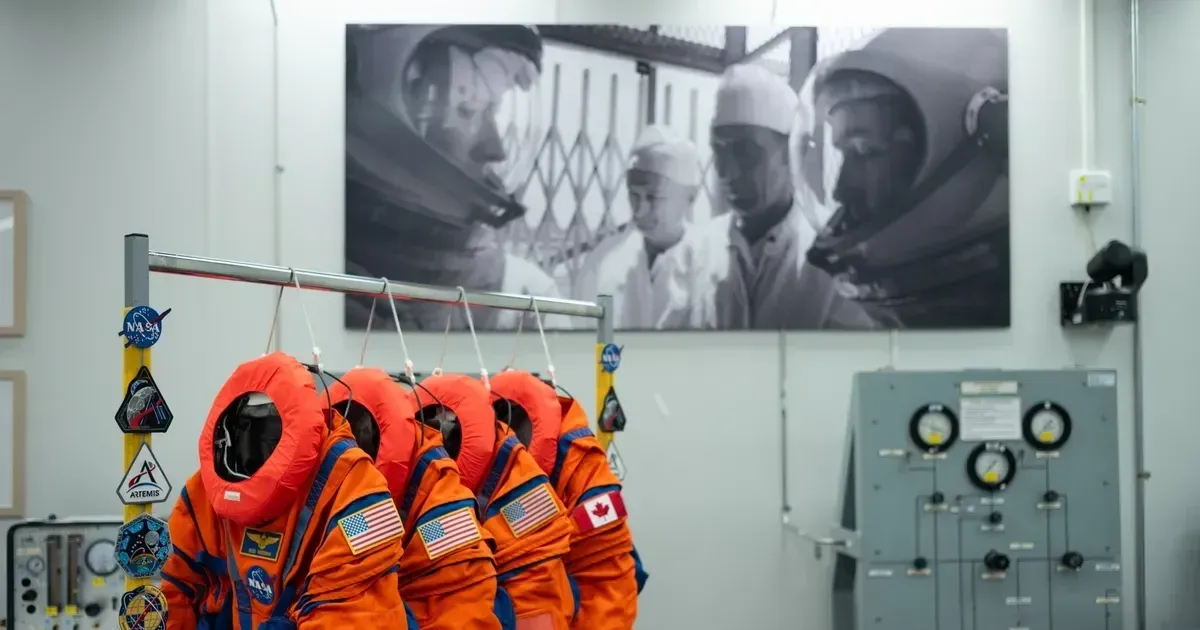
Four Orion Crew Survival System suits currently wait in the sterile suit-up room for their final pressure checks. These bright orange garments provide a self-contained atmosphere for the astronauts during the high-risk phases of launch and re-entry. NASA designed these suits to sustain life for up to six days if the capsule suffers a cabin depressurization event. Each suit features updated communications hardware and thermal management layers that did not exist during the Apollo missions of the previous century. Mission specialists Christina Koch and Jeremy Hansen will use these systems to monitor cabin health while Wiseman and Glover manage the flight path. Technical manuals for the suits emphasize the integration between the garment and the seat cooling systems.
Setting that aside, the Canadian Space Agency is a critical partner in this mission through the inclusion of Hansen. He is the first non-American to depart Earth’s orbit for deep space. Canada secured this seat by providing the sophisticated robotic arms used on the International Space Station and committing to the future Lunar Gateway project. Hansen participated in survival training alongside his American counterparts to prepare for a potential splashdown in the Pacific Ocean. His presence highlights the international coalition required to sustain modern deep-space exploration. The flight is a validation of the Artemis Accords, which govern peaceful cooperation in lunar space.
But the focus remains on the hardware currently perched on Launch Pad 39B. The Space Launch System, or SLS, is the tallest and most powerful rocket ever successfully integrated by NASA. Its core stage holds more than 700,000 gallons of super-cooled liquid oxygen and liquid hydrogen. Two solid rocket boosters flanking the core stage will provide the bulk of the 8.8 million pounds of thrust required to escape Earth’s gravity. Technicians performed a final “wet dress rehearsal” earlier this year to verify that the propellant lines do not leak under cryogenic loads.
Scientific Objectives Beyond the Lunar Far Side
Artemis II will follow a hybrid free-return path that uses the moon’s gravity to pull the spacecraft back toward Earth. This flight path will take the crew approximately 4,600 miles beyond the far side of the moon. No human has ever traveled that far from our home planet. While the Apollo missions stayed closer to the lunar surface, the Artemis II path focuses on testing the high-speed re-entry capabilities of the Orion heat shield. This shield must withstand temperatures of nearly 5,000 degrees Fahrenheit when it hits the atmosphere at 25,000 miles per hour. Data gathered from sensors embedded in the shield will dictate the safety parameters for the subsequent Artemis III lunar landing.
Through Artemis, NASA will send astronauts to explore the Moon for scientific discovery, economic benefits, and to build the foundation for the first crewed missions to Mars.
Scientific American reports that the mission duration will last exactly ten days. During the first twenty-four hours, the crew will remain in a high Earth orbit to check the life support systems before committing to the lunar injection burn. The phase allows the mission control team in Houston to abort the flight and return the crew safely if any malfunctions appear in the Orion service module. Once the crew sparks the second stage for the moon, they are committed to a full loop around the lunar body. Every kilogram of weight on the spacecraft was calculated to balance fuel efficiency with the necessity of carrying food and water for four people.
Meanwhile, the mission goals extend beyond mere survival. The astronauts will conduct a series of proximity operations tests shortly after reaching orbit. They will use the Orion spacecraft to approach the jettisoned upper stage of the SLS rocket to simulate docking maneuvers. These maneuvers are essential for future missions that will require Orion to dock with the Lunar Gateway or a SpaceX Starship landing craft. Victor Glover will handle the manual piloting during these tests to evaluate the responsiveness of the spacecraft’s thrusters. Controllers want to know how the vehicle handles when it is fully loaded with a crew of four.
Kennedy Space Center Prepares for SLS Ignition
Security at the Kennedy Space Center has reached its highest level in decades. Thousands of guests and hundreds of journalists are expected to gather at the various viewing sites across Cape Canaveral. Crowds are already beginning to form along the Banana River and the local beaches. Law enforcement agencies from the local and federal levels have coordinated an enormous exclusion zone around the launch complex. The security perimeter ensures that no unauthorized aircraft or sea vessels interfere with the flight path of the SLS. The sheer acoustic energy of the launch requires a wide safety radius to protect both personnel and the surrounding wildlife refuge.
For instance, the sound suppression system at Pad 39B will dump 450,000 gallons of water onto the launch platform in just thirty seconds. The water prevents the acoustic shockwaves from the rocket engines from reflecting back and damaging the vehicle. Engineers at the launch site have spent the last forty-eight hours verifying the pump pressures and the integrity of the water tanks. Any failure in this system could result in a catastrophic loss of the mission before the rocket clears the tower. Pre-flight checks also include the emergency egress system, which consists of large baskets on cables designed to whisk the crew away from the pad in the event of a fire.
On closer inspection, the financial stakes for this launch are nearly as high as the human ones. Estimates suggest that NASA has spent more than $40 billion on the development of the SLS and Orion systems alone. A successful mission would justify the vast taxpayer investment and solidify the schedule for a crewed lunar landing in late 2027. By contrast, a sizable delay or failure would likely trigger congressional investigations and a re-evaluation of the entire Artemis program. The agency has bet its future on the success of this specific flight profile. Each component of the rocket was manufactured in a different state to ensure broad political support for the funding.
Quarantine rules for the astronauts remain absolute to prevent any illness from compromising the mission. Doctors monitor the crew’s health and diet with military precision during these final five days. Access to the crew quarters is restricted to a small number of essential personnel who have also undergone medical screening. The isolation period is a tradition that dates back to the earliest days of the Mercury program. It ensures that the astronauts do not bring any terrestrial viruses into the confined environment of the spacecraft. The team will have one final opportunity to speak with their families via a glass partition before they board the Astrovan for the trip to the launch pad.
And yet, the mood at the space center is one of focused determination rather than celebration. Staff members are keenly aware that Artemis II is a test flight, not a routine mission. Every previous flight of the SLS was uncrewed, meaning this is the first time the life support systems will be tested in a deep-space environment. Reliability of the carbon dioxide scrubbers and the waste management system is a primary concern for the medical team. If these systems fail, the mission will become a struggle for survival rather than a scientific triumph. Technicians completed the final fuel line inspections on the mobile launcher platform earlier this morning.
The Elite Tribune Perspective
Questioning the enormous price tag of human lunar exploration usually invites accusations of luddism, yet the financial reality of the Artemis program demands such scrutiny. We are looking at a projected cost of nearly $100 billion by the time a human boot touches lunar dust again, a figure that seems disconnected from the current economic pressures facing the average taxpayer. While the spectacle of the SLS ignition provides a needed boost to national prestige, one must wonder if we are merely repeating the 1960s at five times the cost.
Robotic missions have proven they can conduct sophisticated mineralogy and mapping for a fraction of the price. The insistence on sending humans is less about science and more about a geopolitical race to claim the high ground of the lunar south pole before our adversaries do. If NASA wants to maintain public support, it must prove that the lunar economy is more than a slide in a PowerPoint presentation. The moon cannot simply be an expensive bus stop on a hypothetical road to Mars.
It must provide real returns in energy, resources, or defense that justify the risk of four lives and the depletion of the national treasury. Anything less is just a very expensive circle in the sky.