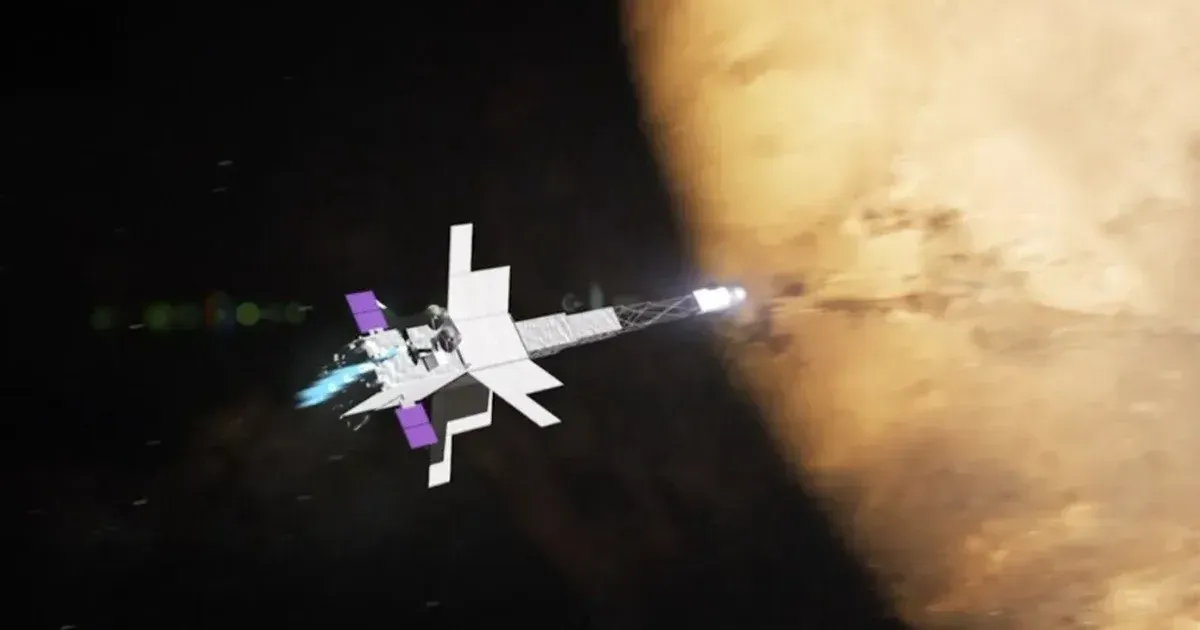
NASA's push toward nuclear-powered spacecraft is moving from theory into mission planning as the agency studies faster routes to Mars and steadier power for a future lunar base. The engineering question is no longer abstract. The program was discussed publicly on March 27, 2026, with officials presenting nuclear propulsion as one answer to the limits of chemical rockets.
Propulsion systems used in the past relied on radioisotope thermoelectric generators which differ from modern fission goals. Voyager probes used these generators to convert the heat from decaying plutonium-238 into electricity for on-board instruments. Those systems do not provide enough power for propulsion. Modern fission reactors generate heat through a chain reaction of splitting atoms to drive an engine. Current designs for these interplanetary vessels remain in the testing phase. NASA engineers believe that doubling the speed of deep space transit will reduce the time astronauts spend exposed to cosmic radiation. Thermal output remains the primary hurdle.
Nuclear Electric Propulsion and Deep Space Efficiency
Nuclear electric propulsion systems vary from the thermal rockets tested during the Cold War era. Thermal rockets heat a propellant directly in a reactor core before exhausting it through a nozzle. By contrast, the electric version uses the reactor as a power plant for an ion drive. Efficiency gains from this approach allow for larger payloads and more sophisticated life-support systems. Experts at NASA indicate that this hardware is essential for any realistic mission to the Red Planet. Current chemical rockets require six to nine months for a one-way trip. Shortening this window to three months could prevent irreversible bone density loss in the crew. Fuel weight remains a secondary constraint.
Safety protocols for these reactors involve keeping the core dormant until the craft reaches a high-Earth orbit. This ensures that any launch failure would not result in radioactive material dispersing into the atmosphere. Once active, the reactor provides a constant stream of energy for years without refueling. Spacecraft designers must still account for the vast heat radiators required to shed excess thermal energy in a vacuum. The biggest aerospace contractors are competing for these development grants. The agency has focused on cooling technology over raw thrust. Shielding the crew from the reactor itself requires heavy lead or polymer barriers.
Astronaut Health Risks in Lunar Colony Missions
Lunar colony construction scheduled for the mid-2030s introduces biological variables that remain largely theoretical. NASA and private partners like Elon Musk intend to establish a permanent presence on the moon within the next decade. Such an environment exposes human bodies to one-sixth gravity and high-energy solar particles for years. Recent studies on the International Space Station provide some data, but the moon lacks the protective magnetosphere of Earth. Medical experts worry about the long-term impact on the central nervous system. Prolonged radiation exposure might induce cognitive decline or early-onset cataracts. Research facilities on the lunar surface will serve as laboratories for these observations.
Space exploration at this scale forces a shift in how the agency views its personnel. Long-duration missions will require crews to endure conditions that cannot be fully simulated on Earth. According to Live Science, the reality of these missions means that individuals will take on roles beyond just pilots or scientists. They will function as the primary data points for a new field of space medicine. Risks include everything from muscle atrophy to the psychological strain of isolation. The drive toward colonization persists among the scientific community. Finding solutions to these problems is a requirement for any permanent settlement. Doctors monitor these changes in real-time.
Building a lunar colony within the next decade, as NASA and Elon Musk want to, will require finding solutions to problems we don't yet fully understand.
Spacefarers participating in these initial landings will effectively serve as clinical subjects. Detailed monitoring of their blood chemistry and genetic expressions will occur daily. The first generation of lunar residents will also be research participants, with medical monitoring built into the mission design. This categorization reflects the high degree of uncertainty regarding human survivability on the moon. Critics argue that the ethical framework for such missions requires more transparency. The Artemis program continues to push forward with its scheduled launches. Every mission profile includes a dedicated medical officer. Supplies of shielding material are limited.
SpaceX Partnership and Rapid Moon Base Development
Commercial partnerships involve SpaceX providing the heavy lift capacity needed for lunar infrastructure. Starship remains the primary vehicle for transporting the modules required for a sustainable base. Yet, the rapid pace of development favored by private companies sometimes clashes with the cautious approach of government regulators. Safety standards for commercial lunar landers are still being codified. Elon Musk has stated that his goal is to make life multi-planetary as quickly as possible. The urgency drives the engineering teams at Starbase to iterate on designs at a speed that often outpaces federal oversight. Redundancy systems are a major point of contention.
Collaborative efforts between the public and private sectors have already lowered the cost per kilogram of cargo. Still, the human cost of a potential failure on the moon is much higher than a cargo loss. Communication delays between Earth and the moon add another layer of complexity to emergency responses. Bases must be entirely self-sufficient for weeks at a time. The development of lunar water ice extraction is still a top priority for fuel production. Without local resources, a colony cannot survive long-term. Transporting water from Earth is prohibitively expensive. Oxygen generation plants are currently under construction.
Future missions will rely on a combination of nuclear power and solar arrays. Nuclear reactors provide the necessary baseline power for the long lunar night when solar panels are useless. Each night lasts for approximately fourteen Earth days. Without a consistent power source, the heating systems would fail, leading to the destruction of sensitive electronics. Engineers are testing small fission reactors known as Kilopower units for that purpose. These units are compact enough to be deployed by a single robotic rover. The integration of these reactors into a living space requires extensive safety buffers. Soil shielding is the current solution.
Those constraints make the safety rules as important as the engine design. A faster spacecraft does not help astronauts if heat, shielding, and medical monitoring lag behind propulsion ambition.