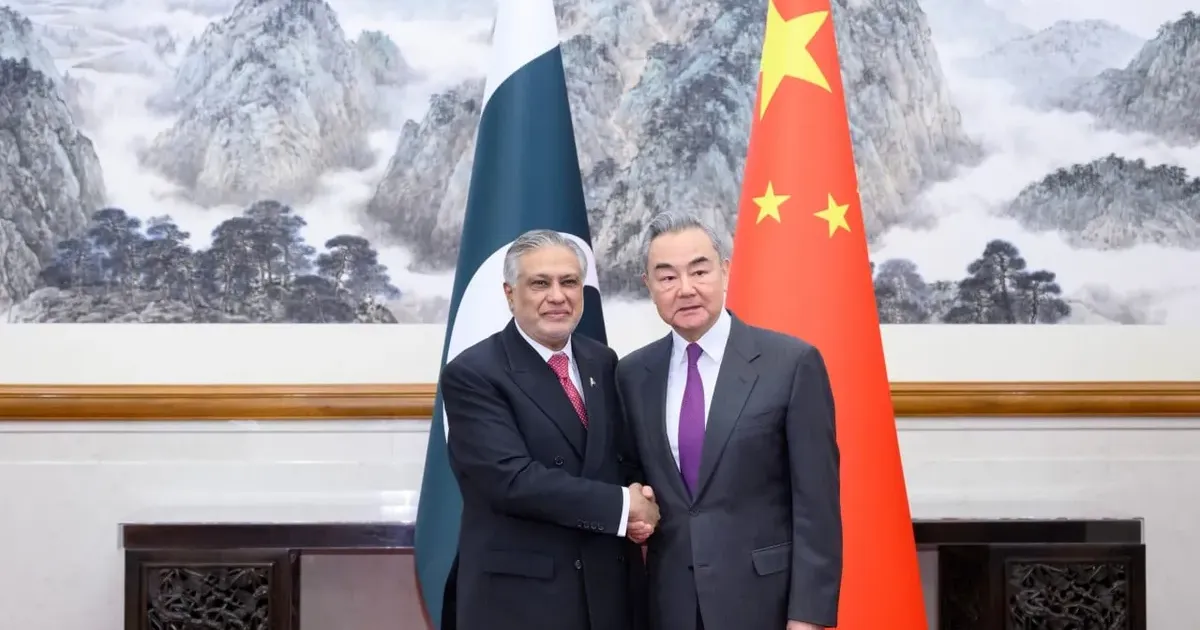
Pakistan Deputy Prime Minister Ishaq Dar arrived in Beijing to finalize a coordinated diplomatic strategy focused on the escalating conflict between the United States and Iran. This high-level delegation highlights the intensifying collaboration between Islamabad and Beijing as regional stability deteriorates. Dar began his second official visit to the Chinese capital in three months by meeting with Foreign Minister Wang Yi to align their mediation positions.
Reports from the Pakistani Ministry of Foreign Affairs indicate that the two sides intend to present a unified front to the international community. By March 31, 2026, Beijing’s pledge had become part of a wider bid to shape regional diplomacy. High-level discussions on Friday preceded this trip, establishing the framework for what both nations describe as a necessary intervention to prevent total regional war.
Diplomatic channels in Beijing emphasize that the relationship between China and Pakistan has entered a phase of intensified strategic coordination. Wang Yi confirmed his government would support Pakistan in its role as a primary mediator between Washington and Tehran. Because of the logistical and political proximity of Islamabad to the conflict zone, Chinese officials view the Pakistani government as an essential bridge. The current itinerary for Dar includes multiple sessions with senior members of the Communist Party of China. Beijing continues to classify Pakistan as an all-weather strategic cooperative partner. This designation reflects an enduring security and economic alignment that has survived multiple global shifts.
Beijing Coordinates with Islamabad on Peace Strategy
Officials from the Chinese Foreign Ministry expressed a firm commitment to enhancing strategic coordination on the Iran crisis during Dar’s arrival. Earlier communications between the two foreign ministers on Friday set the stage for these formal negotiations. Islamabad has become a central hub for shuttle diplomacy, seeking to prevent further military escalation in the Persian Gulf. Chinese leadership, meanwhile, is seeking to leverage its economic influences over Tehran to enable these discussions. Information from the meeting suggests that both countries are concerned about the security of regional infrastructure projects. The delegation from Islamabad includes senior security advisors and economic experts.
China describes Pakistan as an all-weather strategic cooperative partner and supports its unique role in promoting regional peace and stability.
Foreign Ministry spokesperson statements emphasize that China intends to maintain a posture of constructive involvement. While the United States has maintained a policy of maximum pressure, Beijing is advocating for a return to formal negotiations. Data from recent diplomatic cables suggests that the Chinese government believes a Pakistan-led mediation effort offers the most viable path toward a ceasefire. Previous attempts at third-party mediation by European powers have largely stalled over the last six months. So, the focus has shifted toward regional actors who maintain credible ties with both the Iranian leadership and Western capitals. Dar is scheduled to remain in the city for three days of intensive talks.
Domestic Propaganda Frames Regional Conflict for China
Chinese state media entities have simultaneously launched a full narrative campaign to frame the Middle East conflict for their domestic audience. One specific video produced using generative artificial intelligence features a Persian cat representing Iran and an eagle representing the United States. Television broadcasts in Beijing depict the war as a stylized martial arts fantasy, removing much of the visceral reality of the kinetic strikes. Domestic audiences are encouraged to view China as a stabilizing force standing against Western aggression. Analysts monitoring Chinese social media platforms like Weibo report that these videos have accumulated millions of views within 48 hours. The content frequently emphasizes the superiority of Chinese diplomatic philosophy over Western military interventionism.
Propaganda efforts extend beyond short-form videos to include lengthy editorials in state-run newspapers. These publications consistently argue that the United States is the primary instigator of regional instability. One recent article in the Global Times suggested that Washington seeks to disrupt the energy supplies of its global competitors. Narratives regarding the Iran crisis are carefully curated to ensure they align with broader nationalistic goals. Public opinion in mainland China largely reflects this state-sponsored messaging, with many citizens expressing support for the Pakistan-led peace initiative. State broadcasters have devoted meaningful airtime to Dar’s arrival to reinforce the image of a powerful, cooperative bloc.
Global Economic Realities Force Chinese Diplomatic Shifts
Energy security persists as a primary driver of Chinese involvement in the mediation process. Crude oil imports from Iran reached a three-year high in early 2026, making the stability of the Strait of Hormuz a matter of national survival for Beijing. Disruptions to shipping lanes would immediately impact Chinese industrial centers along the eastern seaboard. Because of these economic vulnerabilities, the Chinese government is eager to see a de-escalation that protects maritime trade. Financial analysts in Hong Kong suggest that a prolonged war could shave 1.5 percent off Chinese GDP growth for the fiscal year. These economic pressures provide a powerful incentive for the strategic coordination discussed during Dar's visit.
Investments in the China-Pakistan Economic Corridor also face serious risks from regional instability. Project managers for major infrastructure works in Balochistan have expressed concerns about the potential for spillover violence. Security for these projects relies on the stability of the broader Iranian-Pakistani border region. Beijing has invested over $60 billion into various Pakistani projects over the last decade. A destabilized Iran could lead to an influx of refugees or an increase in cross-border militant activity, threatening these multi-billion dollar assets. Chinese contractors have already increased security protocols at several key sites near the Arabian Sea.
Pakistan also gives China a stage where security diplomacy, trade interests and border stability overlap.
That makes the pledge useful even if the immediate peace effort remains uncertain.
China’s Mediation Calculation
China’s pledge gives Pakistan diplomatic backing while allowing Beijing to present itself as a stabilizing power. That image is useful as the United States remains absorbed by other crises and regional actors seek alternative channels.
The risk is that mediation raises expectations Beijing may not want to enforce. Strategic support is easier to announce than to convert into durable restraint among rivals with their own security pressures.