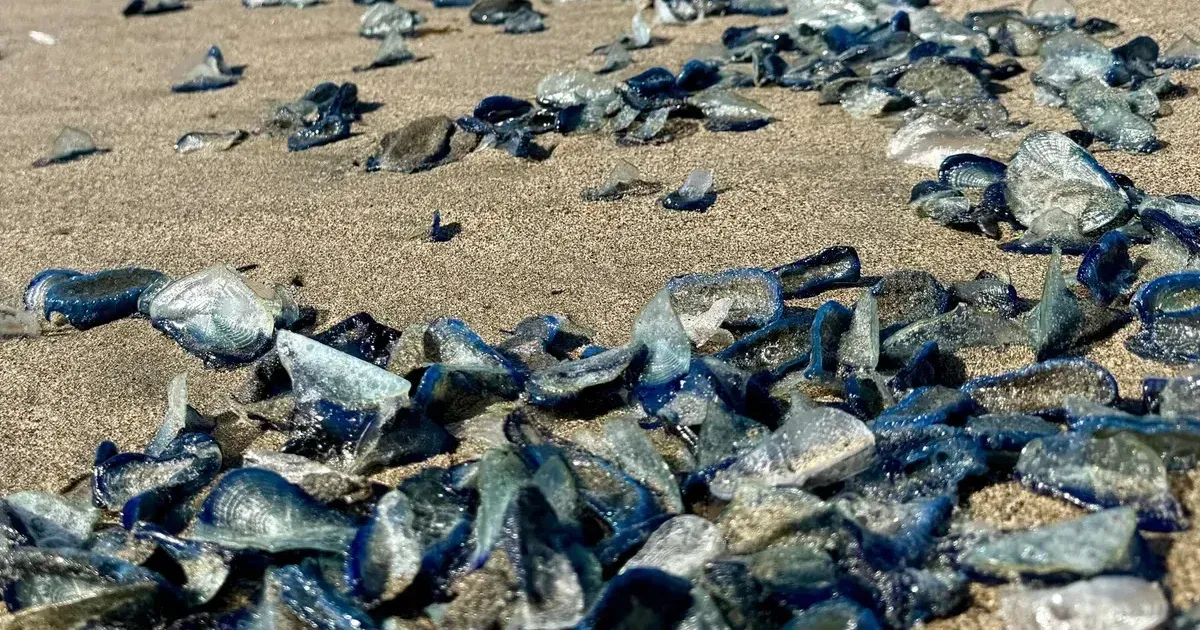
California coastlines became the landing site for thousands of blue marine organisms known as by-the-wind sailors this week. Reports circulated on May 3, 2026, across multiple counties as strong spring winds pushed the creatures toward the shore. Residents from Monterey Bay to San Francisco reported seeing vast carpets of the cobalt-blue organisms lining the high-tide marks.
Marine biologists identify these creatures as Velella velella, a species of hydrozoan that lives on the surface of the open ocean. Coastal visitors reported seeing the first clusters near Monterey Bay. These organisms are not single animals but colonial hydroids, consisting of a flat, oval float and a stiff, triangular sail. While they resemble jellyfish, they are more closely related to the Portuguese man-o-war. Each colony stays afloat using a gas-filled chamber that allows it to drift across the Pacific.
Intense blue pigmentation protects these creatures from the sun's ultraviolet rays while they inhabit the ocean surface. Each organism possesses a specialized sail made of chitin, a durable, leathery material. Scientists categorize these organisms as hydrozoans rather than true jellyfish. The orientation of the sail determines which direction the creature travels relative to the wind. Most colonies in the North Pacific have sails tilted to the right, which usually keeps them offshore during normal weather patterns. By contrast, a minority of colonies possess left-leaning sails, providing a biological insurance policy for the species across different wind regimes.
What By-the-Wind Sailors Are
Experts note that Velella velella lack any independent means of propulsion. These sails are rigid structures that catch the breeze, making the creatures entirely dependent on atmospheric currents. Most colonies spend their lives in the central Pacific gyre, where they feed on microscopic plankton and fish eggs. They use tiny tentacles that hang below the float to capture prey. Unlike their more dangerous relatives, by-the-wind sailors do not possess a sting powerful enough to penetrate human skin, though experts advise against touching eyes or mouths after handling them.
Winds blowing from the northwest normally push these right-handed sailors away from the California coast. Stronger gusts or shifts in the North Pacific High can alter this trajectory, forcing the colonies toward the land. Once the wind pushes them into the surf zone, the colonies lose their ability to stay upright and eventually wash onto the sand. This specific stranding event reflects a recent shift in regional wind patterns along the California coast.
Records show that these mass strandings tend to occur in cycles, often appearing during the spring and summer months. Weather patterns involving the transition from winter storms to spring westerlies frequently create the conditions necessary for these invasions. Although these events seem sudden, they represent the final stage of a journey that began hundreds of miles out at sea. The 2026 event matches the scale of previous sightings recorded in 2014 and 2023.
Atmospheric Drivers of Mass Strandings
Warm water anomalies in the Pacific often correlate with larger populations of by-the-wind sailors. High-pressure systems over the ocean can compress the habitat of these organisms, making them more susceptible to onshore winds. When these conditions align, the result is an extensive influx that can cover miles of shoreline. Once stranded, the blue color fades as the organisms dehydrate, eventually leaving behind translucent, plastic-like skeletons. The sheer volume of organic matter can create a distinct odor as the colonies decompose in the sun.
Shorebirds often avoid eating the stranded sailors because of their low nutritional value and leathery texture. Local officials in beach communities have no plans to remove the organisms, as they are part of a natural cycle that provides nutrients back to the coastal ecosystem. Nature dictates that the skeletons will eventually break down or be pulled back out to sea by high tides. The presence of these creatures is an indicator of the complex interaction between the atmosphere and the surface of the Pacific Ocean. Monitoring these strandings helps researchers understand the movement of surface currents and the health of the open-ocean food web.
Beachgoers should expect more arrivals if the current wind direction persists through the weekend. Cleaning crews have focused on maintaining access to main walkways while leaving the tide lines undisturbed. The biological phenomenon will likely conclude once the offshore wind patterns return to their seasonal norms. Each skeleton left behind shows how completely these small surface organisms depend on wind.