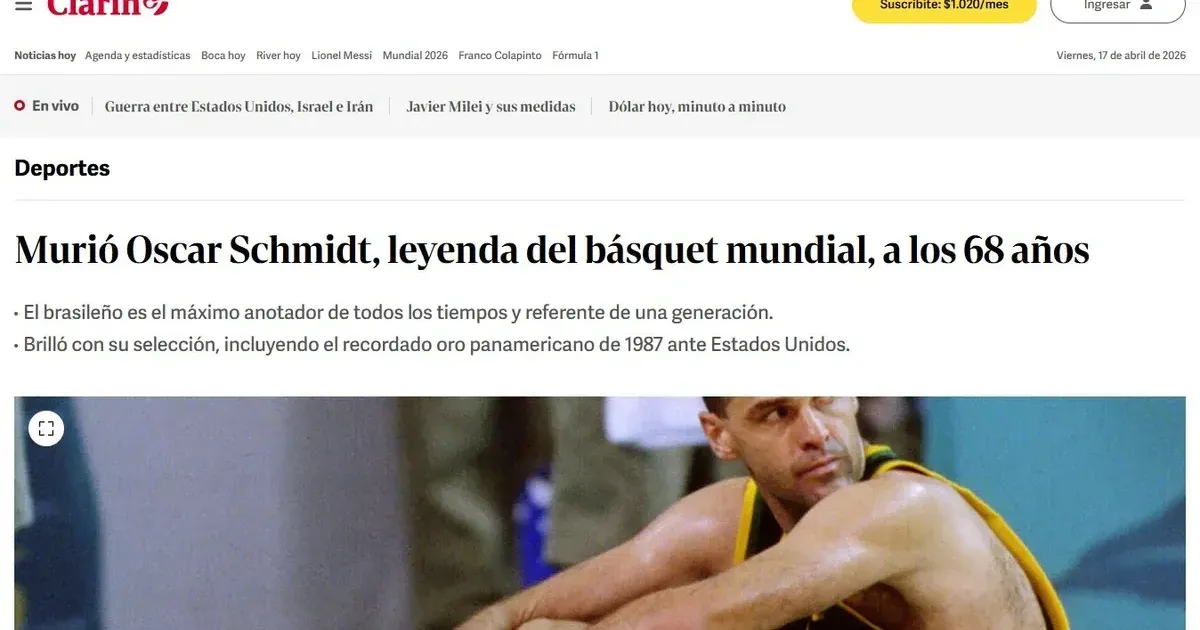
Oscar Schmidt's death prompted a wider reassessment of international basketball history. The Brazilian icon's legacy stretches beyond records into national sports memory. Oscar Schmidt, the prolific Brazilian scorer who defined international basketball for two decades, died on April 17, 2026, following a fifteen-year medical struggle against a brain tumor. Known globally by the moniker Mão Santa, or Holy Hand, the 6-foot-8-inch forward passed away surrounded by relatives who characterized his final years as a display of immense personal resilience. News of his death instantly connected across the sporting world, drawing tributes from former rivals and teammates who viewed him as an unstoppable force on the hardwood.
Family members released a statement on April 17, 2026, confirming that Schmidt had faced his illness with the same determination he once brought to the Olympic arena. He left behind a legacy defined by a singular choice: the refusal to play in the NBA to preserve his eligibility for the Brazilian national team. Such loyalty to the yellow and green jersey transformed him into a national icon, a status rarely afforded to athletes outside the area of professional soccer in South America.
Indianapolis Victory and the 1987 Pan American Games
Brazil achieved its greatest basketball milestone under the leadership of Oscar Schmidt during the 1987 Pan American Games held in Indianapolis. Facing a heavily favored United States roster on their home soil, the Brazilian squad staged a second-half comeback that remains a cornerstone of international basketball history. Schmidt exploded for 46 points, masterfully using the three-point line to dismantle a defense that had rarely encountered such a specialist. The final score of 120-115 marked the first time a U.S. men's team had ever lost a home tournament, shattering the aura of invincibility surrounding American amateur basketball.
International media outlets, including the Argentine daily Clarín, highlighted this specific victory as the moment Schmidt cemented his status as a global phenomenon. His performance in Indiana changed the tactical approach of coaches worldwide who had previously viewed the three-point shot as a desperate secondary option. Instead, Schmidt proved that high-volume perimeter shooting could serve as a primary offensive engine. This tactical shift predated the modern NBA era by nearly three decades.
Refusing to sign with the New Jersey Nets despite being drafted in 1984 allowed him to continue representing Brazil at a time when NBA players were barred from Olympic competition. He saw the national team as his ultimate responsibility.
Olympic Records and Global Recognition
Five Olympic appearances established Oscar Schmidt as the most prolific scorer in the history of the Games. He accumulated 1,093 points across his Olympic career, a record that has stood against the efforts of generations of NBA superstars. His ability to score from any position on the court made him a defensive nightmare for international opponents who lacked the length or speed to contest his high-release jumper. Despite the lack of an Olympic medal, his individual dominance earned him entry into both the FIBA Hall of Fame and the Naismith Memorial Basketball Hall of Fame.
Reports from the Associated Press emphasized that Schmidt was widely considered one of the best players never to play in the NBA. His decision to stay in Europe and South America meant that American fans only saw his brilliance during major international windows. Yet, his impact on the professional game in the United States was deep, influencing the way scouts evaluated international talent and the value placed on long-range shooting. He retired with an unofficial career total of 49,737 points, a figure that many analysts believe surpasses Kareem Abdul-Jabbar for the most points scored in the history of professional basketball.
He was a man who traded millions of dollars in potential salary for the privilege of hearing his national anthem on the world stage.
Tributes From Contemporary Legends
Hortência Marcari, often cited as the greatest female basketball player in history, expressed her grief on April 17, 2026, by describing Schmidt as a symbol of unyielding will. She noted that many believed their idols were immortal, yet the reality of loss has now left a void in the soul of Brazilian sports. Their parallel careers in the 1980s and 1990s helped basketball briefly rival soccer for the attention of the Brazilian public. Both athletes shared a relentless work ethic, often staying hours after practice to perfect their shooting mechanics.
Tadeu Schmidt, a leading Brazilian television presenter and the player's brother, used social media to honor the man he called his greatest reference. He spoke of the admiration he held for Oscar's ability to maintain his dignity while battling a brain tumor for over a decade. The diagnosis in 2011 did not stop the elder Schmidt from making public appearances and continuing to advocate for the growth of the sport he loved. He treated his recovery with the same clinical precision he used to treat a fourth-quarter deficit.
“A gente acha que nossos ídolos são eternos, mas não são,” disse Hortência após morte de Oscar.
International organizations including FIBA and the NBA released statements acknowledging the loss of a pioneer. While he never wore an NBA jersey during a regular-season game, his presence was felt in every front office that began looking toward Brazil for the next generation of versatile scorers. Scouts frequently used Schmidt as the archetype for the stretch-four position before the term even existed in the modern basketball lexicon. His career stands as evidence of the power of individual agency in an increasingly commercialized athletic world.
Oscar Schmidt Legacy Outlives the Game
The passing of Oscar Schmidt is the final sunset of an era where national identity outweighed the gravitational pull of the American dollar. Modern observers often struggle to comprehend why a talent of his caliber would intentionally bypass the glitz of the NBA. They miss the point entirely. Schmidt understood that his leverage resided in his independence; by staying outside the American system, he became a sovereign entity rather than a corporate asset. This was about more than basketball rules; it was an act of cultural preservation that forced the world to come to him.
Will we ever see another athlete of this magnitude reject the pinnacle of professional commerce for a flag? No. The current structure of global sports, defined by predatory scouting and early-career pipeline contracts, makes a second Oscar Schmidt impossible. The financial gap between domestic leagues and the NBA has widened into a canyon that no amount of patriotism can bridge. Today, a Brazilian teenager with Schmidt's wingspan is spirited away to an American prep school before he can even articulate his loyalty to his home country.
Schmidt's career proves that the most valuable commodity in sports is not a championship ring, but the unbought soul of the competitor. He died a legend because he refused to be a product. His legacy is a permanent rebuke to the idea that the NBA is the only stage that matters. The Holy Hand is gone, and the era of the defiant amateur dies with it.