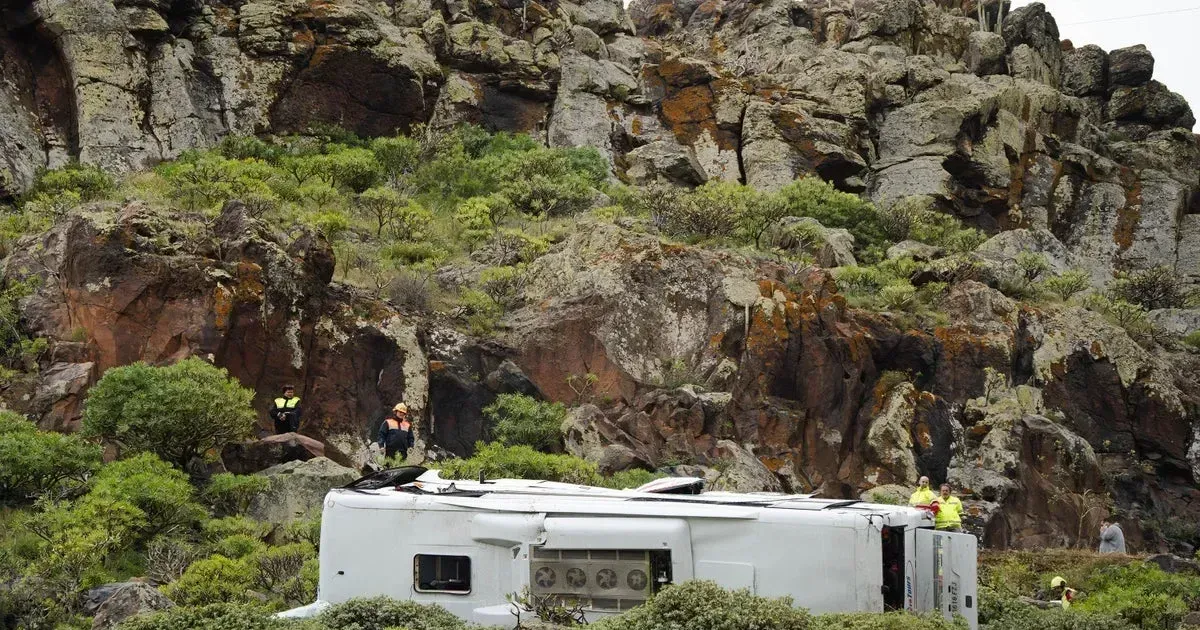
Local officials in San Sebastián de La Gomera confirmed that a 77-year-old British man died after a catastrophic bus crash on the GM-2 highway. Investigators said the bus was carrying British holidaymakers toward a harbor for a planned boat excursion. The April 11, 2026, crash brought medical teams to the site at 1:15 p.m. local time after the vehicle veered off the road and plunged into a steep ravine. Preliminary reports indicate the vehicle crossed the centerline before descending into the rugged terrain that characterizes the island's interior.
Emergency services arrived to find a scene of significant wreckage scattered across the rocky slope. Rescue workers used specialized equipment to extract passengers from the twisted metal of the coach. Twenty-seven people sustained injuries varying in severity, with several individuals requiring immediate stabilization before transport to medical facilities. Hospital staff in San Sebastián began treating the survivors for blunt force trauma, lacerations, and bone fractures shortly after the first ambulances arrived.
San Sebastián de La Gomera Emergency Response
Witnesses traveling behind the coach described a sudden loss of control. No other vehicles appeared to be involved in the initial collision with the roadside barrier. Debris from the bus reached deep into the ravine, complicating the recovery of personal effects and evidence. Officials from the Civil Guard launched a forensic examination of the crash site to determine if mechanical failure or driver error played a role in the trajectory of the vehicle. Heavy lifting cranes arrived late in the afternoon to begin the process of hauling the wreckage back to the road surface.
GM-2 Highway Safety and Ravine Crash Mechanics
Mountainous roads on La Gomera present unique challenges for heavy passenger vehicles due to sharp elevation changes and hairpin turns. The GM-2 highway is a primary artery across the island, yet its narrow lanes and proximity to steep drops require constant driver vigilance. Safety barriers along this specific stretch proved insufficient to halt the momentum of the descending bus. Engineers often cite the volcanic soil and frequent mist as factors that reduce tire traction on these elevated routes. Historical data shows that while accidents are infrequent, the severity of incidents involving vertical drops is consistently high.
“All 27 passengers are believed to be British tourists, and investigations into the tragedy are ongoing,” authorities said.
Travelers had booked this specific tour as part of a larger holiday package focused on the natural scenery of the Canary Islands. The excursion was meant to conclude with a coastal sailing trip departing from a nearby port. Most participants were retirees enjoying the spring climate before the peak summer season arrived. Travel agencies in the United Kingdom are currently working with the Foreign, Commonwealth and Development Office to provide support to the families of those involved. Consular officials arrived on the island within hours to assist with identification and hospital visitation logistics.
Tour operators often subcontract transport to local firms that specialize in island logistics. This arrangement places the burden of safety compliance on regional entities rather than international travel brands. Legal experts anticipate a complex insurance recovery process involving both Spanish and British jurisdictions. Survivors reported that the mood on the bus was festive until the moment the vehicle struck the guardrail. Statements from the passengers will be collected over the coming days as their medical conditions stabilize. Many remain in shock, having experienced a high-speed descent that lasted several seconds before the final impact.
Canary Islands Regional Transport Safety Record
Safety statistics for the Canary Islands generally align with broader Spanish averages, though the topography of the western islands increases specific risks. La Gomera maintains a smaller fleet of tourist vehicles compared to Gran Canaria or Tenerife, which often results in less frequent fleet turnover. Regional government spokespeople defended the safety standards of the local transport sector during a brief press conference. They emphasized that millions of tourists navigate these roads annually without incident. Persistent calls for wider roads in the island interior face opposition from environmental groups seeking to preserve the UNESCO-recognized forests.
Meteorological data from the hour of the crash showed clear skies and dry road conditions. High visibility usually reduces the risk of navigational errors on the GM-2 highway. Police are analyzing GPS data from the bus to reconstruct the speed of the vehicle in the minutes leading up to the exit from the roadway. Toxicological tests on the driver are standard procedure in such cases and results are pending. Regional authorities expressed their condolences to the family of the deceased man and promised a transparent investigation into the causes of the event. The bus now sits in a secure impound lot awaiting further mechanical scrutiny.
Safety Questions for Island Excursions
European holiday destinations frequently prioritize throughput over stringent vehicle maintenance oversight. The fatal incident on La Gomera exposes the lethality of combining aging infrastructure with the heavy demands of mass tourism in vertical environments. While the Spanish government touts its safety protocols, the reality on the ground involves narrow, winding arteries that were never designed to accommodate the sheer mass of modern 50-seater coaches. Relying on seasonal transport contractors in mountainous terrains persists as a gamble that British travelers unwittingly take every summer. Profits derived from high-volume excursions often outpace the reinvestment needed for reinforced roadside barriers or advanced driver training programs.
Regulatory bodies must stop treating these disasters as isolated tragedies. The geography of the Canary Islands is static, but the technology used to navigate it is not. If the industry continues to use larger, heavier vehicles for these tours, the highway infrastructure must undergo a proportional upgrade. Failure to mandate active safety systems like collision avoidance on all tourist transport is a policy choice that costs lives. The U.K. government is unlikely to demand higher standards for its citizens abroad. The status quo favors the cheap, frequent movement of people over the expensive, slow implementation of safety. This crash is not an anomaly; it is the predictable outcome of infrastructure neglect in a high-risk geography.