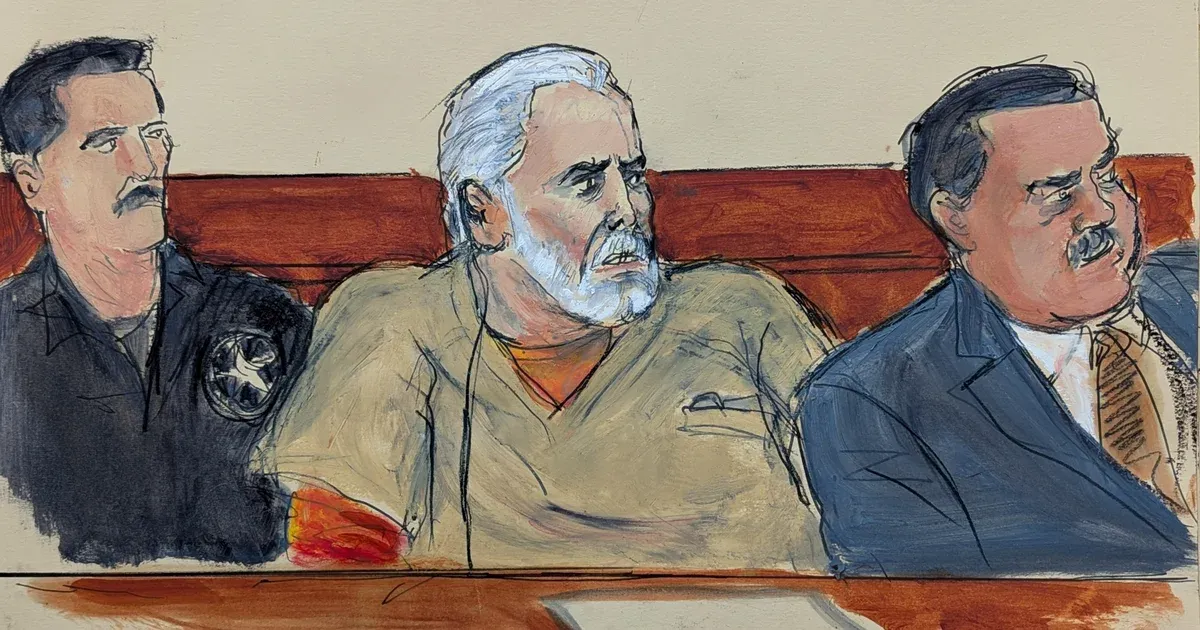
A federal judge sentenced Ismael “El Mayo” Zambada, a co-founder of Mexico’s Sinaloa Cartel, to spend the rest of his life in a US prison. The court also ordered him to forfeit $15 billion attributed to the criminal enterprise’s drug profits. The prison term followed directly from the charges he admitted under a plea agreement.
US District Judge Brian Cogan imposed the sentence in Brooklyn on July 20, 2026. Zambada, 76, addressed the court through a Spanish interpreter and apologized for the damage caused by his organization. His remarks contrasted with nearly four decades in which prosecutors said he directed trafficking operations and authorized violence against people who threatened the cartel’s interests.
The hearing completed an unusual path into US custody. In 2024, Joaquín Guzmán López, a son of Zambada’s longtime partner Joaquín “El Chapo” Guzmán, brought him aboard a plane under the pretense of inspecting airstrips in northern Mexico. The aircraft landed in Texas instead, where federal agents arrested both men. Zambada later agreed to plead guilty to drug-smuggling and conspiracy charges in return for prosecutors taking the death penalty off the table.
The Guilty Plea Fixed the Punishment Before the Hearing
Zambada’s admissions covered his leadership of a network that sent cocaine and other drugs into the United States from the end of the 1980s onward. He formally accepted responsibility for helping create the criminal structure and for directing it as a principal leader. The government calculated the $15 billion forfeiture from proceeds associated with that position. The financial order records the scale alleged by prosecutors even if recovering a comparable sum from hidden or dispersed assets proves difficult.
During the hearing, Zambada accepted responsibility and urged younger people not to repeat his path. His brief statement did not contest the mandatory punishment or seek to recast the enterprise he had already acknowledged in his plea. One sentence carried the center of his appeal:
“The violence must end.”
The remaining dispute concerns confinement rather than guilt. Zambada has asked to serve his term in a federal prison hospital because of age-related medical problems. Prosecutors favor a more secure setting, arguing that he could still communicate with associates and direct illegal activity from custody. Their position treats access to outside networks as a continuing risk even when release is impossible. Judge Cogan may offer a recommendation, but the Federal Bureau of Prisons controls the final placement after weighing medical and security requirements.
His Arrest Removed a Leader but Deepened the Cartel Split
Zambada built the Sinaloa organization with El Chapo and developed a reputation as its lower-profile operator. His partner was extradited to the United States in 2016 and is also serving life in prison. The convictions have now removed both founding figures from active leadership, yet neither case produced a clean end to the network they created.
Fighting intensified in the Mexican state of Sinaloa after Zambada’s arrest. Loyalists aligned with his side of the organization have battled a faction associated with El Chapo’s sons, while disappearances and killings have spread through communities caught between them. Guzmán López also pleaded guilty to federal drug charges and awaits sentencing, but his legal position has not ended the factional struggle. The conflict illustrates how taking one leader out of circulation can trigger a contest over routes, personnel and territory instead of dissolving the business.
Washington has increased pressure on Mexican criminal groups, including designating cartels as terrorist organizations after President Donald Trump returned to office. Mexico has sent thousands of troops into Sinaloa as its government confronts the resulting violence. A previous report on World Cup cartel activity also showed how criminal groups exploit legitimate commerce and public events, making enforcement broader than the prosecution of individual bosses.
The Sentence Closes a Prosecution, Not the Trafficking System
The life term is a substantial institutional result for US prosecutors. Zambada evaded capture for decades, admitted his role without a trial and now faces no route back to operational freedom. The judgment also places a formal value on the proceeds the government says flowed from his leadership. For the court, those outcomes settle the criminal case even though questions about prison security and medical care remain administrative.
They do not establish that cocaine or fentanyl flows will fall by a measurable amount. Smuggling networks can redistribute command, and the violence following Zambada’s detention shows that his former organization had enough personnel and money to continue competing internally. Enforcement agencies must therefore distinguish between incapacitating a historically important leader and reducing the cartel’s capacity at ports, border crossings, financial channels and local distribution points.
Zambada’s sentence removes ambiguity about his personal future: he will remain in federal custody for life. The public-security result will depend on whether US and Mexican authorities can use the case to disrupt assets, communications and successor factions rather than treating the conviction as an endpoint. Convictions can be counted immediately; changes in supply, territorial control and cartel recruitment require evidence collected over time. The cartel’s response since 2024 suggests that leadership decapitation alone changes who commands the network more readily than it changes the market the network serves.