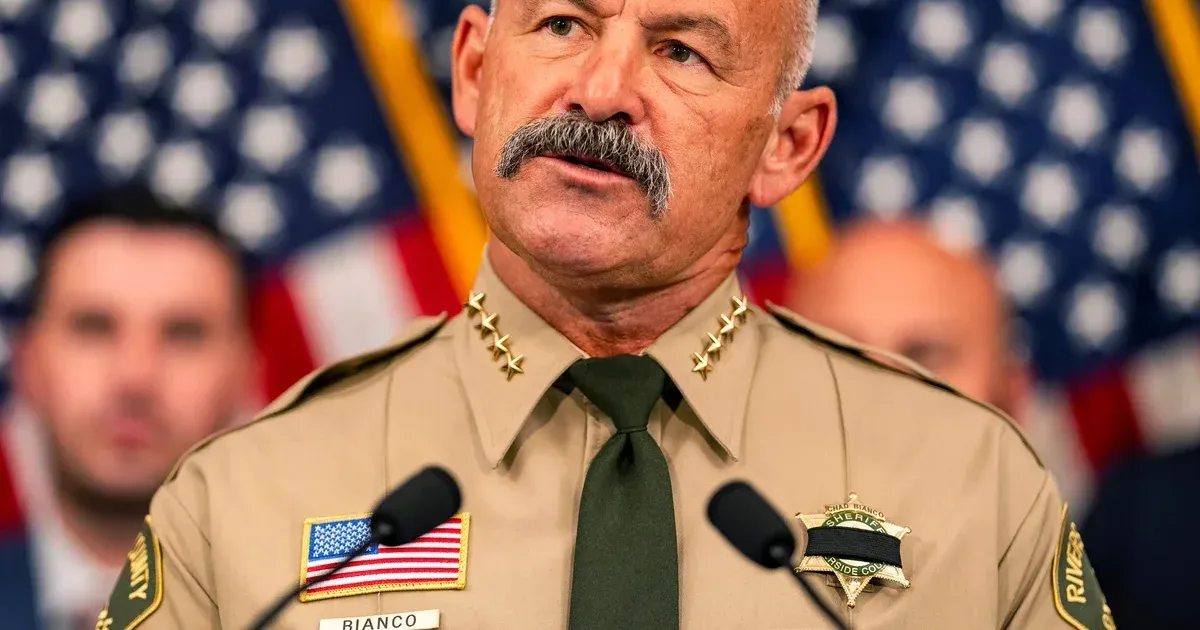
Riverside County Sheriff Chad Bianco's ballot seizure turned a local election-fraud claim into a statewide legal warning because it moved the dispute from rhetoric into physical control of election materials.
Bianco's office seized more than 650,000 ballots tied to California's 2025 special election and Proposition 50 after claims from a local election-integrity group about large discrepancies in Riverside County data. Election officials said the claim came from a misreading of raw figures and that the real discrepancy was much smaller. What could have been handled through transparent election procedures became a fight among a county sheriff, state officials, voting-rights lawyers and the courts.
Bianco is also a Republican candidate for governor, which made every enforcement step politically charged. Even if the sheriff argues that he acted through warrants and in response to public concern, the overlap between criminal investigation and campaign-era election rhetoric is the core risk.
Ballot Custody Became The Central Question
The legal issue is not whether election concerns can ever be reviewed. They can. The issue is who controls ballots, under what authority, with what chain-of-custody safeguards and under whose supervision.
California officials argued that election materials must remain under election-administration control and that a sheriff-led seizure threatened the integrity of the custody process. Bianco's side pointed to judicial warrants and the need to investigate possible wrongdoing. The conflict turned ballot storage into a constitutional and administrative fight.
The Discrepancy Claim Was The Weak Foundation
The underlying fraud claim matters because extraordinary intervention should require strong evidence. The local group alleged a large mismatch between ballots and certified results. County election officials said the allegation reflected a misunderstanding of preliminary or raw data, not proof of mass fraud.
The distinction is not technical hair-splitting. Election systems generate multiple data streams before reconciliation is complete. Treating unfinished or misunderstood figures as proof of fraud can create a crisis before officials have finished explaining the ordinary accounting.
The Courts Had To Freeze The Fight
Attorney General Rob Bonta and voting-rights advocates challenged the sheriff's actions, arguing that Bianco had exceeded his authority. The California Supreme Court later ordered the investigation paused and required preservation of the seized materials while the legal process continued.
The court order did not resolve every factual question. It did make one point unavoidable: ballot control cannot be improvised by politically visible law-enforcement officials after a contested election claim. The materials themselves have to be preserved before anyone can argue about what they show.
The Attorney General's Authority Is Also On Trial
The dispute is bigger than one county because it tests how much supervisory power California's attorney general has over elected sheriffs. Bonta argues that the state must be able to stop local law enforcement from interfering with election administration. Bianco argues that his office has independent investigative authority.
The authority question reaches beyond Prop 50. If every elected sheriff can independently seize election materials on contested claims, California could face county-by-county election investigations after politically sensitive votes. If the attorney general's authority is too broad, local independence becomes weaker. The court has to draw a line that protects both lawful investigation and election administration.
Election Integrity Requires Restraint
Bianco can say he is defending election integrity. But election integrity is not only about investigating claims. It is also about preserving custody, avoiding politicized interference and making sure voters can trust that ballots are not being turned into campaign-stage props.
Law enforcement has a role when there is credible evidence of crime. It cannot become a parallel election office whenever an aligned group dislikes or misunderstands a result. A parallel election office would damage trust even when no fraud is found.
The Precedent Is The Real Danger
The Riverside episode shows how quickly election-denial politics can become an administrative crisis. A contested data claim produced seized ballots, emergency petitions and a statewide fight over who controls the evidence of a vote.
California now has to make the boundary unmistakable. Fraud claims need review, evidence and transparent process. They do not need sheriffs turning ballots into political evidence before courts and election officials can establish the facts. Trust in elections is not restored by dramatic seizures. It is restored by rules that even ambitious politicians cannot bend.