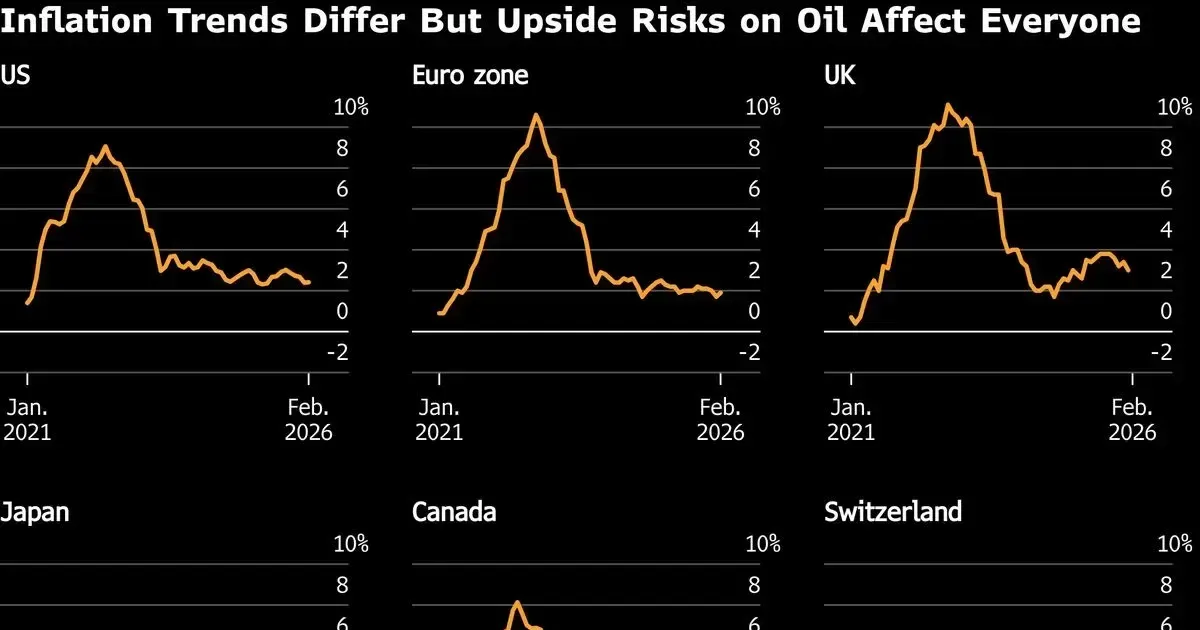
Middle Eastern energy markets entered a state of emergency early Monday morning as missile strikes targeted critical infrastructure. Central banks across the G7 are preparing for a major inflation crisis as the Iran war disrupts global energy supplies. Brent crude futures spiked immediately after reports surfaced of explosions near major extraction sites. Analysts at Bloomberg Economics now project that sustained conflict could push prices toward $120 per barrel. Such a move would effectively erase a year of progress in taming consumer price indices. Central bankers who were once planning to lower borrowing costs are now recalculating their positions. Trading desks in London and New York reported heavy selling in government bonds. Investors moved rapidly into safe-haven assets like gold and the Swiss franc. The yield on the 10-year Treasury note moved higher as inflation expectations adjusted to the new geopolitical reality.
Energy Shock Tests Central Banks
Supply chain disruptions are no longer theoretical. The Strait of Hormuz remains the primary concern for maritime insurers who have already raised premiums to prohibitive levels. Many shipping conglomerates have ordered their fleets to anchor in safe waters or take the long route around the Cape of Good Hope. This maritime blockade will inevitably increase the cost of imported goods in Europe and North America. Gasoline prices at American pumps typically lag crude movements by about two weeks. If the current path holds, the national average could reach levels not seen since the post-pandemic supply crunch. Households would likely reduce discretionary spending in response to higher fuel costs. Retail sales figures for the upcoming quarter will reflect this contraction in consumer confidence. Energy-intensive industries are sounding alarms. Manufacturing firms in Germany and steel producers in China rely on stable energy inputs to maintain thin margins. A prolonged Iran war threatens to push these sectors into a recessionary spiral. Industrial output in the Eurozone has already shown signs of stagnation in early March data.
Airspace Closures Hit Gulf Travel
Tehran has expanded the battlefield into the digital sphere by targeting the financial architecture of its neighbors. Recent reports from the Washington Post indicate that cyber strikes have hit data centers, hotels, and airports in several regional capitals. These attacks aim to destabilize the economic progress of nations that rely on foreign investment and tourism. Financial institutions in Riyadh and Dubai are operating under heightened security protocols. While no major bank has collapsed, the disruption to digital payment systems has caused localized panic. Tourists in luxury hotels found themselves unable to settle bills or access digital room keys during a 48-hour outage. Tehran warns that these digital strikes are only the beginning of a broader campaign against the global finance hub of its more prosperous neighbors. Commercial banks are struggling to quantify the risk of further data breaches. Insurance companies are reviewing force majeure clauses in their cyber-liability policies. Losses from operational downtime could reach hundreds of millions of dollars if the outages persist. One major hospitality group in the UAE reported a 30 percent drop in bookings within 24 hours of the first cyber attack. Travel routes that once connected the East and West have been effectively severed. Major carriers including Emirates, Qatar Airways, and Etihad Airways have grounded substantial portions of their fleets. These airlines built their business models on the geographical advantage of the Persian Gulf as a global transit point. With the Iran war expanding, those same transit points have become high-risk zones for civilian aviation. Flight paths are being diverted across Africa or Central Asia. These new routes add several hours to travel times and sharply increase fuel consumption. Carriers are passing these costs onto passengers through surcharges. The New York Times reported that a round-trip ticket from London to Singapore has increased in price by 40 percent since hostilities began.
The closure of regional airspace has turned some of the world's busiest airports into ghost towns overnight.
The impact extends beyond the airlines themselves. Airport service providers, duty-free retailers, and ground handling crews are facing immediate layoffs. Dubai International Airport, which handled over 80 million passengers last year, is seeing its terminal halls empty. Cargo operations are similarly paralyzed, delaying the shipment of high-value electronics and pharmaceuticals. Policymakers at the Federal Reserve encounter a difficult balancing act. Before the conflict, the market expected a series of rate cuts to support a cooling economy. Now, the threat of cost-push inflation may force Jerome Powell to keep interest rates higher for longer. This shift in monetary policy could trigger a sell-off in equity markets that have relied on the promise of cheaper credit. Traders are closely watching the Federal Open Market Committee meeting scheduled for later this month. According to sources cited by the Financial Times, some members are even discussing the possibility of an emergency rate hike. This strategic move would be intended to anchor inflation expectations before they become unmoored. High interest rates would further strain a banking sector already dealing with the fallout of regional instability. Some analysts argue that the shock to consumer demand will be so severe that inflation will eventually collapse on its own. They suggest that the Fed should look through the temporary spike in energy prices.
Inflation Fight Can Restart Fast
Was globalization ever as strong as the Davos set claimed, or was it a fragile mirage built on the assumption of permanent Middle Eastern stability? The current crisis in the Persian Gulf suggests the latter. For decades, Western economies outsourced their energy security to a region defined by ancient grievances and modern missiles. Now, the bill for that complacency has finally arrived. We are watching the terminal decline of the low-inflation era that defined the early 21st century.
Central banks are not the masters of the universe; they are only janitors trying to sweep up the glass after a barroom brawl they failed to prevent. If the Federal Reserve raises rates now, it risks crushing a fragile recovery. If it does nothing, it allows inflation to incinerate the purchasing power of the middle class. There is no soft landing when the runway is being bombed. The reality is that the era of cheap energy and frictionless travel was a historical fluke.
Investors who continue to bet on a return to the 2010s status quo are not just optimistic; they are delusional. The world is re-orienting itself toward a fractured, expensive, and far more dangerous reality where the cost of a barrel of oil is once again the ultimate arbiter of geopolitical power.