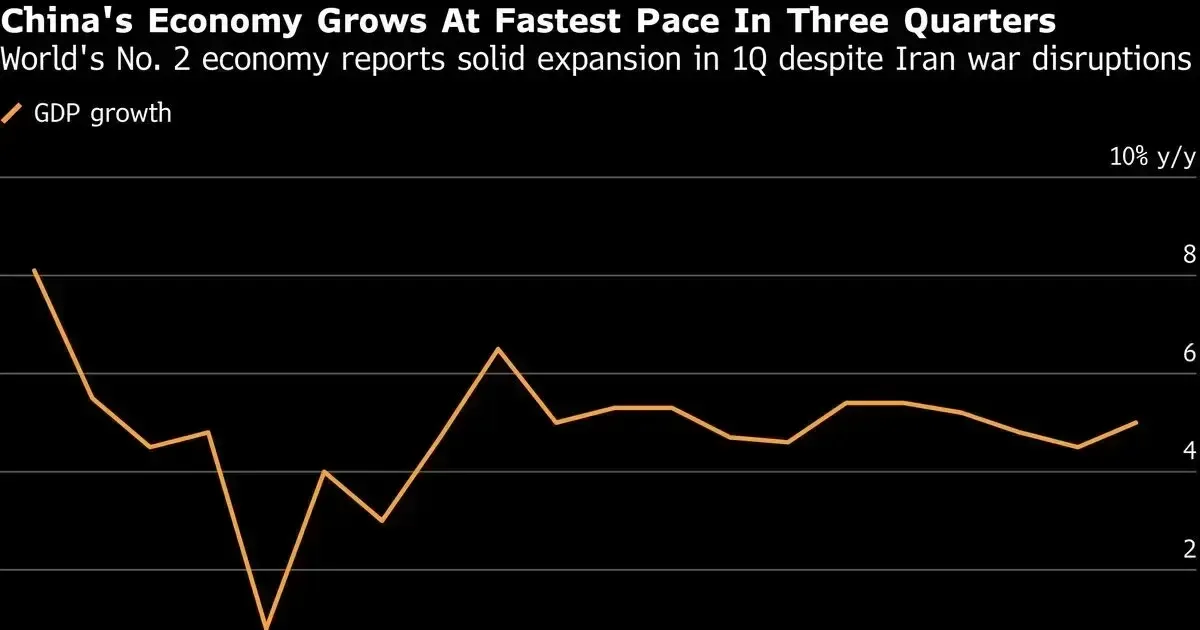
China’s latest growth report arrived with global energy markets under wartime pressure. The result shows how industrial policy can cushion but not erase external shocks. Investors are watching whether resilience can survive another supply chain squeeze. Beijing officials announced on April 17, 2026, that the nation's industrial output surged as global energy markets adjusted to the conflict in Iran. Data from the National Bureau of Statistics indicated that gross domestic product grew at an annualized rate of 5.3% during the first quarter. Analysts initially projected a cooling period due to regional instability. Manufacturing activity instead accelerated across the coastal provinces. Markets reacted immediately to the figures released by the statistics bureau. Investors had braced for a sharp contraction linked to maritime disruptions in the Persian Gulf. China secured alternative energy pathways through Central Asian pipelines and expanded its strategic petroleum reserves throughout the winter. Trade volumes with Southeast Asian partners provided a necessary buffer for export-oriented factories. Stimulus measures totaling $1.2 trillion in infrastructure spending authorized late last year began circulating through the provincial economies. State-led investment focused heavily on semiconductor fabrication and renewable energy grids. These sectors bypassed many of the inflationary pressures hitting Western consumer markets. Export demand for electric vehicles stayed strong in emerging markets across Africa and South America.
"China's economic fundamentals possess a resilience that outweighs external geopolitical volatility," a spokesperson for the National Bureau of Statistics stated in the official report.
War in the Middle East typically triggers a flight to safety that penalizes emerging markets. Beijing countered this trend by deepening its ruble-yuan trade settlement mechanisms. Energy imports from Russia and non-aligned African nations filled the gap left by sanctioned or disrupted Iranian crude. Refineries in Shandong province reported record throughput levels during the first ten weeks of the year.
Industrial Resilience Drives China Growth Figures
Industrial production remains the primary engine of this unexpected expansion. Factories producing high-end telecommunications equipment and green energy hardware reported a 7.2% increase in year-on-year output. Private sector firms moved aggressively to fill voids left by Western competitors who scaled back operations in the region. Supply chains proved more adaptable than most World Bank models predicted. Local governments accelerated the issuance of special purpose bonds to fund urban renewal projects. This influx of capital sustained the construction sector despite the ongoing cooling of the residential property market. Small and medium enterprises received tax breaks that allowed them to maintain payrolls during the height of the energy price spike. Employment rates in the tech hubs of Shenzhen and Hangzhou climbed for the third consecutive month.
Foreign direct investment showed signs of stabilization after two years of steady decline. European manufacturing conglomerates expanded their footprints in the Yangtze River Delta to maintain proximity to localized supply networks. The logic of decoupling faced a direct challenge from the reality of integrated electronic component production. Logistics costs for rail-based trade between Xi'an and European hubs fell by 12%.
Energy Security Strategy Limits Economic Disruption
Maintaining a stable flow of hydrocarbons stayed at the top of the priority list for the People’s Bank of China. Monetary policy focused on ensuring that importers had sufficient liquidity to navigate volatile spot markets. Brent crude prices occasionally touched $85 per barrel during the peak of the Iranian naval escalations. China's long-term contracts with Gulf Cooperation Council members shielded its primary industrial clusters from the worst of the volatility.
Beijing continued to diversify its energy mix with a focus on domestic coal and nuclear power. Coal production reached an all-time high in the northern provinces to ensure the electricity grid could handle the surge in industrial demand. The move away from imported gas for power generation reduced the impact of pipeline sabotage risks in Eurasia. Solar installations exceeded the total combined capacity of the European Union in a single quarter.
Diplomatic efforts to secure shipping lanes played a secondary but essential role. China's naval presence near the Bab el-Mandeb strait provided enough security for COSCO vessels to maintain their schedules. Insurance premiums for Chinese-flagged ships stayed much lower than those for vessels with Western registration. This cost advantage allowed Chinese exporters to undercut competitors on shipping-inclusive pricing models.
Global Supply Chain Shifts During Iran War
Conflict in the Persian Gulf forced a major reorganization of global shipping routes. While Western firms faced delays at the Cape of Good Hope, Chinese rail freight through the Middle Corridor saw a 40% increase in volume. This land-based alternative became a critical lifeline for sensitive electronics and machinery components. Logistics firms in Kazakhstan and Turkey expanded their handling capacity to meet the demand.
Israel and Lebanon agreed to a ceasefire on April 17, 2026, which offered a brief window of stability for Eastern Mediterranean trade. The cessation of hostilities between Hezbollah and the Israeli Defense Forces lowered the risk profile for ships entering the Suez Canal. Markets remain cautious about the longevity of the peace. The ceasefire did not immediately resolve the underlying tensions in the Strait of Hormuz.
Domestic Consumption Fuels China GDP Expansion
Consumer spending within the domestic market outperformed the tepid growth seen in 2025. Retail sales grew by 4.8% as households began to draw down the excess savings accumulated during previous years of economic uncertainty. Travel and tourism within the country surged during the Lunar New Year period. High-speed rail networks carried a record number of passengers across the internal provinces.
Digital payment data from Alipay and WeChat Pay indicated a shift toward service-based consumption. Health care, education, and entertainment sectors saw the highest gains. The government's efforts to boost the silver economy for an aging population created new niches for specialized service providers. Pension reforms contributed to a higher sense of financial security among middle-income families.
E-commerce platforms integrated artificial intelligence to streamline logistics and personalized marketing. The technological integration reduced overhead costs for small retailers. Rural consumption grew faster than urban spending for the fifth month in a row. Improved internet infrastructure in western provinces brought millions of new consumers into the digital marketplace.
China Growth Runs Through Energy Security
Can anyone truly trust data emerging from a state that treats economic statistics as a weapon of psychological warfare? The 5.3% growth figure reported by Beijing feels less like an objective measurement and more like a carefully timed geopolitical signal. By announcing these numbers during a period of intense regional conflict, the Chinese Communist Party wants to project an image of invulnerability to the very energy shocks that are currently crippling Western manufacturing bases. It is a narrative of decoupling successfully achieved, even if the underlying reality is one of huge, states-mandated debt expansion.
Beijing has essentially doubled down on a high-stakes gamble. The $1.2 trillion stimulus package is a blunt instrument designed to drown structural weaknesses in a sea of liquidity. While the industrial output figures look impressive on a spreadsheet, they mask a growing imbalance between supply and demand. China is producing goods at a rate the global economy cannot absorb, particularly as the Iran war restricts consumer confidence in the West. The strategy leads directly to an enormous deflationary export wave that will likely trigger a new round of protectionist tariffs from Washington and Brussels.
The figures point less to a genuine recovery than to a state-funded inventory build-up. The bill for this artificial growth will eventually come due. The conclusion is stark: China is buying time, not stability.