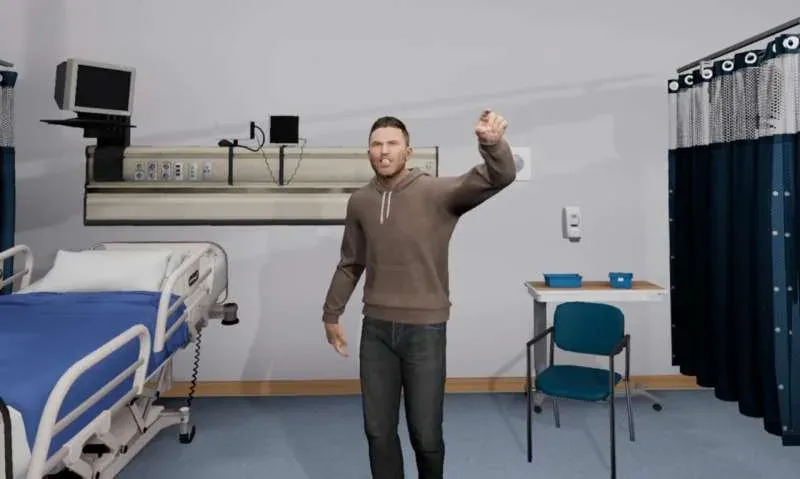
A 20-minute virtual reality exercise was followed by a substantial increase in nursing students' confidence about managing patient aggression, according to a study of 221 undergraduates in Australia. The finding supports further testing of the I-VADE training program. It does not show that the program prevents assaults or improves behavior during real clinical emergencies.
The distinction matters because the study measured what participants said about their confidence immediately before and after one training session. It did not observe them de-escalating patients at work, compare VR with another teaching method or track injuries. Confidence is a relevant educational outcome, but it is not a hospital-safety outcome.
The study was published in Teaching and Learning in Nursing and publicized by Edith Cowan University on March 12, 2026. Its authors evaluated I-VADE as an educational intervention, with self-reported confidence, usability and motion sickness among the specified outcomes.
One Group Completed the Same VR Exercise
Researchers used a single-group, quasi-experimental pretest-posttest design. All 221 participants were undergraduate nursing students from one public Australian university. They completed questionnaires before and after the intervention, so every participant received the VR training and there was no untreated or alternative-training group.
The program, called I-VADE, placed students in an immersive scenario involving an aggressive patient. Edith Cowan University's Simulation and Immersive Digital Technology Group developed it with a 12-member clinical advisory group that included frontline health workers, workplace-safety managers and violence-training coordinators.
Students used Meta Quest 2 headsets in groups of about 20. Each session included a briefing, roughly 20 minutes in VR and a structured debrief. Two facilitators supported each group. That delivery model is an operational result: the researchers showed that many students could complete a standardized scenario with relatively few facilitators.
Confidence Improved, but Performance Was Not Tested
Average confidence scores rose from 51.17 before the session to 65.77 afterward on a 110-point scale. The difference was statistically significant, and the reported effect size was 0.70. Those numbers support the narrow conclusion that participants felt more confident after the session.
Students also rated the format favorably. Ninety-three percent agreed that immersive VR was a suitable medium for aggression and violence training, and 89% said they wanted more training in VR. Those responses measure acceptance and preference. They do not establish that students learned the right actions or would use them under pressure.
The researchers measured usability and motion sickness as well. Five percent of participants reported moderate to severe motion sickness, although no one stopped the session because of it. Participants with severe symptoms were monitored for five to 10 minutes before returning to normal activities. That finding is relevant if educators consider making headset-based training a required part of a curriculum.
The Study Has No Control Group or Field Outcome
The authors state the central limitation directly: self-reported confidence has not been verified as a predictor of real-world performance. The study also came from a single site and a single cohort. Without a comparison group, it cannot show whether VR worked better than a classroom lesson, actor-based simulation, desktop training or the effect of simply completing any structured exercise.
The research did not count violent incidents before and after training. It did not measure injuries, restraint use, security calls, patient complaints or the quality of students' verbal responses. It also did not test how long the confidence increase lasted. Claims that the session rewired threat responses, reduced anxiety hormones or changed conduct in actual emergencies go beyond the evidence.
The study was supported by the Western Australia Department of Health. The paper says VR may offer a way to make aggression-management practice more accessible after the initial hardware and development costs. It did not conduct a cost-effectiveness analysis or demonstrate net savings.
A Safer Hospital Requires Harder Evidence
Practicing a difficult encounter without exposing a student or patient to danger is a plausible use for VR. Standardized scenarios can also make repetition easier. The next question is not whether students enjoy the format or leave feeling readier. It is whether they can demonstrate better decisions and communication when assessed independently.
A stronger trial would compare I-VADE with an active alternative, use blinded ratings of de-escalation skills, retest participants after the immediate confidence effect has faded and examine implementation across more than one institution. If the program moves into clinical workplaces, researchers could then study incident reports and harm while accounting for staffing, reporting practices and other safety measures.
Hospital violence is a real safety problem, but urgency does not turn a surrogate into proof. This study showed a confidence gain after a scalable 20-minute exercise. It did not show fewer assaults, safer staff or better patient care. Until those outcomes are measured, I-VADE should be described as a promising training tool under evaluation, not a demonstrated solution to hospital violence.