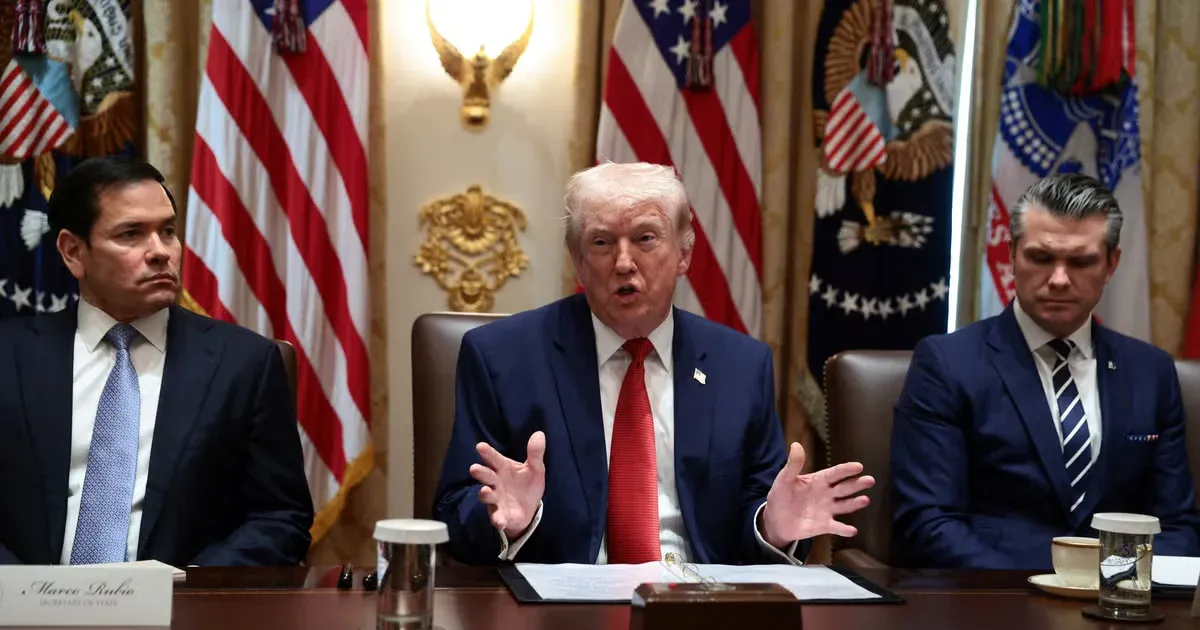
Donald Trump intensified his assault on the North Atlantic Treaty Organization on March 27, 2026, by claiming the military alliance has failed to support American interests in the Middle East. Speaking from the White House, the president asserted that the coalition has done absolutely nothing to assist the United States in its ongoing confrontation with Iran. This rhetorical broadside targets the core of the transatlantic security architecture during a period of heightened regional volatility. Trump frequently insisted that Tehran is currently begging to make a deal to end the hostilities.
Meanwhile, the president directed specific vitriol toward the United Kingdom and its naval contributions to the region. He characterized British warships as toys in comparison to American carrier strike groups. These comments come as the British government maintains its commitment to maritime security in the Persian Gulf and the Gulf of Oman. Trump specifically targeted the leadership of Prime Minister Keir Starmer, describing the British involvement in the Iran conflict as a vast mistake. Tensions between Washington and London have reached a historic low point despite scheduled diplomatic events.
NATO Alliance Faces Harsh Criticism Over Iran
Trump claimed that the alliance is still a laggard in global security while relying on American military might. He argued that the organization failed to provide meaningful intelligence or tactical support during the recent escalation of the Iran war. This stance ignores the logistical support and airspace access provided by several European member states. President Trump stated that the alliance members are benefiting from a sluggish approach to collective defense. He has often argued that the United States carries an unfair share of the financial and tactical burden for protecting European interests.
But the president's dismissal of the alliance extends beyond financial contributions to the actual effectiveness of their hardware. He suggested that European allies lack the technological sophistication required for modern warfare against a motivated adversary like Tehran. This perspective clashes with the assessments of Pentagon officials who rely on NATO inter-operability for regional stability. Pentagon records show that allied contributions have been essential for protecting commercial shipping lanes. NATO officials have yet to issue a formal response to the latest round of verbal attacks from the Oval Office.
The president renewed his criticism of the military alliance and claimed Tehran was begging to make a deal to end the war, according to reports from The Independent.
As it turns out, the administration has signaled that it may unilaterally pursue a new agreement with Iran without consulting its traditional partners. It would bypass the diplomatic framework established by previous international coalitions. Trump believes his personal negotiation style can secure a better outcome than the multi-lateral approaches favored by the European Union. He maintains that his pressure campaign has forced the Iranian leadership into a desperate position. Economic data from the region confirms that sanctions have sharply hampered the Iranian oil sector.
British Naval Capabilities Dismissed as Mere Toys
Keir Starmer faces a difficult balancing act as he attempts to maintain the Special Relationship while defending British sovereign interests. Trump’s description of British destroyers and frigates as toys has caused serious friction in the House of Commons. Defense analysts in London point out that the Royal Navy has deployed its most advanced Type 45 destroyers to the region. These vessels are specifically designed for high-threat environments and anti-air warfare. The British Ministry of Defense insists that its naval presence is essential for the protection of international trade routes.
Yet, the American president remains unimpressed by the scale of the British fleet. He suggested that the Royal Navy is more of a ceremonial force than a functional combat entity. The critique comes at a time when the British government is investing billions in carrier-based power projection. Trump reportedly told advisors that the British should focus on domestic issues rather than attempting to play a major role on the world stage. He criticized the strategic direction of the Starmer administration as being disconnected from current geopolitical realities. Tensions are expected to rise further when the King Charles visits the United States later this year.
Working from that premise, the White House has not yet clarified if the presidential rhetoric will affect the planned state visit. British officials are worried that the president may use the occasion to further criticize the British government’s foreign policy. Public opinion in the United Kingdom has turned sharply against the American administration following these comments. Many members of the British public view the toy comment as a direct insult to the men and women serving in the Royal Navy. Starmer has stayed firm in his position that British security interests are not subject to the whims of the American executive branch.
Russian Support for Iran Complicates Allied Strategy
Russia has seized upon the rift between the United States and its allies to strengthen its own position in the Middle East. Intelligence reports indicate that Moscow is providing advanced radar systems and logistical backing to Iranian forces. The support has emboldened Tehran to resist American demands for a new nuclear framework. Trump has been accused of backing America’s enemies by undermining the very alliances designed to contain Russian and Iranian influence. The Kremlin views the fragmentation of NATO as a primary strategic objective. Russian state media has widely broadcasted Trump’s criticisms of the military alliance to highlight Western disunity.
On another front, the president’s refusal to condemn Russian interference in the Iran conflict has raised eyebrows in Washington. Some lawmakers argue that the administration is allowing Moscow to dictate the terms of regional engagement. The perceived weakness despite Russian aggression is a departure from historical Republican foreign policy. Critics claim that the president is more interested in insulting allies than in confronting actual adversaries. The relationship between Russia and Iran has evolved into a full military partnership involving drone technology and missile development.
Still, Trump maintains that his approach is the only way to avoid a larger global fire. He believes that by distancing the United States from NATO’s collective obligations, he can better negotiate bilateral deals. The strategy relies on the assumption that other nations will always choose American partnership over Russian or Chinese alternatives. However, the increasing cooperation between Moscow and Tehran suggests that a new axis of power is forming. The development presents a direct threat to the stability of the global energy market. The price of Brent crude has remained volatile as the diplomatic situation deteriorates.
Republican Concerns Mount Over Presidential Liability
And yet, the president’s own party is beginning to show signs of internal dissent regarding his foreign policy. Several senior Republican senators have expressed concern that the constant attacks on allies are damaging long-term American interests. For one, the Senate Foreign Relations Committee has held private briefings to discuss the impact of the president’s rhetoric on intelligence sharing. There is a growing fear that allies may become reluctant to share sensitive data if they feel the United States is no longer a reliable partner. The sentiment is shared by several high-ranking military officials who have served in NATO commands.
For instance, World affairs editor Sam Kiley noted that it is time for the Republican Party to view the president as a liability rather than an asset. Kiley argues that the president’s behavior is actively undermining the security of the American people by isolating the country. The analysis is gaining traction among traditional conservatives who focus on strong alliances. They argue that the United States cannot successfully confront threats from Russia and Iran alone. The shift in Republican rhetoric is subtle but increasingly visible in public statements from key lawmakers.
According to reports, some Republican donors are also questioning the long-term viability of the current foreign policy. They worry that a breakdown in the transatlantic alliance will lead to economic instability and trade disruptions. By contrast, the White House remains defiant and insists that the president’s base supports his America First agenda. Trump continues to hold rallies where he repeats his criticisms of NATO and the United Kingdom. He remains convinced that his supporters value national sovereignty over international cooperation. The upcoming election cycle will likely serve as a referendum on this isolationist approach.
Global markets have reacted with caution to the ongoing diplomatic spat. Investors are concerned that a weakened NATO will lead to increased risk in European and Middle Eastern markets. That said, the American economy has shown resilience despite these geopolitical tensions. Domestic energy production has provided a buffer against the volatility caused by the Iran war. Analysts suggest that the real impact of the president’s rhetoric will be felt over decades rather than months. The erosion of trust between the United States and its oldest allies is a process that may be impossible to reverse.
The Elite Tribune Perspective
Ask any career diplomat in Foggy Bottom about the state of transatlantic relations, and the silence will be deafening. The current administration has moved beyond mere skepticism of international institutions into an area of active sabotage. By labeling British warships as toys and NATO as a useless relic, Donald Trump is not just negotiating better terms; he is burning the blueprints of the post-war order. It is a gamble of catastrophic proportions that presumes American exceptionalism can survive in total isolation.
The reality is that the United States lacks the industrial capacity and the diplomatic reach to manage the Russia-Iran axis without the logistical backbone provided by its European partners. Insulting Keir Starmer and the Royal Navy serves no strategic purpose other than to satisfy a domestic craving for performative toughness. If the administration continues to treat its most loyal allies with the contempt usually reserved for rogue states, it will eventually find itself standing alone in a world that has moved on.
The irony is that by attempting to make America great through isolation, the president is effectively ceding the global stage to the very adversaries he claims to be outmaneuvering. History does not befriend the lonely superpower.