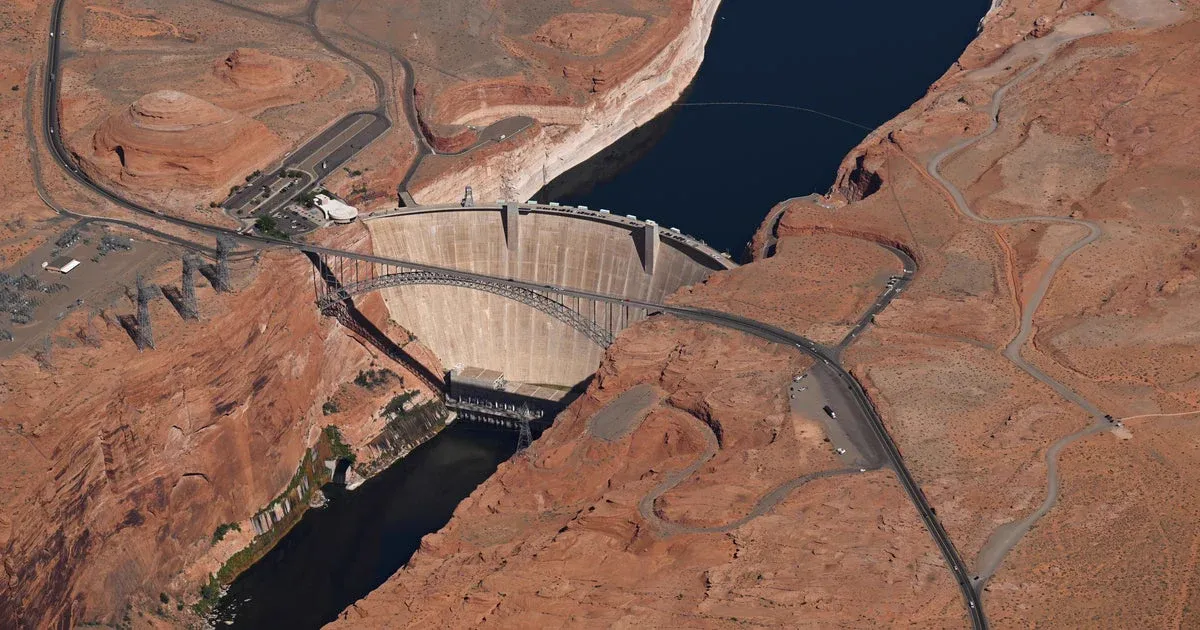
Lake Mead and Lake Powell have fallen to their lowest recorded levels while seven Western states remain divided over how to reduce their use of the Colorado River. The dispute separates four upper-basin states from three lower-basin states after years of negotiations failed to produce a durable allocation. Federal officials are now considering cuts that could exceed the reductions offered by the states themselves.
On Sunday, July 26, 2026, CBS News reported that the Trump administration was preparing to impose reductions if the states could not agree. The Colorado River supports cities, farms and power generation across a region where demand has continued to press against a shrinking supply. The federal decision would determine how much water can move to each basin while the reservoirs remain at record lows.
Colorado, Wyoming, Utah and New Mexico form the upper basin. California, Arizona and Nevada make up the lower basin. The division also reflects competing records: each group is defending a different record of use and a different view of who should absorb the next cut. An imposed allocation would set both a total volume and a distribution among governments that have not accepted the same baseline. The impasse has therefore left federal agencies to decide an issue the states had expected to negotiate.
Seven States Have Not Agreed on the Size of the Cut
Kelly Shannon McNeill, managing director of the watchdog group LA Waterkeeper, told CBS News that California and the other lower-basin states have reduced Colorado River use by nearly 20% since 2015. She said the upper-basin states moved in the other direction during the past year and maintain that they cannot afford reductions. The competing claims make the baseline for a fair cut as contested as the final volume.
“And so this is really, you know, it's about political will,” McNeill said.
The three lower-basin governments have put a two-year conservation package on the table. Its annual volume is 1.6 million acre-feet, which CBS News equated to roughly 500 billion gallons. Across the full term, the offer totals 3.2 million acre-feet, or about one trillion gallons. That establishes a measurable lower-basin contribution, but it has not resolved how the upper basin would participate or whether federal officials consider the total sufficient.
The officials who control river flows are considering an annual reduction close to twice the states' offer. That scale would approach 3.2 million acre-feet in one year, although CBS did not report a final figure, an order or allocations for individual states. The remaining gap could be nearly as large as the lower basin's entire proposal. Governments and water agencies still need to decide which users would carry that additional shortage.
Cities could face higher costs as they seek replacement supplies or pay for conservation measures. Residents may encounter tighter limits on outdoor use. Farmers face the largest direct exposure because agriculture consumes most of the river's supply, and a large reduction could require changes in planting, irrigation or the amount of land kept in production. The sequence matters: municipal restrictions can reduce household demand, but the largest volumes cannot be reassigned without decisions about agricultural deliveries.
Lake Powell Is 33 Feet From a Power Threshold
Lake Mead and Lake Powell are each less than 30% full. At Lake Powell, another 33 feet of decline would put the reservoir below the level needed to generate hydroelectric power, according to CBS News. The report said water would then be unable to pass through the dam into the Colorado River by the power-generation route. The 33-foot margin is an operating threshold, not only a measure of how the shoreline has moved. Crossing it would turn a supply emergency into a power-generation failure at the same dam. A supply dispute could become an infrastructure constraint before the reservoirs are empty.
The river begins with snow in the Rocky Mountains, but a warming climate has reduced the snowpack and the spring melt that replenishes the system. Population growth has increased demand at the same time. Earlier ETUD coverage of declining mountain snowpack describes the same upstream pressure from another regional risk. Reservoir operations cannot replace water that does not arrive, so negotiations are taking place against a physical limit.
Federal Allocation Will Decide Which Users Absorb the Shortage
A federal order can settle a volume without resolving the states' argument over responsibility. The lower basin can point to its reduction since 2015 and its two-year offer. The upper basin can argue that its communities have less room to surrender water. Washington must convert those positions into enforceable shares while preserving enough storage to operate the river system and its dams. A larger headline cut without a workable distribution would simply move the dispute from negotiations to implementation.
The record-low reservoirs narrow the time available for another open-ended negotiation. A compromise would let the states decide how to distribute the losses; an imposed plan would transfer that choice to federal officials and expose every allocation to political and legal resistance. The decisive measure will not be the headline size of the cut alone. It will be whether the order keeps water moving through Lake Powell while assigning costs that cities, farms and states can actually carry.