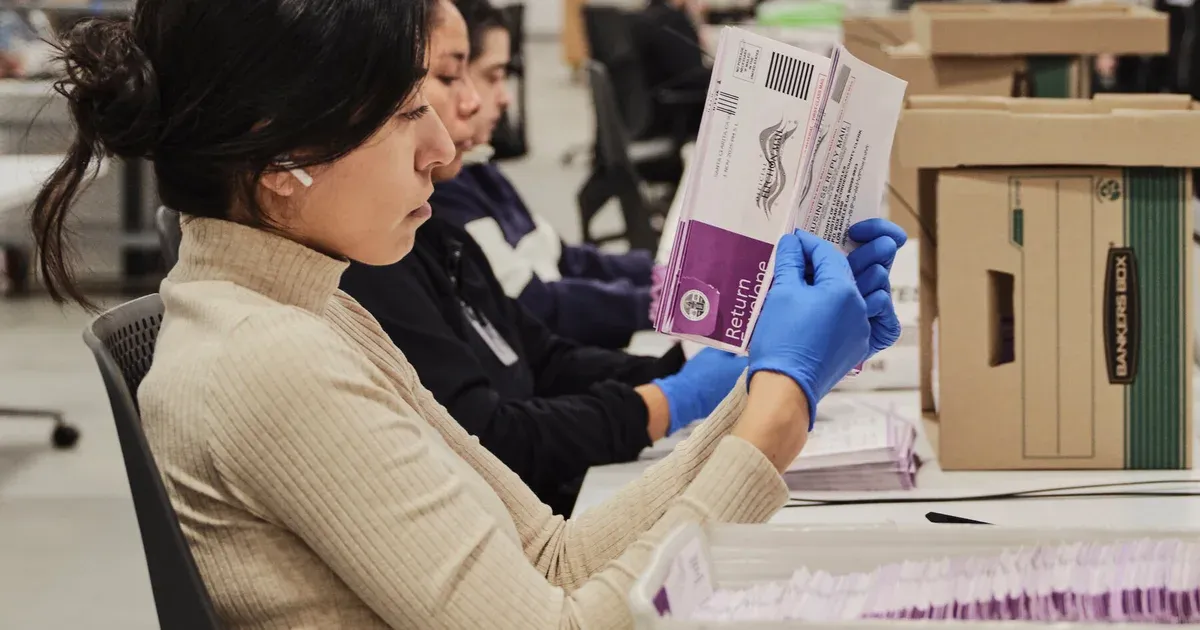
A federal appeals court has left in place an injunction preventing the Trump administration from enforcing key parts of its mail-voting executive order in 23 states and the District of Columbia. The 2-1 decision by the First U.S. Circuit Court of Appeals denied the government's request to pause a lower-court ruling while a broader appeal moves forward.
The panel acted on July 25, 2026, with September contests and the November midterm elections approaching. The immediate result is continuity, not a final resolution of the case: the challenged federal directives remain blocked in the jurisdictions that sued, but the appeals court has not yet completed its review of the underlying constitutional questions.
President Donald Trump's March order directed the Department of Homeland Security to build and send states lists of people confirmed as U.S. citizens and eligible to vote, using federal citizenship and naturalization records. It also instructed the U.S. Postal Service to deliver mail ballots only to voters appearing on each state's approved list. A related proposed postal rule would require states to provide names and identifying barcodes connected to their ballots.
The order also told the Justice Department to prioritize investigations and possible prosecutions of state and local officials who issue federal ballots to people the government considers ineligible. U.S. District Judge Indira Talwani blocked the voter-list and postal provisions on June 25 after a coalition led by California, Massachusetts, Nevada and Washington challenged them.
The Panel Rejected a Prematurity Argument
The Justice Department argued that the lawsuit came too early because federal agencies had not finished the policies needed to carry out the order. The majority disagreed. It found that the order established fast-approaching deadlines and required states to coordinate with federal officials while simultaneously preparing election workers and voters for potentially changing rules.
That timing was central to the stay decision. States cannot wait until every federal detail is final before deciding how to print instructions, manage voter data, train local officials and explain eligibility procedures. The panel concluded that the plaintiff states had a practical need to respond now, making the dispute concrete enough for the injunction to remain in effect during the appeal.
Talwani's lower-court ruling went further into the merits. She found no authority for the president to create voter lists for states and no law from Congress allowing the Postal Service to regulate which state mail ballots may be transmitted. She also said necessarily incomplete federal citizenship lists could pressure local officials to disregard their legal duty to make sure eligible citizens can vote.
The administration can continue its First Circuit appeal and has warned that it may ask the Supreme Court to intervene if the injunction remains in place. Before Talwani ruled, a federal judge in Washington rejected a related request from Democratic groups on standing and irreparable-harm grounds. That separate result involved different plaintiffs and a different procedural record; it does not cancel the injunction won by the states. The parallel cases show why the dispute may reach higher courts through more than one route. The July 25 order settles the near-term enforcement question for the plaintiff jurisdictions, but not the final boundaries of federal power.
The Practical Issue Is Election-System Stability
Mail voting depends on linked systems operated by state election offices, local administrators and the Postal Service. A new federal eligibility list or ballot-handling requirement would affect data transfers, envelope standards, public guidance and delivery decisions. Changing those systems close to voting dates carries consequences before a single disputed ballot reaches a courthouse. Officials must either spend time and money preparing for a rule that may disappear, or risk being unready if a court permits it to take effect.
The injunction preserves the existing state-run process while judges examine who has legal authority to change it. That restraint is the most consequential part of the ruling. The appeal may eventually validate or reject the executive order, and the Supreme Court could alter the schedule sooner. Until then, the court has placed the burden of legal uncertainty on the federal government that issued the directives rather than on election offices and voters already working toward this year's fixed election dates.