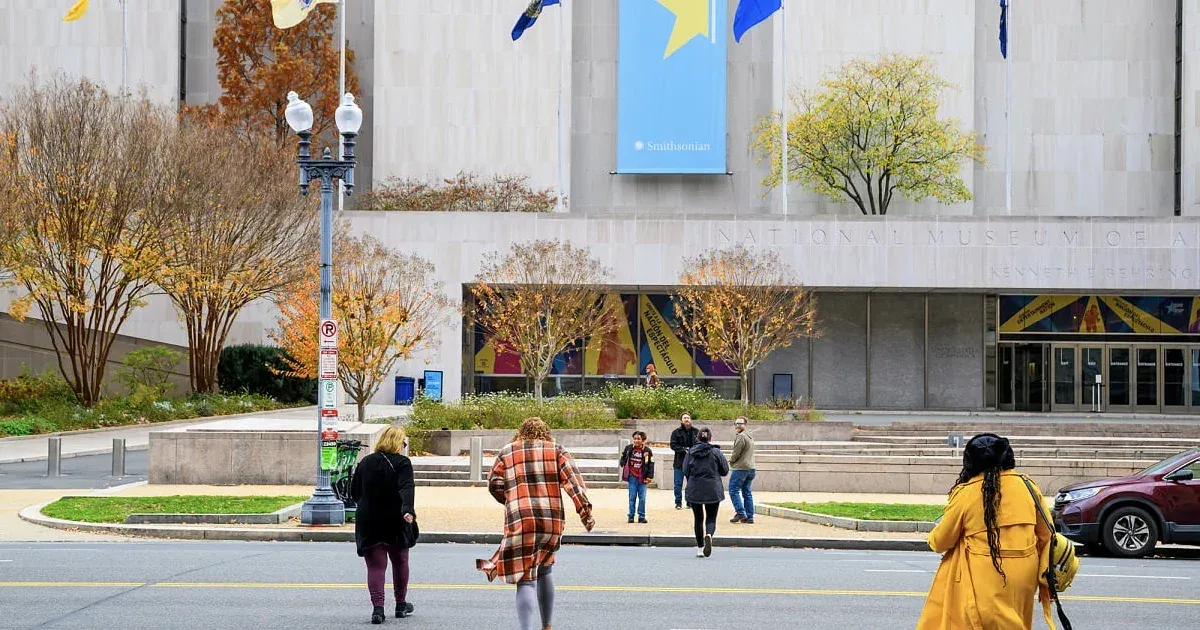
President Donald Trump has ordered warning signs outside Washington's National Museum of American History, directing visitors toward the administration's objections before they enter the Smithsonian building. The order was issued on July 24, 2026, three weeks after the White House published a report attacking the museum's leadership and presentation of the country's past.
The directive moves the dispute from exhibit policy and federal leverage to the public approach outside the museum. Trump says visitors should be alerted to information that he considers inaccurate and shown other resources that the administration regards as reliable.
The Order Assigns the Museum Entrance to Park Officials
Interior Secretary Doug Burgum was instructed to work with the National Park Service on the installation. The signs are to stand along Park Service-maintained sidewalks and walkways used by people entering the museum in Washington, rather than inside galleries controlled by Smithsonian staff.
According to the order, the signs should point to the White House report released on July 4 and explain the administration's demand that its findings be carried out. They are also supposed to direct visitors to other places and materials for what the president describes as accurate American history. NBC News reported no installation date or final wording for the signs. The order also does not identify a single exhibit label for correction; it presents the administration's broader report as the basis for warning people about the museum as a whole.
The directive reaches beyond the Interior Department. Budget Director Russell Vought, the head of the General Services Administration and the White House domestic policy operation were told to use their available powers to advance the policy. That language leaves several agencies involved in a project whose most visible feature would be a message encountered on the way to the museum doors. The order does not specify what each office must contribute, but their inclusion extends the administrative chain from sign installation to budgets, federal property and domestic policy.
A Year-Long Policy Fight Now Has a Public Marker
The July 4 report accused the Smithsonian's leadership of failing to present a unifying account of American history. Trump repeated that argument in the new order, saying the institution treats history as a way to promote social justice and broad social change rather than as a shared national inheritance.
The confrontation began well before this week's signage directive. In March 2025, Trump signed an executive order seeking changes at the Smithsonian and targeting federal support for programs the administration associated with divisive narratives or improper ideology. The new action uses that earlier order as the basis for applying the July report's conclusions. It adds a visitor-facing consequence to a policy that had previously focused on institutional programs and government support, without requiring Smithsonian leaders to accept the report's premise.
Smithsonian Secretary Lonnie Bunch rejected the White House's characterization earlier this month. He said the report did not fairly represent the museum's full work and defended the institution's commitment to telling a broad, evidence-based account of the United States.
“At the Smithsonian, our work is driven by scholarship, accuracy and an uncompromising commitment to tell the fullness of America’s story.”
Bunch also emphasized nonpartisanship, independence and institutional integrity in his response. The Smithsonian declined to comment on Friday about the new order itself, leaving unanswered whether it will formally object to the signs, negotiate their presentation or treat the installation as a matter outside its galleries.
The Signs Will Show How Far the Order Can Reach
A warning on the sidewalk does not revise an exhibit, but it changes the frame through which visitors are asked to view one. It can place the administration's judgment beside the museum's public identity without requiring curators to rewrite a label or remove an artifact. That distinction explains why responsibility was assigned to the Park Service and other executive agencies.
The practical force of the order will depend on details not yet public: the exact language, the size and placement of the signs, the resources they promote and how long the installation remains. Each choice will determine whether visitors encounter a short notice about a government report or a sustained alternative narrative positioned at the museum's entrance.
The first concrete measure will be the signs that actually appear, not the accusations already exchanged. Their wording will reveal whether the administration is documenting a policy dispute or attempting to discredit the museum at the point of entry. The Smithsonian's response will then show whether institutional independence can be maintained when the contested message stands outside its doors but directly in its visitors' path.