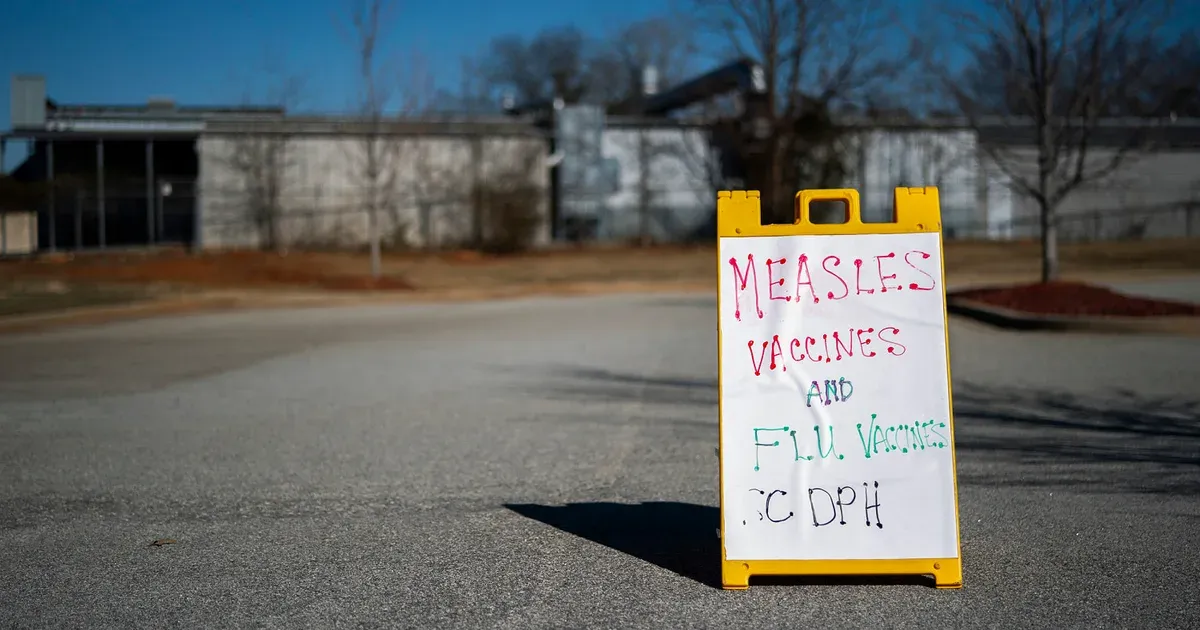
The United States has recorded 2,318 measles cases during the first seven months of 2026, already exceeding the 2,289 cases reported across all of last year. The Centers for Disease Control and Prevention released the updated count on July 24, 2026, placing the country at its highest annual measles total in 35 years even though more than five months remain in the calendar. The figures are preliminary and may be revised as state investigations classify additional reports.
The rise is concentrated among people without documented protection. CDC data cited by NBC News show that 93% of confirmed patients were unvaccinated, while national coverage among kindergartners stood at 92.5% for the 2024-25 school year. Measles spreads so efficiently that public-health agencies generally look for coverage near 95% to provide community-level protection, leaving local gaps capable of sustaining transmission even when the national average appears close.
The current wave began building in early 2025 and has moved through a series of state outbreaks rather than one isolated episode. A West Texas outbreak grew to 762 cases and included the first U.S. measles deaths in more than a decade. South Carolina later reported 997 infections, while Utah has counted more than 700 cases since its outbreak began in June 2025, including 514 during 2026.
“Measles is the canary in the coal mine,” pediatrician Richard Besser told NBC News.
New clusters are now being reported in Arizona, Delaware and Wyoming. Pennsylvania has logged 132 cases, including 27 diagnosed in the latest reported week, and Virginia has recorded 177. Virginia has not added a new case since July 4, an indication that intensive local work can slow transmission, but the expanding national map shows how quickly progress in one area can be offset by growth elsewhere.
Vaccination Gaps Turn Imported Cases Into Long Outbreaks
Measles was declared eliminated from continuous circulation in the United States in 2000, but elimination never meant that imported infections would disappear. The virus can arrive with an infected traveler and then spread where vaccination coverage is low. CDC guidance says state and local health departments lead case investigations, while federal teams can provide laboratory work, genomic sequencing and outbreak support when jurisdictions request help.
The coverage gap is therefore a distribution problem as well as a national percentage. A statewide or nationwide average can conceal schools, neighborhoods or close-knit communities where many people are susceptible at once. In those settings, one case can generate a chain of exposure that demands testing, isolation, contact tracing and rapid vaccination outreach. The 2026 totals reflect multiple chains continuing long enough to overlap.
Vaccination changes both the individual risk and the speed at which those chains can grow. CDC guidance identifies the measles, mumps and rubella vaccine as the best protection against infection and serious complications. For people exposed without evidence of immunity, public-health officials may recommend MMR vaccination within 72 hours or immune globulin within six days. Those narrow windows make prompt reporting important: delays allow additional exposures before a patient is isolated and leave health departments less time to protect susceptible contacts. The response clock begins with the first suspected case, not when a cluster becomes large enough to attract national attention.
The health burden also extends beyond the rash most closely associated with measles. The disease can cause pneumonia, brain inflammation, dehydration and death. In 2025, 12% of reported U.S. patients were hospitalized and three deaths were confirmed, according to CDC clinical guidance. Doctors interviewed by NBC News described high fevers, breathing problems and severe gastrointestinal symptoms among patients during recent outbreaks.
The November Elimination Review Now Has a Clear Test
The Pan American Health Organization is expected to consider in November whether the United States has lost its measles-elimination status. That decision will depend on whether epidemiologists find continuous domestic transmission for at least 12 months, not simply on the headline case count. The strategic test is now straightforward: public-health teams must break the linked chains that began in 2025 while preventing newer clusters from connecting into another year of circulation. The difference between a record outbreak and a restored endemic disease pattern will be measured in local vaccination reach, faster detection and whether health departments can close those chains before the review.