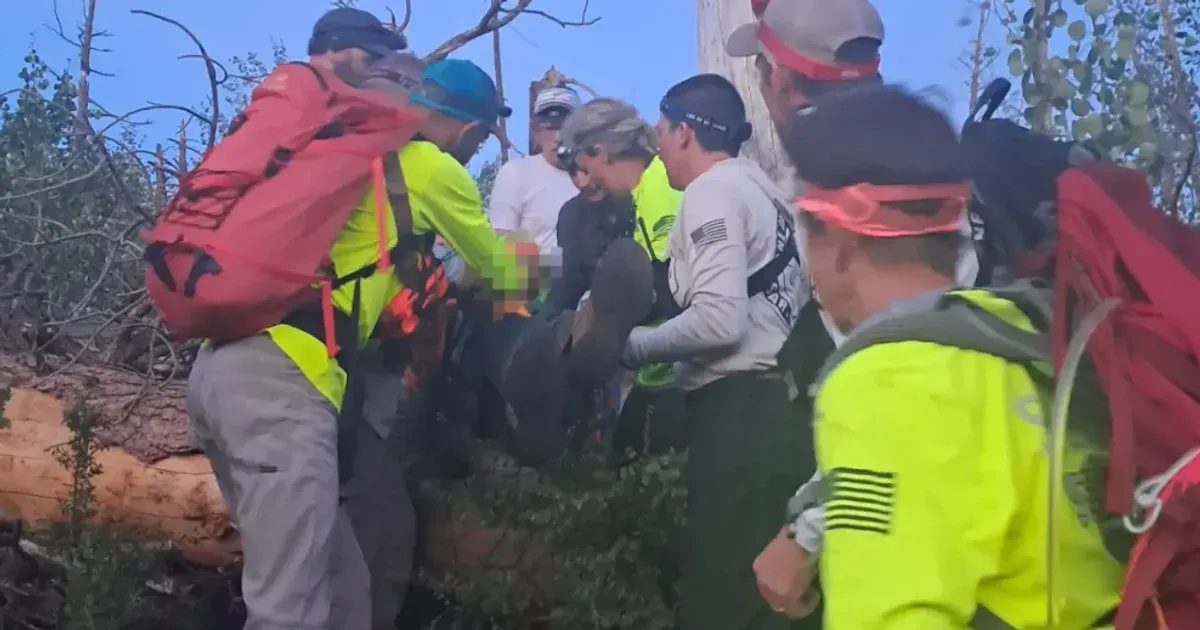
A cellphone location update helped search teams find an 83-year-old Utah man after he spent a night missing in remote terrain near Grand Canyon National Park. Gerald Guinn had separated from his hiking companion on July 21, 2026, and did not return to their meeting point. The National Park Service and Kane County Sheriff's Office ultimately combined air and ground resources to bring him back.
The pair had begun hiking around 12:30 p.m. along the edge of Kaibab National Forest, according to the sheriff's office. They split up while looking for a nearby historic object. Guinn's companion searched for several hours before requesting help, leaving rescuers with a broad area and limited remaining daylight. Because the two had deliberately separated, the missing-person report began without a witness who could identify Guinn's exact route after the split.
Kane County's search-and-rescue team worked through the night with drones and search dogs. Neither method located Guinn. Grand Canyon National Park personnel then took over the operation the next morning, adding a helicopter and ground crews, while the county team returned later that afternoon to support the expanded effort. The unsuccessful overnight work still established where Guinn had not been found and kept the search active until daylight made aviation possible. Each hour also increased the importance of locating an older hiker exposed to nighttime cold without assuming that he could reach a road on his own.
The change in command did not end cooperation between the agencies. It added aviation and park knowledge to the county's overnight work, then brought the same county rescuers back when the search narrowed. That sequence allowed teams to keep moving rather than restart the operation when responsibility shifted across the park and forest boundary. It also matched different tools to different phases: dogs and drones for the night search, then a helicopter and coordinated ground teams after daybreak.
A Cellphone Signal Moved the Search East
Early in the afternoon, the National Park Service received a cellphone ping that indicated Guinn's general location. The signal shifted the search east, and a park helicopter soon spotted him from the air. Guinn was alert enough to wave at the pilot, giving crews their first direct confirmation that he was alive. A moving location estimate was more useful than the original meeting point because it redirected aircraft and people toward the area where his phone was actually registering.
The aircraft could find him but could not land because of the terrain. A Kane County ground team was sent to reach him, assess his condition and stabilize him for removal. Rescuers found Guinn in good spirits but cold and unable to walk. They supplied liquids and warm layers before beginning the trip back toward a road. His inability to walk changed the assignment from contact and guidance to a staffed carry over ground that had already prevented the helicopter from landing.
The Last Mile Required Twenty People on the Ground
Locating Guinn solved the search problem, but not the extraction. About 20 people were needed to move him through the area. Team members carried him, cleared fallen logs and marked hazards for those following behind. A paramedic joined the county crew during the transport, turning the return route into a continuous medical and logistics operation rather than a simple walk out. Clearing and marking the path also protected the rescuers rotating through the carry, since a fall or blocked route could have delayed the patient and created another emergency.
Guinn reached the road and was examined by Kane County emergency medical services before being cleared and released. The operation ended around 1:30 a.m., roughly a day and a half after the hike began. Its timeline shows why a remote rescue can remain labor-intensive even after technology supplies a location: the cellphone ping and helicopter reduced uncertainty, but people on the ground still had to cross the terrain, protect the patient from cold and build a safe path to medical care. The successful outcome came from that sequence, not from any single device or agency acting alone. The final medical clearance also confirmed that the long carry had delivered Guinn without requiring hospital treatment after he reached the road.