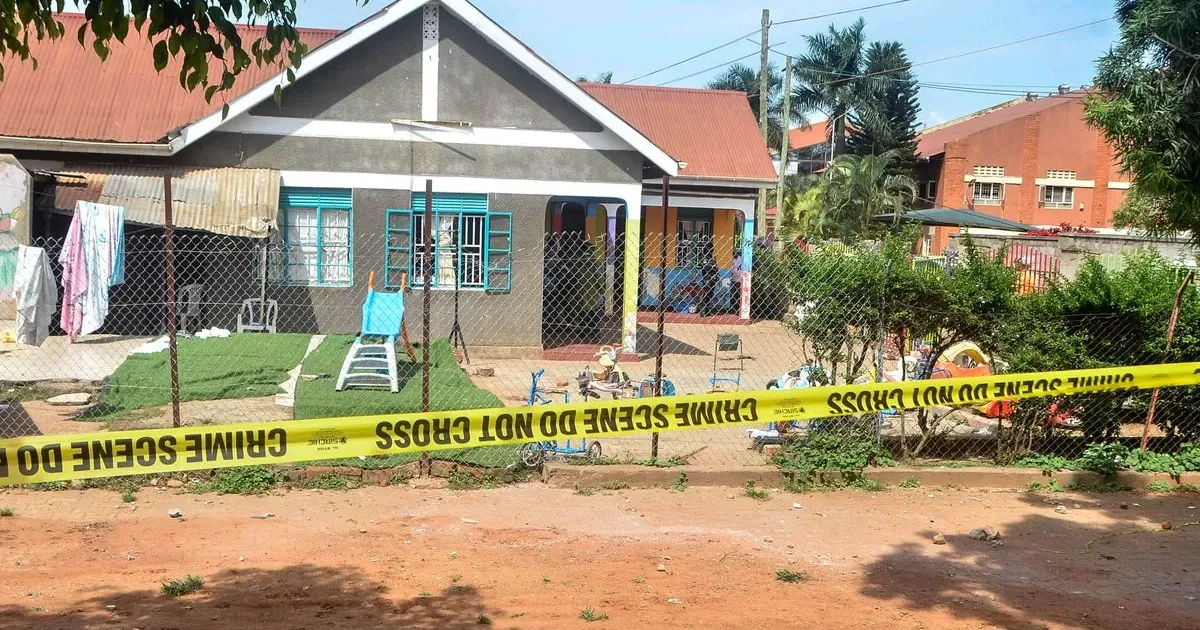
Kampala Metropolitan Police officers detained a male suspect on April 2, 2026, in response to a lethal stabbing incident at a local nursery school where four toddlers died from their wounds. Violence erupted during early morning hours at the kindergarten facility, leaving the capital city in a state of mourning as emergency responders arrived to find a chaotic scene. Investigators took the unidentified assailant into custody immediately at the site of the attack. Police cordoned off the perimeter while forensic teams began gathering evidence from the classroom where the murders occurred. Initial reports indicate the perpetrator used an edged weapon to target the young victims before staff members could intervene or call for help.
Detectives have not yet released the identity of the assailant.
Witnesses described a scene of absolute terror as parents rushed to the school upon hearing rumors of the violence on social media. Officers from the Kampala Metropolitan Police established a secure zone to prevent distraught relatives from contaminating the crime scene. Medical personnel confirmed that all four victims were deceased by the time ambulances reached the location. Bloodstains marked the entrance of the nursery, a facility that serves dozens of families in the surrounding urban district. Local news outlets reported that the suspect did not attempt to flee when the first patrol cars arrived, suggesting a deliberate and stationary act of violence.
Kampala Metropolitan Police Secure Scene
Law enforcement officials focused their immediate efforts on securing the facility and ensuring no other threats persisted within the school grounds. Primary evidence suggests the attacker entered the premises through a main gate that may have been left unattended during the morning drop-off period. Authorities have seized several items of interest, including the suspected murder weapon, which forensic specialists are currently analyzing for biological markers. Officers conducted door-to-door inquiries in the immediate neighborhood to determine if the suspect lived nearby or had been seen loitering in the days preceding the attack. Intelligence units are currently scrubbing the suspect's digital history to find any indication of premeditation or extremist leanings.
"The suspect is in custody but his motive is unknown," according to a brief statement issued by the Kampala Metropolitan Police.
Public records indicate the school operated as a private entity, a common arrangement in Uganda where the state often relies on individual entrepreneurs to fill gaps in early childhood education. Security at such institutions varies widely, often consisting of a single unarmed guard or a simple padlock system. Investigators are questioning the school management regarding their vetting processes for visitors and temporary staff. Neighbors reported that the facility had been a quiet fixture of the community for several years, making the sudden outburst of lethal force even more difficult for residents to comprehend.
Legislative Gaps in Private School Oversight
Ugandan law mandates certain safety standards for educational institutions, yet enforcement remains a meaningful challenge for the Uganda National Bureau of Standards and the Ministry of Education and Sports. Regulatory frameworks often prioritize curriculum content over physical security requirements or mental health screening for employees and visitors. Private kindergartens frequently operate in residential buildings that have been repurposed without serious structural upgrades to handle emergency lockdowns. National statistics show that thousands of these small-scale nurseries exist across the country, many of them operating with expired licenses or no formal registration at all. Government oversight committees have previously warned that the lack of standardized security protocols leaves children vulnerable to targeted attacks.
Legislators in the Ugandan Parliament have struggled to pass full safety bills that would require mandatory background checks for everyone entering school premises. Resistance often comes from small business owners who argue that high compliance costs would force them to close their doors. This financial barrier leaves many urban schools without basic surveillance equipment or trained security personnel. Budgetary constraints at the local level mean that school inspectors rarely visit private nurseries more than once a year. So, the burden of protection falls almost entirely on underfunded staff members who lack the training to handle violent intruders.
History of School Violence in Central Uganda
Security concerns in Ugandan schools are rooted in a history of regional instability and high-profile attacks by organized groups. The 2023 massacre at Lhubiriha Secondary School, where dozens of students were killed by Allied Democratic Forces militants, forced a national conversation about campus safety. While the April 2, 2026, incident appears to be a criminal act by a lone individual, it taps into a deep fear regarding the safety of educational spaces. Past incidents in the central region have often involved arson or corporal punishment gone wrong, but targeted stabbings of toddlers are exceptionally rare in the domestic criminal record. Local leaders are now calling for a permanent police presence near all major school clusters in the capital.
Internal security documents suggest that the threat profile for schools has shifted toward individual actors with personal grievances. Police records from the last decade show a rise in domestic disputes spilling over into public institutions. Analysts at the Makerere University Institute of Social Research point toward a growing trend of urban alienation and its link to random acts of violence. Without a powerful social safety net, individuals suffering from acute psychological distress often go unnoticed until they reach a breaking point. The government has focused heavily on counter-terrorism, sometimes at the expense of addressing the root causes of localized criminal behavior.
Mental Health and Security Failures in Urban Centers
Kampala has seen its population swell to over 1.6 million residents, creating a dense urban environment where traditional community monitoring systems have broken down. Rapid urbanization has outpaced the growth of social services, including mental health clinics and crisis intervention teams. Public health data indicates that only a fraction of people with severe psychological conditions receive any form of medical support in the city. This gap in care creates a dangerous vacuum where individuals can become radicalized or simply succumb to violent impulses without detection. Security experts argue that no amount of physical fencing can replace a functioning community health system that identifies risks before they manifest.
Funding for mental health services in the most recent national budget was less than 1 percent of the total healthcare spend. High unemployment rates and the rising cost of living in the capital further worsen social tensions among young men. Law enforcement agencies have traditionally focused on reactive measures, such as arrests and prosecutions, rather than investing in preventative social work. The April 2, 2026, tragedy is a brutal illustration of how quickly neglect in the social sector can translate into a physical security crisis. Community leaders in the affected district are now organizing vigils while demanding that the government allocate at least $50 million toward a national school safety fund.
Government ministers have promised a full report on the security failures that allowed the suspect to enter the kindergarten. Public pressure is mounting on the Ministry of Internal Affairs to provide more transparency regarding the suspect's background and previous criminal record. Many parents have opted to keep their children home from school until the police provide a guarantee of safety. Small businesses in the vicinity of the crime scene stayed closed throughout the afternoon as a mark of respect for the grieving families.
The Elite Tribune Strategic Analysis
Sovereignty means little when a state cannot protect its smallest citizens within the four walls of a classroom. The horrific events in Kampala on April 2, 2026, expose the hollow nature of the Ugandan security apparatus, which has spent decades perfecting the surveillance of political dissidents while leaving kindergartens to rot in a regulatory vacuum. This is the inevitable result of a government that prioritizes regime survival over the mundane but essential task of civil administration. By allowing thousands of private nurseries to operate without mandatory security vetting or structural safety requirements, the state has effectively outsourced its duty of care to the lowest bidder.
One must ask why the Kampala Metropolitan Police, an organization that can deploy thousands of officers to crush a street protest within minutes, was unable to secure a single nursery gate. The answer lies in the systemic misallocation of resources that characterizes East African governance. While the intelligence services are busy monitoring encrypted chats for signs of sedition, they are blind to the localized threats growing in their own backyard. The incident is not an anomaly; it is the logical conclusion of a system that views security through the lens of power preservation instead of public safety.
If the Museveni administration fails to enact immediate, federally mandated security standards for every school in the country, it is not merely negligent but complicit in the next tragedy.
The blood of these four toddlers is a permanent stain on a bureaucracy that values paper licenses more than human life. Empty promises of investigations and committee reports will not suffice. Only a total overhaul of the Education Act and an enormous infusion of capital into urban security will prevent the next knife from finding its mark. The time for diplomatic silence is over.