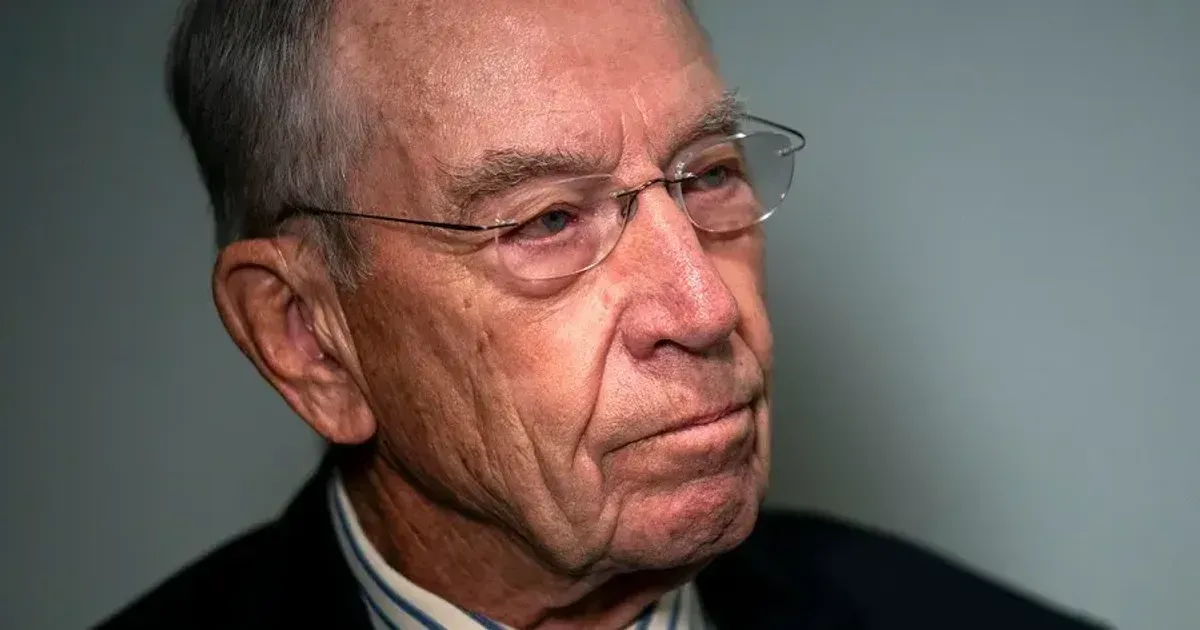
Chuck Grassley took to his digital pulpit to voice a rare dissent from the Republican ranks. The senior senator from Iowa posted a blunt assessment on the social media platform X. He labeled the recent decision to ease restrictions on Russian petroleum as a strategic error. The criticism was reported on March 13, 2026, as U.S. Russian oil policy drew pressure from allies and lawmakers. President Donald Trump moved to suspend these sanctions late Thursday evening. Domestic gasoline prices have climbed steadily since military operations began in the Middle East. The administration sought to inject more supply into the global market to counteract the volatility. Military analysts point to the joint US-Israeli strikes on Iranian nuclear and energy infrastructure as the primary driver of the current price surge. Crude oil futures spiked nearly 15 percent within 72 hours of the first missile barrages. Motorists in swing states are now paying upwards of five dollars per gallon. Grassley focused his criticism on the financial implications for Moscow. He argued that allowing the sale of Russian oil provides the Kremlin with the capital necessary to sustain its ongoing invasion of Ukraine. His stance mirrors long-held concerns within the traditional wing of the GOP. This decision arrived just as the Treasury Department finalized similar waivers for shipments to New Delhi.
Grassley Breaks With the Oil Policy
Conservative lawmakers generally support the expansion of domestic drilling and deregulation. But the explicit rehabilitation of Russian trade routes has fractured the party's unified front on energy independence. Grassley emphasized that revenue from these sales directly finances the production of Russian munitions. He remains one of the few high-ranking Republicans willing to openly challenge the White House on matters of foreign policy and trade. For one, the senator has long prioritized the geopolitical stability of Eastern Europe over short-term economic relief at home.
Temporarily removing sanctions 4 Russian oil is [the] wrong move.
Internal polling from the White House suggests that high energy costs remain the single largest threat to the administration approval ratings. Advisors have scrambled to find alternative sources of crude after Iranian exports were effectively neutralized by regional combat. The short-term waiver is a calculated attempt to stabilize the consumer price index before the spring travel season. Industry data shows that Russian tankers have already begun preparing for increased throughput at Baltic ports. Skepticism persists regarding the long-term effectiveness of such a reprieve. For instance, the global tanker fleet is already strained by insurance limitations and navigation risks in the Red Sea. Removing the legal barriers to Russian sales does not necessarily guarantee an immediate drop in retail prices. The price of Brent crude reached 112 dollars per barrel on Friday.
Zelensky and Merz Add Pressure
Volodymyr Zelensky reacted with visible frustration during a televised address from Kyiv. The Ukrainian president suggested that the American move undermines years of diplomatic efforts to isolate the Russian economy. He characterized the policy as an indirect subsidy for the very forces bombarding Ukrainian cities. Kyiv has consistently called for a total embargo on Russian hydrocarbons to dry up the Kremlin war chest. This 30-day window provides a lifeline that Ukrainian officials believe will be used to regroup and rearm. In Berlin, Friedrich Merz echoed these sentiments with a focus on continental security. The German leader has been a proponent of total energy decoupling from the East since the conflict began years ago. Merz argued that the American waiver creates a loophole that other nations will inevitably exploit. Washington has long pressured European capitals to maintain a hard line against the Kremlin. The sudden shift in American policy was made without adequate consultation with NATO allies. Transatlantic relations are at a point of high tension. Still, the reality of the German industrial sector requires consistent energy inputs that the current market cannot provide without significant cost. Merz finds himself in a difficult position as he balances the need for security with the economic demands of his constituents. He noted that the credibility of the Western sanctions regime depends on consistency and mutual trust. By contrast, the current American approach appears to prioritize domestic political survival over international commitments. The European Union is now considering its own set of independent energy regulations to counter the volatility of American policy.
Iran War Complicates Supply Choices
India has become a critical intermediary in the global oil trade. Since the initial escalation of the Eastern European conflict, New Delhi has sharply increased its imports of Urals crude. This oil is often refined in Indian facilities and then sold to European and American markets as non-Russian products. The Trump administration's decision to formalize this arrangement through the 30-day relief measure effectively acknowledges a reality that has existed in the shadows for months. Separately, the Indian government has signaled it will continue to prioritize its own energy security regardless of Western pressure. Oil remains the lifeblood of the global economy.
Energy experts at the International Energy Agency noted that the loss of Iranian supply removed approximately two million barrels per day from the market. The joint US-Israeli operation targeted the Kharg Island terminal, which serves as the primary hub for Iranian exports. Damage to the facility is expected to take months to repair. Meanwhile, the global supply gap has forced even the most ardent hawks to reconsider their stance on Russian exports. The administration argues that the risk of a global recession outweighs the benefits of maintaining the oil blockade.
Traders on the London ICE exchange anticipate continued volatility as the 30-day window approaches its expiration. The technical requirements for processing Russian crude vary sharply from the light sweet crude typically sourced from the Middle East. Refineries in the Gulf Coast must recalibrate their equipment to handle the heavier Russian grades. Such transitions often take weeks to implement, potentially blunting the immediate impact of the policy change. Market analysts are watching to see if the waiver will be extended beyond its initial timeframe.
Kremlin Revenue Shapes the Stakes
Russian officials have welcomed the announcement with cautious optimism. Spokespeople in Moscow indicated that the country is prepared to fill the supply gap left by the Iranian shutdown. They did not comment on whether the new revenue would be earmarked for military expenditures. In fact, the Kremlin has already adjusted its fiscal projections for the coming quarter to account for the expected influx of foreign currency. The Russian central bank has also stabilized the ruble in response to the news. Diplomacy usually dictates a coordinated approach to economic warfare, but the current administration has favored a more transactional model.
Economic data from the fourth quarter indicates that Russia has managed to maintain a resilient trade balance despite previous sanctions.
Energy Policy Tests Wartime Alliances
Does the price of a gallon of regular unleaded in Ohio justify the continued bombardment of Kharkiv? The current administration seems to believe so, operating under a brand of ruthless pragmatism that treats international alliances as disposable assets. By lifting sanctions on Russian oil to mask the consequences of its own military adventures in Iran, the White House has effectively funded both sides of a global conflict. This is not leadership, it is an admission of failure in energy independence. If the United States were truly the energy powerhouse it claims to be, it would not be forced to beg for barrels from a regime it spent years trying to bankrupt. The 30-day waiver is a desperate bandage on a sucking chest wound of foreign policy. It signals to every adversary that American principles are for sale whenever the domestic inflation rate ticks upward. Zelensky and Merz are right to be outraged, not just because the policy helps Russia, but because it proves the word of the United States has become a depreciating currency.
Real stability comes from a consistent strategy, not from toggling the ethics of trade based on the latest polling data from the pump. The Kremlin is laughing as the West pays for the very missiles that target its allies.