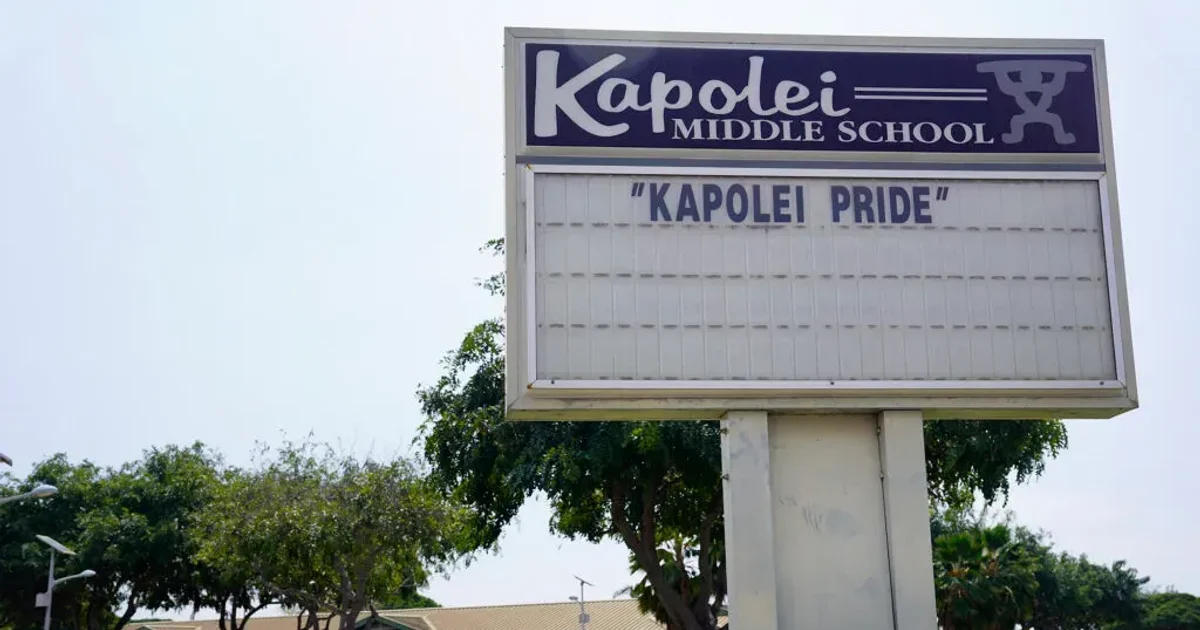
The pepper spray incident at Kapolei Middle School deserves more care than a simple police-versus-counselors argument allows. Public reports say Honolulu police responded after an after-school fight, three girls were arrested, and pepper spray was deployed as officers tried to control the scene. The students are minors, so the public discussion should focus on policy, not personal detail.
Schools cannot ignore fights or pretend every conflict can be mediated after it has already escalated. The question is whether Hawaii's school safety system gives adults enough options before a student conflict turns into a chemical-force event. Pepper spray may be an authorized police tool, but its use around middle school students carries medical, emotional and trust costs that make the standard for deployment especially important.
Kapolei shows the handoff problem
A school fight begins as a campus discipline and safety issue. Once police enter the scene, it can become an arrest and use-of-force review. The shift changes everything for students, parents, administrators and officers. A chaotic crowd may require fast action, but speed does not remove the need for clear policy.
The Kapolei case sits exactly in the gap between campus discipline and police action. Officers were reportedly trying to make an arrest when others interfered and pepper spray was used. Supporters of the response will argue that officers were outnumbered and needed to stop escalation. Critics will argue that chemical spray in a school environment should be treated as a last-resort tool, especially when bystanders can be exposed.
Counselors cannot replace emergency response
Advocates are right to press Hawaii for more counselors, social workers and trained de-escalation teams. More behavioral-health capacity can reduce the number of conflicts that reach police. It can also help identify students who are repeatedly involved in fights before the next incident becomes public and punitive.
But counselor-based response has to be discussed honestly. A counselor may prevent tomorrow's fight through relationships, mediation and support. A counselor cannot always stop today's physical struggle once bodies are moving and a crowd is forming. Schools need prevention and emergency response, not a slogan pretending one can replace the other.
Police policy needs child-specific rules
General use-of-force policy is not enough for a middle school campus. Officers responding to children need rules that account for age, disability, trauma, crowd density, asthma risk, panic and the likelihood that students nearby may be hit by spray even if they are not targets. Chemical force in a school should trigger documentation beyond a normal arrest report.
The paperwork should answer basic questions: why pepper spray was chosen, what alternatives were considered, who was exposed, what medical checks were offered, whether parents were notified quickly and how the school separated discipline decisions from health needs. A policy that cannot answer those questions leaves everyone arguing from rumor.
Parents need fast, plain information
After any force incident involving students, silence damages trust. Parents need to know whether their child was exposed, whether medical evaluation was available, whether the campus is safe and what review process will follow. A vague message about an incident being handled is not enough.
Clear communication also protects staff and officers from distorted accounts. If officials believe the use of force was necessary, they should be able to explain the sequence without naming minors or releasing sensitive student information. If the review finds mistakes, parents deserve to hear what will change before the next campus fight.
Discipline has to be predictable
School systems lose control when students believe consequences are random, delayed or dependent on whether police happen to arrive. Discipline cannot be only therapeutic, and it cannot be only punitive. Students need predictable rules, adults need authority to intervene early, and families need to know how repeated violence will be handled.
Predictable discipline should include restorative options when appropriate, suspensions or arrests when legally required, and ongoing support for students who are unsafe, targeted or repeatedly involved in conflict. The weakest model is a vacuum: too little prevention, too little consequence and then a sudden police response when the situation becomes visible.
Order should not depend on spray
Kapolei should push Hawaii officials toward a better school safety architecture. That means more counselors, clearer police thresholds, child-specific force rules, better parent notification and after-action reviews that are public enough to build trust while still protecting minors.
A school system should not need pepper spray to prove it can keep order. It also should not pretend that serious fights will vanish through good intentions alone. Hawaii should prevent more conflicts before police are needed, and when police are needed, make sure the response is proportionate, documented and shaped for children rather than a street-corner crowd.