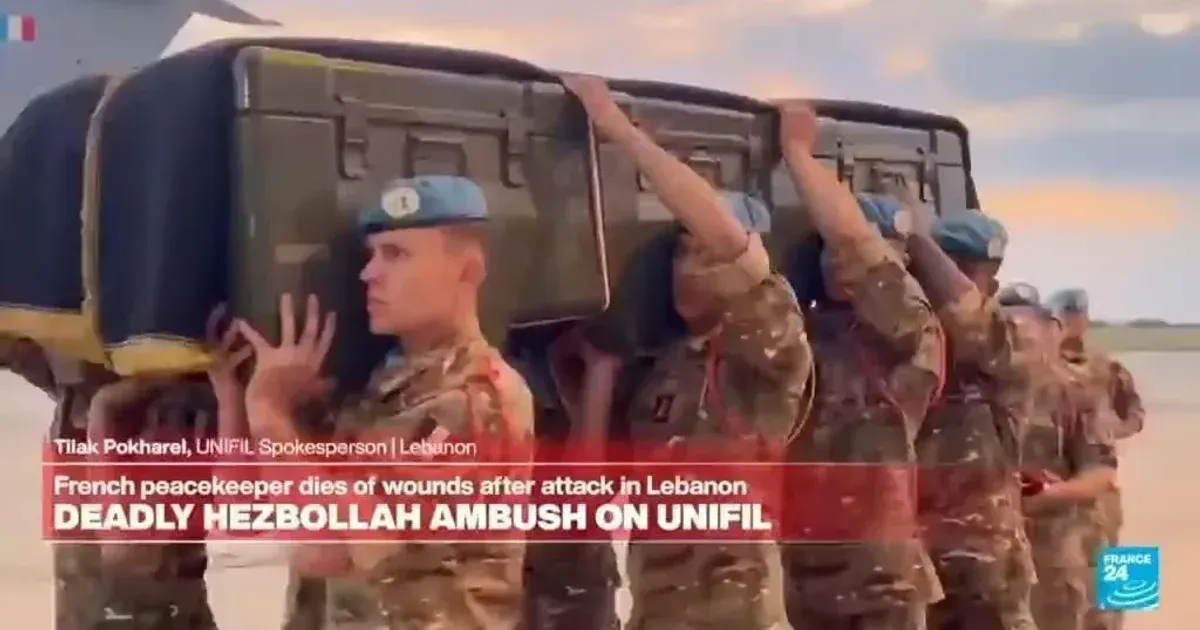
The death of a second French peacekeeper after a southern Lebanon ambush deepens scrutiny of UNIFIL’s ability to operate amid attacks on soldiers and journalists. President Emmanuel Macron announced on April 22, 2026, that a second French peacekeeper died after an attack on United Nations forces in southern Lebanon. Medical teams at a regional military hospital confirmed the death after the soldier failed to recover from critical wounds sustained during a weekend ambush. Hezbollah militants reportedly carried out the strike in a contested border zone where tensions between international forces and local proxies remain at peak levels. Staff Sergeant Florian Montorio, the first casualty of the incident, was shot dead during the Saturday engagement when a convoy came under direct fire. Doctors struggled to stabilize the second victim for four days before the soldier succumbed to his injuries on Wednesday morning.
French Peacekeeper Toll Rises Following Ambush
French officials identified the deceased as a member of the elite peacekeeping contingent deployed to maintain the fragile buffer near the Blue Line. Hezbollah leadership issued a swift denial of responsibility for the Saturday ambush, contradicting French intelligence assessments that linked the attack to Iran-backed cells. Violence in the sector has surged since early spring, placing international observers in the crosshairs of a conflict they were sent to monitor. France maintains one of the largest national contributions to the United Nations Interim Force in Lebanon, known as UNIFIL, which operates under a mandate that has faced increasing scrutiny from all sides of the political divide.
President Emmanuel Macron said on Wednesday that a second French soldier had died following an attack on United Nations peacekeepers in Lebanon last week, which he said was carried out by Iran-backed Hezbollah.
Tilak Pokharel, the official spokesperson for UNIFIL, confirmed that the mission is conducting a forensic investigation into the logistics of the ambush. Convoy movements in the south are typically coordinated with the Lebanese Armed Forces, but gaps in communication have grown frequent during recent months. Peacekeepers now travel in armored vehicles with high-alert status, yet these precautions did not prevent the fatal wounding of the two French nationals. Security analysts in Paris suggest the attack was a deliberate attempt to pressure Western nations to withdraw their military presence from the region. France has refused to alter its deployment schedule despite the rising body count among its personnel.
Southern Lebanon Airstrikes Target Members of the Press
Rescuers in the southern Lebanese town where Amal Khalil resided recovered the journalist’s body on Wednesday after an Israeli airstrike demolished a residential structure. Khalil, a leading voice in local media, was covering the impact of border hostilities on civilian populations when the missile struck. Israeli military officials stated the operation targeted a nearby operational hub used by armed groups for reconnaissance. Civil defense teams spent several hours clearing rubble to reach the site where Khalil was found alongside several other casualties. Journalism advocates in Beirut called for an international inquiry into the targeting of media professionals in active combat zones.
Two other Lebanese journalists suffered severe injuries during a separate Israeli airstrike on April 22, 2026, while filming near the border. Employers of the wounded reporters stated the group was clearly identified with press insignia and was positioned in an area previously designated as safe for media activity. Shrapnel from the explosion caused deep lacerations and fractures, requiring an emergency evacuation to a hospital in the city of Tyre. Israel has consistently maintained that its air operations are directed solely at military infrastructure, though the frequency of journalist casualties has prompted sharp rebukes from human rights organizations. Reports indicate that over a dozen media workers have been caught in crossfire since the current cycle of escalation began.
UNIFIL Mission Security and Rising Border Hostility
Attacks on international peacekeepers and the press illustrate the total breakdown of the security protocols established under Resolution 1701. Tilak Pokharel emphasized in a recent interview that the mission’s ability to move freely is being hampered by both official and unofficial blockades. Local residents in some southern villages have staged protests against UNIFIL patrols, occasionally resulting in physical altercations and vehicle damage. Iranian influence in the region continues to manifest through logistical support for the groups conducting these harassing maneuvers.
Political stability in Lebanon persists as a distant goal while the central government in Beirut remains unable to exercise authority over the southern militias. The presence of nearly 10,000 peacekeepers has not deterred the daily exchange of rockets and artillery fire between the warring factions.
Media outlets in the region are operating under extreme duress as both Israeli strikes and local intimidation tactics limit reporting capabilities. Amal Khalil was known for her detailed accounts of life in the border towns, providing a perspective that often clashed with official military narratives. Her death marks a sharp loss for the Lebanese press corps, which has already seen its numbers dwindle due to safety concerns. This environment of heightened risk has forced many international news agencies to pull their staff back to the capital or operate with minimal ground presence. Conflict dynamics in the south are now largely documented through grainier drone footage and unverified social media reports.
France’s military history in Lebanon is long and full of significant losses, including the 1983 bombing that killed dozens of French paratroopers. Macron’s decision to maintain the current troop levels is a continuation of that historical commitment to the Levant. Defense officials in Paris are currently reviewing the rules of engagement for their peacekeepers to allow for more solid self-defense during convoy transits. If the casualties continue to mount, the French public may begin to question the strategic value of a mission that appears incapable of enforcing its own mandate. Southern Lebanon has become a theater where international diplomacy is failing to keep pace with the lethality of modern proxy warfare.
Lebanon Ambush Exposes UNIFIL’s Failing Mandate
Can a peacekeeping force actually maintain peace when neither side of the border recognizes its legitimacy? The death of a second French soldier in southern Lebanon exposes the terminal decay of the UNIFIL mandate. Western leaders, including Emmanuel Macron, continue to treat Lebanon as a sovereign state while the reality on the ground confirms it is a playground for Hezbollah and Israeli military objectives. UNIFIL has transitioned from a monitoring force into a collection of expensive targets, serving no tactical purpose other than to provide a veneer of international concern. France is clinging to its colonial-era influences in the Levant, but the price of that nostalgia is being paid in the lives of staff sergeants like Florian Montorio.
Israel’s strategy of precision strikes, which repeatedly claim the lives of journalists like Amal Khalil, suggests a total disregard for the presence of observers. By eliminating the eyes on the ground, the warring parties can dictate the narrative of the conflict without the interference of objective reporting. Lebanon is effectively partitioned between a paralyzed government and a militant wing that answers only to Tehran. Macron’s rhetoric about holding perpetrators accountable rings hollow when Paris lacks the leverage to force a change in the regional security architecture. Unless the United Nations shifts from peacekeeping to peace-enforcement, these casualties will be viewed as the inevitable overhead of a failing diplomatic experiment. The border is a graveyard of resolutions.