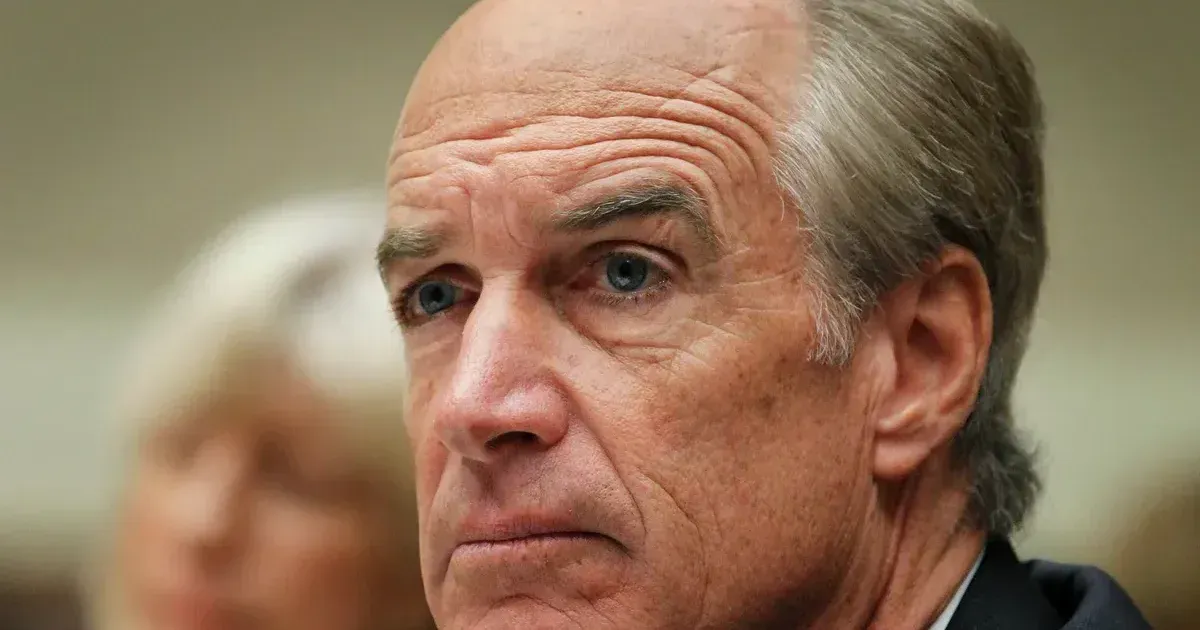
Dirk Kempthorne’s death prompted tributes from Idaho officials and former federal colleagues who worked with him across three decades. His career connected municipal politics, the governor’s office, the Senate and the Interior Department. The announcement also renewed attention to a Western Republican style built around land, water and local authority. Dirk Kempthorne, who navigated the heights of Republican power from the Idaho statehouse to the President’s cabinet, died on April 24, 2026, though his family officially confirmed the loss on April 25, 2026. Boise residents and political figures across the country woke to news of the passing of a leader who defined Western conservatism for three decades. He was 74.
Family members released a written statement on April 25, 2026, noting he passed away on Friday evening in his beloved home city. While a specific cause of death was not immediately cited, the former statesman had been public about his diagnosis of colon cancer during the previous year. He leaves behind a legacy that bridged the gap between local municipal management and the complex oversight of the nation’s public lands. Beyond his public service, he was a devoted husband, father, and grandfather whose greatest joy came from time spent with family and the people he met along the way. He had a rare gift for truly seeing others, remembering names, stories, and the small details that made each person feel known and valued.
Kempthorne first entered the political fray at age 34 when he was elected mayor of Boise. His seven-year tenure in the mayor's office coincided with a period of rapid expansion and urban renewal for Idaho’s capital. He leveraged that local popularity into a successful bid for the U.S. Senate in 1992, taking over the seat previously held by Sen. Steve Symms. His arrival in Washington coincided with a shift in the Republican platform toward decentralized governance and Western land rights.
Boise Political Ascent and Senate Legacy
Senate colleagues from the 1990s recall a man who prioritized Idaho’s specific needs over national partisan bickering. He focused on unfunded mandates and federal overreach, issues that connected deeply with his constituent base in the Pacific Northwest. Instead of seeking a second term in the Senate, he chose to return to Idaho to run for the governorship in 1998. The voters rewarded this decision with a landslide victory.
Election night in 1998 saw Kempthorne secure more than two-thirds of the total vote. He defeated his Democratic opponent by one of the largest margins in state history. His time in the governor’s office was defined by an enormous push for infrastructure modernization. He introduced the GARVEE bond program, which allowed Idaho to borrow against future federal highway funds to accelerate road construction projects. His administration claimed these investments were necessary to keep pace with the state's exploding population.
Governance under Kempthorne also prioritized family-centric policies. He and his wife, Patricia, championed initiatives for early childhood education and public school funding. Idaho Governor Brad Little, who served under the Kempthorne administration’s shadow, noted that these transformational investments in transportation and education continue to benefit residents. The former governor’s focus on the nuclear family was a hallmark of his public persona.
Interior Department Tenure and Polar Bear Protection
President George W. Bush recruited Kempthorne to join the federal cabinet in 2006. As the 49th U.S. Secretary of the Interior, he assumed responsibility for 500 million acres of federal land and the management of the nation’s natural resources. His confirmation came in a time of intense friction between energy extraction interests and conservation groups. He attempted to maintain a middle ground that often drew fire from both sides of the aisle.
Interior Department history will record the 2008 decision to list the polar bear as a threatened species under the Endangered Species Act. This move was the first time the federal government officially recognized the impact of melting sea ice on a specific species' survival. Environmentalists argued the listing did not go far enough because it included carve-outs for oil and gas exploration in the Arctic. He stood by the decision as a balanced application of the law. Kempthorne lived on a houseboat named Homeward Bound during his years in Washington. The 60-foot vessel was docked in the Potomac River, acting as a unique residence for a cabinet secretary. He told visitors that the boat reminded him of the rugged, water-rich environments of his home state. This unconventional choice of housing humanized a man tasked with making high-stakes decisions about the American wilderness.
Humanitarian Efforts and Afghan Evacuations
Post-political life did not signal a retreat from the world stage for the former secretary. He remained active in international humanitarian circles and the George W. Bush Presidential Center. His most urgent late-career project involved the chaotic 2021 withdrawal from Afghanistan. Kempthorne joined a frantic effort to assist allies who had supported the U.S. mission during the twenty-year conflict. Working alongside a small group of former officials, he helped enable the evacuation of nearly 400 U.S. citizens and Afghan partners. The group raised private capital to fund charter flights for individuals being hunted by the Taliban. He spoke about this experience in 2023, describing the desperate months spent coordinating logistics to get vulnerable families to safety. These actions illustrated a commitment to personal loyalty that went beyond his official retirement from office.
Idaho political veterans often point to Kempthorne’s ability to build consensus as his primary strength. He was a practitioner of a style of politics that relied on personal relationships and institutional respect. His death marks the departure of a leader who saw public service as an extension of neighborly duty. Flags across Idaho will fly at half-staff to honor a man who moved from city hall to the halls of the Interior Department without losing his Boise roots.
Kempthorne’s Pragmatic Western Republicanism Leaves a Lasting Legacy
Kempthorne walked a line between corporate extraction and federal conservation that has effectively vanished from the American West. He was the last of the pragmatic Western Republicans who could navigate the Endangered Species Act without triggering an immediate constitutional crisis. His decision to list the polar bear in 2008 was not an act of environmental activism but a calculated legal concession to prevent more radical court-ordered mandates. He understood that to save the system, he had to occasionally bend to the science that his party’s donor class preferred to ignore. His legacy is a paradox of development and preservation.
While he paved Idaho with GARVEE bonds, he also protected the most iconic predator of the North. This duality is what current political discussion lacks. Kempthorne did not view the Interior Department as a weapon for partisan warfare but as a large, complex machine that required a mechanic's touch. His move from the Senate back to the governorship remains a rare example of a politician valuing executive results over the perceived prestige of a lifetime seat in Washington. He was a gentleman in a profession that has since traded its manners for social media engagement. Western politics is now louder, but it is certainly less effective without his brand of quiet, persistent diplomacy.