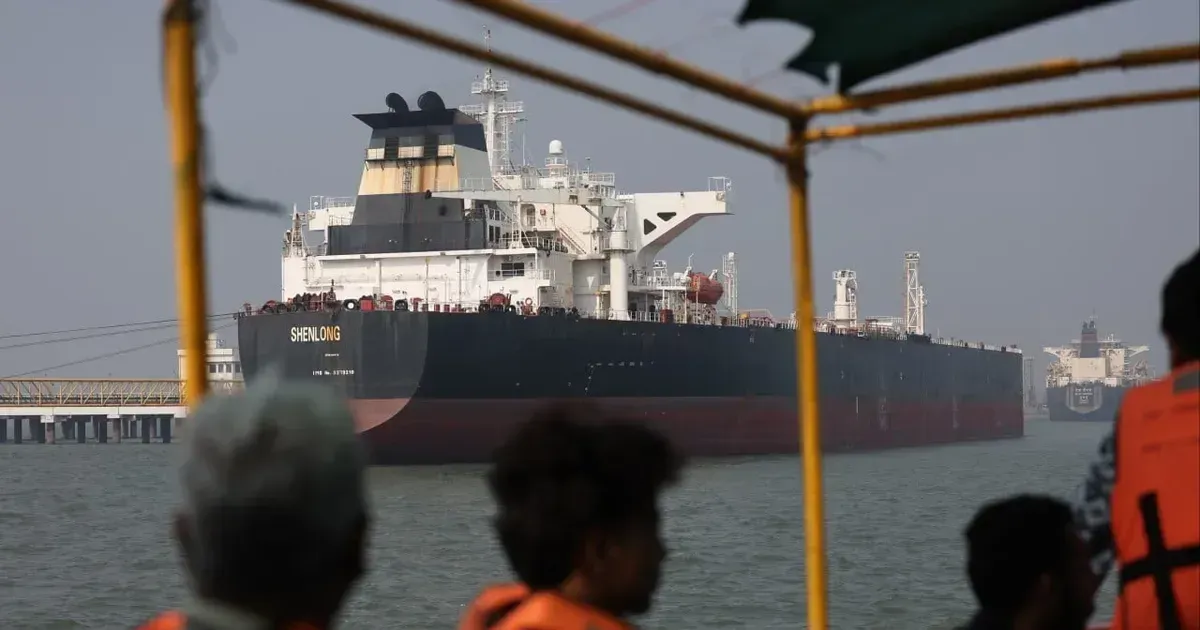
Two Indian-flagged tankers moved through the Strait of Hormuz on Friday. Sources with direct knowledge of the matter confirmed that the Shivalik, a liquefied petroleum gas carrier, crossed the strategic chokepoint under a heavy naval escort. Iran usually enforces a strict blockade in these waters, but the Nanda Devi followed its sister ship through the channel hours later. This exception is a rare crack in the Iranian maritime strategy during a period of intense regional violence. The tanker easing was reported on March 13, 2026, as Indian carriers moved through a tense Persian Gulf. Military operations continue to expand elsewhere. Pentagon officials confirmed that a Marine expeditionary unit arrived in the Middle East to strengthen existing forces. US and Israeli forces have struck approximately 15,000 targets since hostilities commenced two weeks ago. These strikes targeted command centers, drone launch sites, and logistical hubs across Iranian territory. But the scale of the bombardment has not yet forced a total cessation of Iranian military activity. Mojtaba Khamenei, the Iranian Supreme Leader, warned that the Islamic Republic will open new fronts if the campaign persists. He emphasized that the closure of the Strait of Hormuz remains a primary tool for Tehran. Global energy markets reacted with volatility to the news of the Indian tankers. Brent crude prices fluctuated as traders assessed whether the Indian exception suggested a broader softening of the blockade or merely a targeted diplomatic gesture.
Iran has allowed two Indian-flagged liquefied petroleum gas carriers to sail through the Strait of Hormuz, a rare exception to the Iranian blockade that has disrupted global energy supplies.
$95 per barrel remains a critical resistance point for oil prices. While India maintains a specific relationship with Tehran, most other nations find their shipping assets trapped or rerouted around the Cape of Good Hope. Separately, the Indian Ministry of External Affairs has refused to comment on the nature of the deal that secured the passage of these specific vessels.
Iran Opens a Narrow Tanker Path
New Delhi deployed multiple warships to ensure the safety of its energy imports. The Shivalik and Nanda Devi carry essential fuel for the Indian domestic market. Iranian authorities granted passage despite the ongoing aerial campaign led by Washington and Jerusalem. The escort included the INS Kolkata, an Aegis-style destroyer equipped with advanced surface-to-air missiles. This presence served as a signal to Iranian fast-attack craft that India would defend its tankers with lethal force if necessary. Diplomatic circles in Asia view this move as a strategic hedge. Tehran likely seeks to maintain some economic lifelines while its infrastructure sustains heavy damage from 15,000 targeted munitions. By contrast, vessels flagged in the United Kingdom or European Union have faced immediate seizure attempts. The Indian vessels were permitted to pass only after rigorous inspections by Iranian naval personnel near Bandar Abbas. Energy security remains the primary driver for Prime Minister Narendra Modi's government. India imports more than 80% of its crude oil and a significant portion of its liquefied petroleum gas from the Middle East. Any prolonged closure of the Strait would trigger an industrial slowdown in Mumbai and New Delhi. In fact, the Indian government has initiated secret back-channel talks with the Iranian foreign ministry to secure a semi-permanent corridor for energy traffic.
India Tries to Protect LPG Supply
Military hardware continues to flood the region. The arrival of the Marine unit provides the United States with amphibious capabilities and quick-reaction forces. Pentagon planners are preparing for various contingencies, including ground incursions or large-scale evacuations of American personnel. These units are stationed in the Red Sea, awaiting orders to move closer to the Iranian coastline. Still, the sheer volume of air strikes dominates the current phase of the war. Israeli intelligence provided many of the high-value coordinates used in the initial waves. These operations decimated several Islamic Revolutionary Guard Corps facilities. Despite this, Iranian missile batteries in the interior of the country remain operational. Satellite imagery shows that the 15,000 strikes have damaged but not destroyed the primary underground enrichment facilities at Fordow. Command and control structures in Tehran have proven more resilient than expected. Iranian commanders are utilizing a decentralized communication network to avoid detection by electronic warfare units. This allows local insurgent cells and regional proxies to continue operations without direct orders from the capital. The conflict has entered a phase of attrition where the side with the most durable logistics wins.
Hormuz Risk Still Drives the Market
In turn, the State Department has largely ignored these calls for a pause. Officials in Washington maintain that the military campaign will continue until Iran ceases its maritime provocations. Even so, the Latin American trio is a growing bloc of nations that view the conflict through a lens of economic survival rather than ideological alignment. Their influence in the United Nations could complicate future efforts to pass additional sanctions.
US domestic support for the war remains fractured. Ipsos public affairs data indicates that voters are increasingly confused by the Trump administration's end-game in Iran. While the strikes receive initial support, the long-term goals remain opaque to the average citizen. Cliff Young, a professor at Texas A&M University, noted that the public is wary of another long-term commitment in the region.
Many voters question if the 15,000 strikes serve a clear national interest or if they represent mission creep. Strategic ambiguity often serves a purpose in military planning, but in a democratic election cycle, it creates a vacuum that political opponents are quick to fill. And the economic costs of the conflict are starting to hit American gas stations. $4.50 per gallon is the national average in several states, a figure that historically triggers voter dissatisfaction.
Tehran's rhetoric has sharpened in response to the internal American debate. Mojtaba Khamenei is not just threatening the Strait. He hinted at mobilizing proxy networks in Lebanon, Iraq, and Yemen to strike at American interests globally. It would expand the theater of war far beyond the borders of Iran. To that end, the Pentagon has increased security at bases across Europe and the Pacific.
Analysis from Bloomberg suggests that the Trump administration has not defined what victory looks like. Is it regime change, or is it the total destruction of nuclear capabilities? Without a clear definition, the Marine deployment feels like an open-ended commitment. The White House has yet to provide a timeline for the cessation of hostilities.
Energy Access Becomes Political Pressure
Does the Washington establishment truly believe that 15,000 strikes will achieve what decades of sanctions could not? History suggests that an aerial campaign without a clear political objective is merely an expensive exercise in target practice. The Trump administration is repeating the mistakes of the early 2000s, assuming that technological superiority can compensate for a lack of strategic foresight. By ignoring the diplomatic overtures from the Global South and failing to explain the mission to the American voter, the White House is inviting a domestic backlash that will arrive just as the war reaches its most critical phase.
The exception granted to Indian tankers is not a sign of Iranian weakness, but a masterstroke of divide-and-conquer diplomacy. Tehran is effectively picking off American allies by offering them the energy security that Washington cannot guarantee. While the Pentagon counts its sorties, Mojtaba Khamenei is counting the days until global oil markets force a Western retreat. It is not a war that will be won by destroying command centers in the desert. It is a war of nerves where the first side to blink loses everything.
If the goal is not regime change, then the current level of destruction is gratuitous. If regime change is the goal, the current force posture is woefully inadequate.