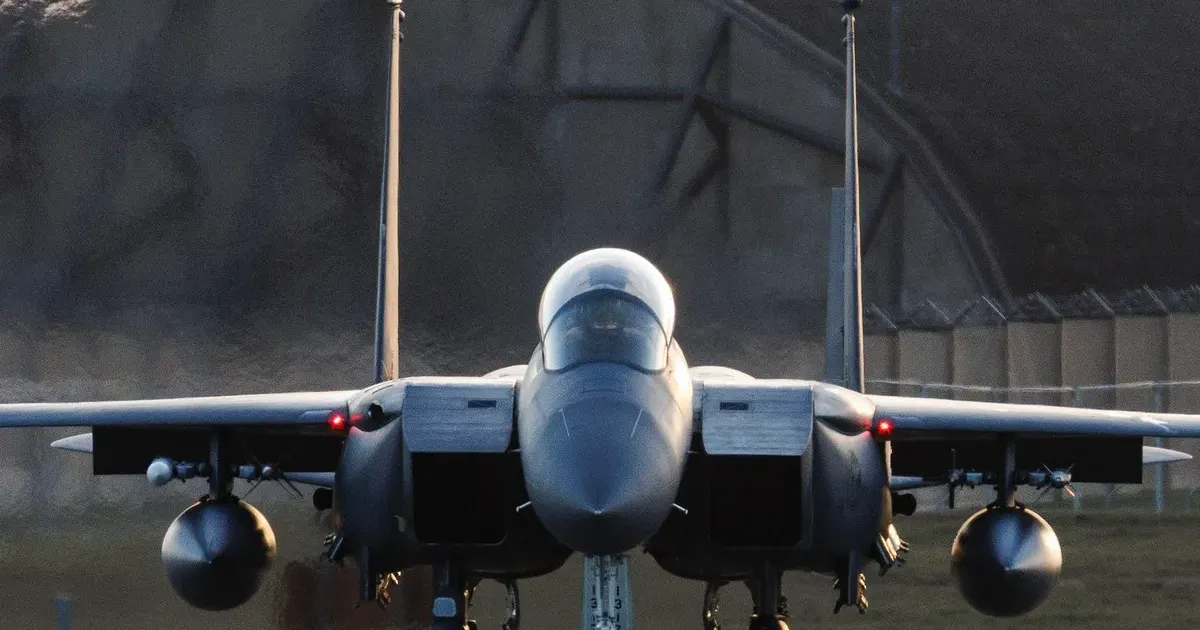
Iranian air defenses destroyed a United States F-15 fighter jet, marking the first loss of a manned American aircraft in five weeks of hostilities. State media in Tehran published detailed images of smoking wreckage and a mangled ejection seat scattered across a remote hillside. Officials at the Pentagon confirmed that a search and rescue operation is currently underway for two missing service members who were on board the twin-engine aircraft when it vanished from radar screens. The April 3, 2026, shootdown marked a direct escalation in the five-week air war.
Iranian state television channels interrupted regular programming to broadcast footage of the crash site. Reporters on the ground in the Islamic Republic described a frantic search by local security forces and civilian volunteers. Authorities in Tehran have offered financial rewards to any civilians who locate or capture the missing American crew members before United States special operations teams reach them. The deployment encourages local interference with international search and rescue protocols.
Axios confirmed the shoot-down through two sources familiar with the incident. Military analysts suggested the loss came at a sensitive moment for the White House as it attempts to maintain a policy of air-only intervention. Iranian military officials claimed their indigenous missile systems successfully intercepted the high-performance jet during a combat mission over sovereign territory. The successful interception by Iranian forces ended a month-long streak of American aerial dominance.
Iranian State Media Distribute Wreckage Images
Digital evidence circulated by Iranian outlets appears to confirm the identity of the aircraft as a Boeing-manufactured F-15 Eagle. Visual analysis of the debris, including specific serial numbers visible on fuselage fragments, aligns with the technical profile of the Strike Eagle variant frequently used for precision bombing runs. One photograph showed an empty ejection seat, indicating that at least one of the two crew members successfully exited the aircraft before impact.
Tehran maintains that the jet was engaged in a mission to strike civilian infrastructure when it was brought down. Hostilities had intensified recently after United States forces conducted strikes against energy grids and transportation hubs. Iranian officials framed those bombings as a regression to medieval warfare, citing previous American threats to bomb the country back to the Stone Ages. State-run media outlets continue to loop footage of the crash to strengthen domestic morale.
Military observers noted that the F-15 had not previously been vulnerable to Iranian air defenses during this campaign. Sources at CENTCOM indicated that tactical adjustments are already being implemented to protect remaining assets in the theater. Ground units have not been deployed in a combat capacity, leaving the search and rescue teams as the only American personnel currently operating behind enemy lines. The risk to these recovery teams increases with every hour the crew stays missing.
White House Proposes $1.5 Trillion Defense Budget
Budgetary repercussions of the conflict became evident on Friday morning when the White House released its 2027 fiscal proposal. Financial documents submitted to Congress include a request for $1.5 trillion in defense spending, representing a major surge intended to replenish depleted stockpiles and modernize the aging fighter fleet. President Donald Trump has consistently messaged a desire for a swift, decisive victory that ends the conflict in weeks without requiring a full-scale ground invasion.
Legislative leaders expressed immediate concern over the scale of the request. Republicans argued the funding is necessary to crush Iranian nuclear ambitions and maintain global deterrence. Democrats questioned whether the sudden loss of an advanced fighter jet indicates that the current strategy is failing to account for Iranian surface-to-air capabilities. Budget projections show that the cost of sustained air operations over the Persian Gulf could exceed original estimates by 40 percent.
Strategic focus remains on the rapid acquisition of next-generation unmanned systems. Military contractors have seen a surge in interest for autonomous platforms that could perform the same high-risk missions as the F-15 without putting human pilots at risk. The shift in procurement priorities aligns with the administration's stated goal of ending the war without incurring heavy casualties. Current expenditures for the five-week conflict have already surpassed the initial quarterly allocation.
Military planners continue to rely on a strategy of crushing force delivered via standoff weapons and long-range bombers. RealClearPolitics reports suggest that the Trump administration believes it can secure an endgame within weeks by targeting the Iranian regime's core economic and military nodes. The plan explicitly avoids the use of boots on the ground, a policy intended to prevent the kind of long-term entanglements seen in previous decades. The recent combat losses, however, challenge the assumption that air power alone can achieve total submission.
Iranian forces have demonstrated a resilience that some intelligence analysts failed to predict. Despite four weeks of intense bombardment, the Iranian command structure is still capable of coordinating sophisticated air defense operations. The downing of the F-15 suggests that the Islamic Revolutionary Guard Corps retains mobile missile batteries that can evade detection and strike at opportunistic times. The regional air-defense units are likely using a combination of Russian-made hardware and locally manufactured upgrades.
Commanders in the region must now decide whether to escalate the air campaign to suppress these remaining defenses or pause to reassess the risk to pilots. Total victory, as defined by the administration, requires the complete dismantling of the Iranian nuclear program and the cessation of its regional proxy activities. Achieving those goals exclusively from the air would be a first in modern military history. Pentagon data indicates that over 2,000 targets have been struck since hostilities began.
Five-Week Air War Exposes US Vulnerability
The loss of an F-15 and its two-person crew exposes the fatal flaw in the administration's fantasy of a bloodless, high-tech victory. By insisting that Iran can be bombed into submission within weeks without a single American boot touching the soil, the White House has boxed itself into a corner where every tactical setback becomes a political catastrophe. The $1.5 trillion budget request functions as both a replenishment plan and a quiet admission that the previous five weeks of air strikes have failed to achieve the promised decapitation of Iranian defenses.
History is littered with the corpses of empires that believed air superiority was a substitute for strategic clarity. If the missing crew members are captured and paraded through Tehran, the administration's rhetoric about a swift victory will evaporate. You cannot claim to be ending a war in weeks when the enemy is still capable of plucking your most advanced fighters out of the sky. The decision to target civilian infrastructure was a desperation move that has only served to stiffen Iranian resolve and provide them with a propaganda victory on the global stage.
Washington is now faced with the choice of a humiliating retreat or a grinding escalation that contradicts every promise made to the electorate. The air campaign is no longer a surgical operation; it is a multi-trillion dollar gamble with human lives as the ante.